Showing posts with label migratory birds. Show all posts

Sunday, 27 March 2022

Wirral's Wild 50: April Worksheets


Here are the Wirral's Wild 50 activity sheets for April. Look for more signs of spring and learn all about bees.

April activities
April activities
 

Things to do in April

Look for swallows returning, young rabbits, wild garlic and bees

Learn about migration

Find out which wild plants can be used for food or as medicine

Learn how to identify 3 different bees

Find out why bees are an important part of the ecosystem


Do a bumblebee survey

Resources


1.  Migratory bird wordsearch

https://www.treetoolsforschools.org.uk/activities/pdfs/pdf_migratory_bird_wordsearch.pdf


2. Bumblebee Conservation Trust lots of resources

https://www.bumblebeeconservation.org/learning-zone/curriculum-resources-for-schools/


3. Bumblebee facts

https://www.bumblebeeconservation.org/wp-content/uploads/2019/11/BBCT_Kids_Activity_7-10_General_v2.pdf


4. Spring bees guide

https://www.record-lrc.co.uk/Downloads/Spring%20bees%20(4)[09042020].pdf


5.How do bees see?

https://www.bumblebeeconservation.org/assets/documents/BBCT_Kids_Activity_7-10_how_bees_see.pdf


6. Pollination

https://www.bumblebeeconservation.org/wp-content/uploads/2019/11/02-InsectPollination.1_v2.pdf


7. How bees use static electricity to collect pollen

https://www.bumblebeeconservation.org/wp-content/uploads/2019/11/03-StaticElectricity.1_v2.pdf


8. Do a bumblebee survey


Sunday, 9 August 2020

Summer 2020 at Cleaver Heath


Common heather
Common Heather (Calluna vulgarisset off by the yellow blooms of the Western Gorse (Ulex Gallii)


Working in Cleaver over the summer has been very pleasant – the Common Heather (Calluna vulgaris) is coming into prime condition, at least visually! The purple is set off nicely by the yellow blooms of the Western Gorse (Ulex Gallii).


Bell Heather (Erica cinerea)


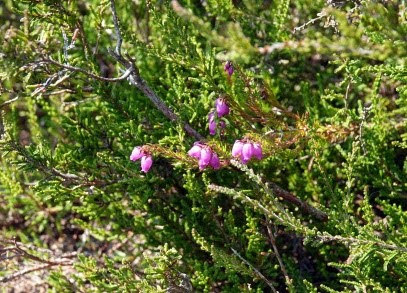
I am also pleased to report that the 2 small plants of Bell Heather (Erica cinerea) have survived even though they have been unwittingly trampled a few times by visitors creating an unofficial path right next to them. My diplomatic skills were stress-tested one day when I had to persuade some older visitors to retreat having parked a wheel-chair right on top of them. All ended well after a discussion of wildlife on the reserve and of what exactly I was doing there among the heather! In fact I was making a start on bracken pulling. Having realised we needed reinforcements to do a proper job on the bracken, I submitted a ‘Covid-aware’ risk assessment to the Trust and then sent round an email call to arms. To make it sound like a reasonably attractive proposition, I included some recent photographs of what was currently showing here.


Now showing at Cleaver Heath


A couple of sessions have broken the back of the work. The strategy was to hand-pull bracken within the heathland panels and around the edges so as to keep the dense stands from further expansion. We may at a later stage do some machine–cutting in areas where we still entertain plans to restore more heathland.


Volunteers at Cleaver Heath


I completed the annual Common Bird Census survey visits (10 in April and May) but have only just started on the species maps which can be used to show what is breeding and where. Here is a first go at this year’s Linnet map.


Map of linnet sightings


The idea it to transfer observations from each visit map onto a single map using a letter code to indicate the date. D was 15 April and K was 28 May. The symbols indicate if the bird was singing or in flight or if one of a pair. A judgement can then be made over which areas constitute established territories. I think there was only one pair this year with at least 2 fledging – but I could be wrong! The area is roughly the same each year and so we bear this in mind when we do our annual gorse and birch coppicing.


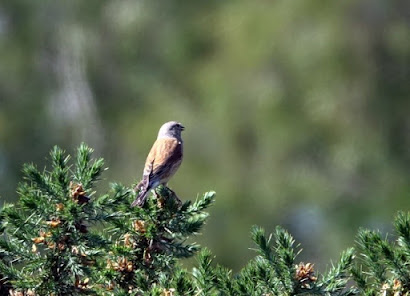
Linnet
Linnet


As well as the Linnets (shown above), there is good evidence of breeding by migrants such as Blackcap, Chiffchaff and Willow Warbler. Sadly, Whitethroat seem to visit only rarely. Tits, Wrens, Blackbirds and Robins were all abundant. Swallows, Swifts and House Martins have been feeding over the reserve. I know where the Swallows nest but not the other two species. Sadly my swift box still stands empty.


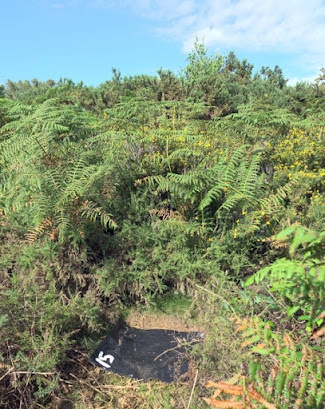
A reptile mat amongst the bracken


As reported in the spring newsletter, a local reptile expert helped us lay out reptile mats (refugia) in suitable places. This was in early March before lockdown. I tried to keep an eye on them during my lockdown exercise trips: some exposed mats got blown away in the gales; others had been collected by illicit drinkers to sit on and distribute litter; others had disappeared in the bracken forest, beyond the help of GPS; finding others in the heather would have required stumbling about during the bird nesting season. So, it was a pleasant surprise when bracken pullers uncovered matt number 2, to find a rapidly disappearing Common (Viparious) Lizard. Gianfranco Uli then discovered this still frame from a phone-video he was alert enough to take during the unveiling.


Common lizards running for cover

He thought he had missed the action, but close examination showed him two lizards scarpering. During his bracken pulling exploits, Gianfranco also had time to picture some fungi (Tawny Grisette) and this young Common Frog hiding in the heather.


Tawny Grisette (left) and a young Common Frog hiding in the heather (right)


On sunny days, the heather has been alive with insects of all shapes and sizes. Some of them need a hand lens to appreciate and nearly all of them need greater invertebrate ID skills than I possess. However, I am pretty confident that those shown here are respectively a Tree Bumblebee enjoying the Bramble flower and a Gatekeeper feeding on the Heather.


Tree Bumblebee on Bramble flower (left) and a Gatekeeper feeding on the Heather (right)


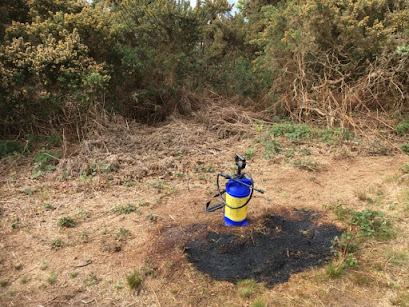
The extended hot and dry spell in May brought a sharp reminder of the dangers of fire in a heathland area, particularly one in a residential area such as Cleaver. Fortunately, this one started by a still smouldering cigarette was spotted and doused before it extended even further into the bracken litter and gorse.


Fire extinguished at Cleaver Heath


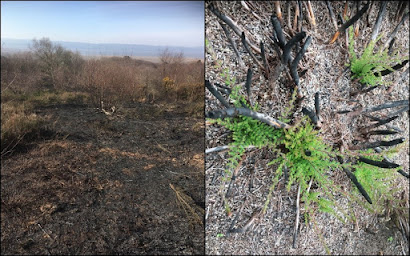
Accidental (?) fires are quite common on Heswall Dales. If the fire does not get too far down into the soil the heather can recover as the pictures below show. The left photo was taken in March on the first day of Lockdown (my morning exercise!) and the second one exactly 4 months later. The main lesson, of course, is that fires on heathland are difficult to control and so are very dangerous to humans, property and of course wildlife. So we all need to be extra vigilant in dry weather.


Burnt area in March (left) and in July (right)


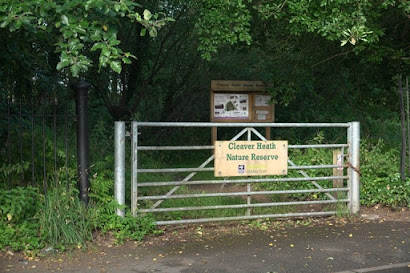
Here is my usual seasonally-updated photo of the reserve entrance. It shows that I will soon need to get the loppers out again.


Entrance to Cleaver Heath in summer


Alan Irving
Volunteer Reserve Warden for CWT
Cleaver Heath
August 2020

Monday, 13 May 2019

Spring 2019 at Cleaver Heath


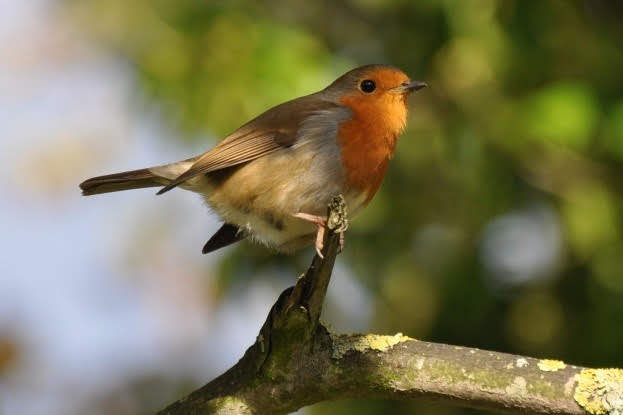
Robin

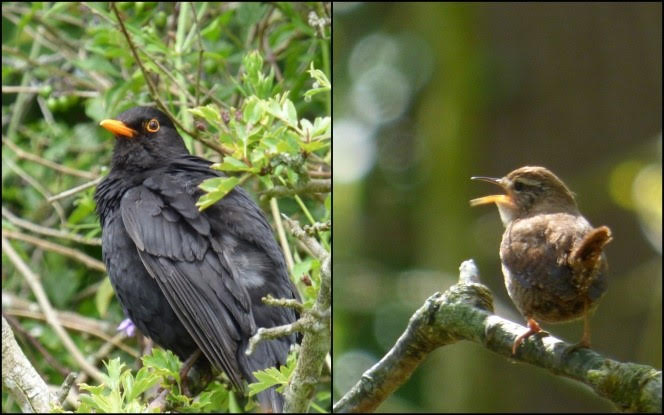
On the first Sunday in May each year, I get up well before the lark for our annual Dawn Chorus Walk starting at Cleaver. A 4:30am start is not for everyone but, once you are out there, you are usually glad you did make the effort. This year, a group of 12 brave souls shivered in the cold. As always, the Robins and Blackbirds started the ball rolling closely followed by the Wren.

Blackbird (left) and wren (right)

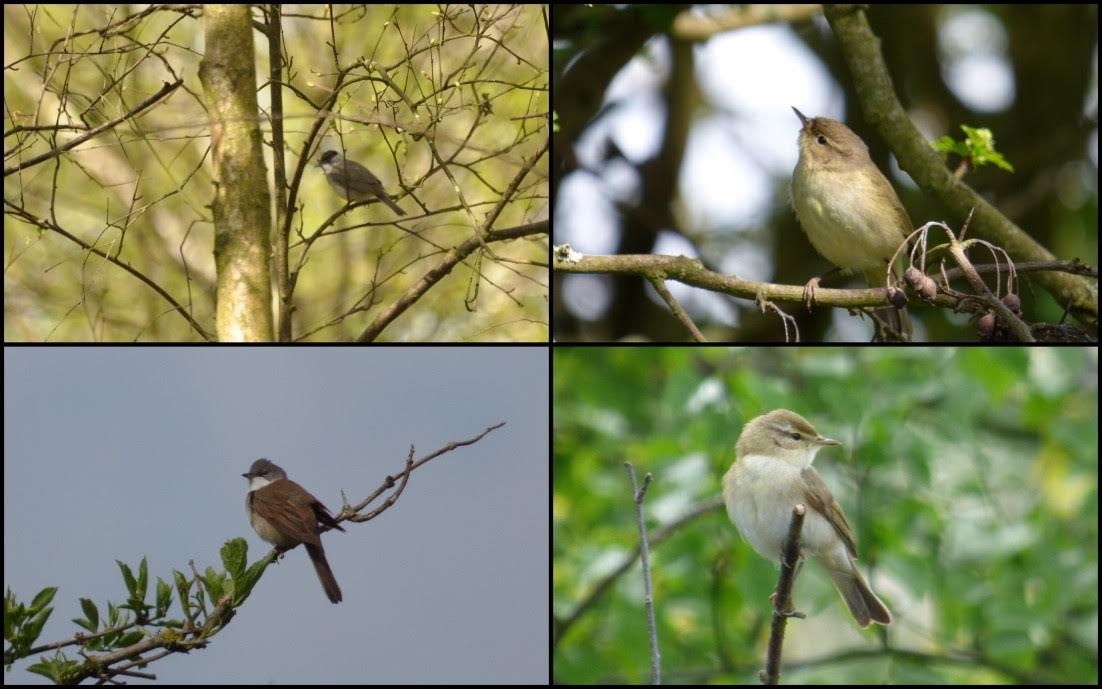
We heard and/or saw some 20 species in our 2 hour walk through Cleaver Heath and Heswall Dales. As the light came up, we started to hear more from the visiting summer warblers; first Blackcaps then Chiffchaffs, Willow Warblers and Whitethroat (shown in that order clockwise from the top left).

Blackcap, chiffchaff, willow warbler, whitethroat (clockwise from top left)

Of course, some of these are very hard to spot in the leafy spring trees, so it is very good to get to know their distinctive songs. For example, the Chiffchaff and Willow Warbler are clearly very similar to look at but their songs are totally different. If you have a smart-phone and point the camera at the QR code shown here, your phone will take you to a web page where you can play the bird song. We used this trick to help visitors to our ‘Spring in Heswall Dales’ Open Day on May 11 identify what they were hearing.


The arrival dates of various migrant birds at Oldfield this year were not too different from usual: Chiffchaff (March 1), Blackcap (April 6), Willow Warbler (April 7), Swallows (April 11), House Martins (May 2). The Chiffchaff singing on March 1 was a bit early but it might have flown only from its wintering grounds in scrub beside Heswall water treatment plant rather than from Africa! Target Road Heswall is a well-known home to Blackcap and Chiffchaff over winter.

Buff-tailed bumblebee (top) and wasp (bottom) on bilberry

Compared with Heswall Dales, we have quite small amounts of Bilberry in Cleaver but our bushes are now being well used by insects such as the Buff-tailed Bumblebee and Wasp shown above.

Scarce Fungus Weevil (Platyrhinus resinosus)

In early April, we had a group of entomologists from RECORD doing an invertebrates study on Cleaver and, I am told, they found a Scarce Fungus Weevil (Platyrhinus resinosus). The photo above (© Leanne Dixon) is taken from page 4 of the RECORD Spring Newsletter. It certainly is a strange-looking creature. The adjective ‘Scarce’ is not out of place as this was in fact the first record for Cheshire. The group tell me their visit was very productive and they will re-visit in May.

Stumps at Cleaver Heath

Speaking of insects and fungus, we often neglect the importance of leaving dead wood lying about our gardens and reserves. At Cleaver, I am regularly disappointed to find that a lot of the wood which has either fallen down or been coppiced over winter has gradually disappeared by spring, presumably into people’s wood burning stoves. On one occasion a few months ago, we interrupted someone systematically loading sections of birch trunks and branches into the rear of his SUV. Following a brief introductory course on the value of dead wood to a reserve and on theft from private land, we left him returning the wood to precisely where he found it. He seemed genuinely ignorant on both counts. The photo above shows a couple of stumps remaining after we dropped the rotting trunks overhanging the path following a storm. There were a dozen segments of birch trunk of which only one remained by spring when this was taken.

Rotten wood

If left, the pieces of birch rot down into something like that in the picture above where it provides a rich environment for insects, birds and other wildlife such as badgers. Let’s hear it for rotting dead wood.

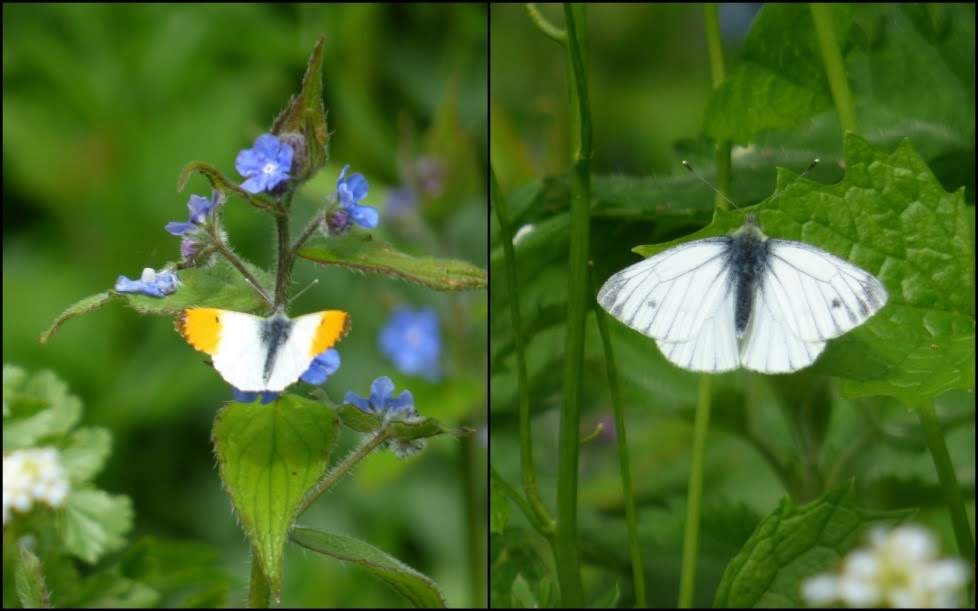
Orange tip butterflies: male (left) and female (right)

This year’s butterfly transect from Cleaver to Thurstaston has begun. This will be the first year we will have missed at least 1 week out of the 26. There has been some very cold and/or wet and windy weather recently. However, things are looking up again. Initially on the wing were a few species that over-winter as adults such as Red Admiral and Peacock. Numbers have been quite low. Now we are starting to see the whites led, as usual, by the Orange Tip. Most of us instantly recognise a male Orange Tip. The clue is in the title. However the female, shown alongside here, can be easily mistaken for a Small White or Green-veined White which are also starting to be on the wing. The secret to identifying these is to look (much good luck and presistence required) at the underwing.
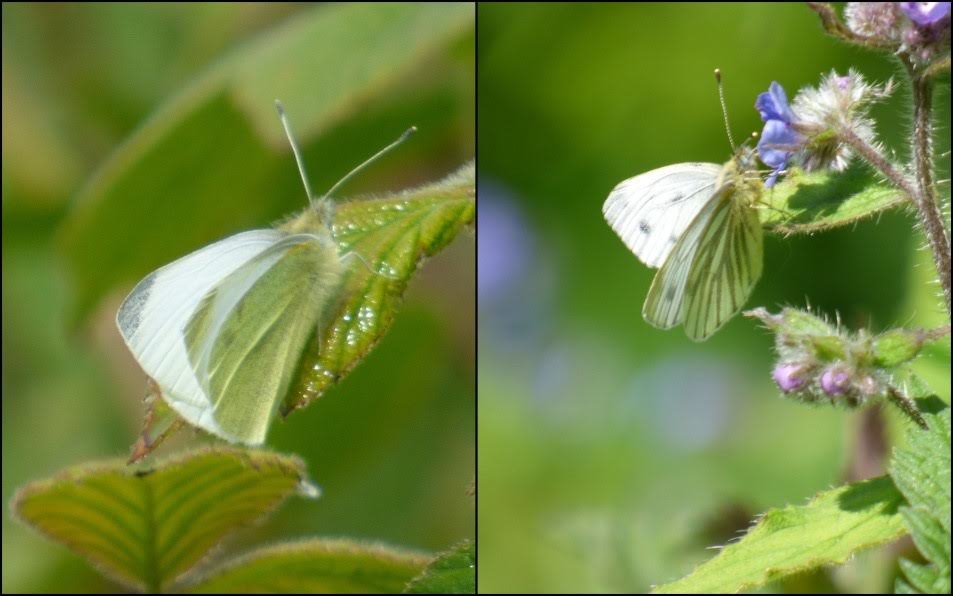
Small White (left) and Green-veined White (right) butterflies

The two shown together here are Small White (left) and Green-veined White (right). Notice the relatively bland yellowy-green underwing in one and the heavy green vein markings of the other. The photo below is of the underwing of the female Orange Tip which is actually rather like the underwing of its male partner – a quite attractive green on white pattern. So, you can see that we have our work cut out trying to identify the small white things as they flash by. These are the analogues of the ‘little brown jobs’ in the bird world.

Underwing of  female Orange Tip butterfly

The next guided walk starting in Cleaver will be the summer one on August 11 this year – our annual Heathland WalkThe Beauty of Heswall’s Heathland’ which takes in both Cleaver and Heswall Dales Nature Reserves. It is timed to take full advantage of the purple Heather and yellow Western Gorse which sould be in full bloom. Bookings for this are taken at the Cheshire Wildlife Trust web site:

Hedgehog

It is several years since I have seen a (non-flattened) hedghog. Since there is quite a lot of badger activity in my garden and in the Reserve, I have been consoling myself that this is because hedgehogs and badgers are not best friends. So, I was pleasantly surprised the other day to find this large hedgehog walking through my garden. After watching its rather unsteady progress for a bit, we realised that it was probably not in good health. However, I am pleased to report that the creature is now recovering well in expert hands at the Hog Centre at Larton. Cilla (they apparently all get names) is one of 20 patients currently in their hedgehog infirmary.

Pipistrelle bat

Another mammal starting to wake up to spring is the pipistrelle. If you look closely at the bottom right of this photo you will see one of a pair of bats feeding in the ex-carpark area of the reserve at dusk the other evening. You are almost certain to see bats there at dusk right through the summer. Just stand by the new interpretation board and enjoy. Combine it with a late sunset view over the estuary.

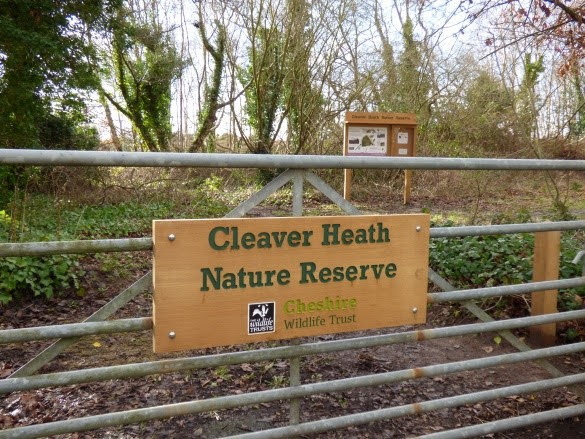
The entrance and interpretation board at Cleaver Heath

Alan Irving
Volunteer Reserve Warden for CWT
Cleaver Heath
May 2019

Thursday, 21 March 2019

Spring Is Here!


From the unrolling of bluebell carpets to the dawn chorus of birdsong, migrant birds returning to babies being born - spring is the time for new beginnings. You can feel it in the air.

But you can also see, hear and smell it if you know where to look.


Bluebells


From mid-April onwards, bluebells set our woodlands ablaze with their bright blue flowers. The UK is home to more than half the world’s population of bluebells, making it our unofficial national flower. The presence of native bluebells, (as opposed to their Spanish cousins sold in garden centres) is a sure sign you are in a very old and special woodland.

Where to see bluebells

Poors Wood, Northwich
Pumphouse Wood, Northwich
Owley Wood, Weaverham
Swettenham Valley, Holmes Chapel


Wildflower meadows


Whether it's a blaze of yellow from meadow buttercups, the buzz of grasshoppers and crickets or the amazing perfume given off by the combination of flower – the colours, sounds and smells of a wildflower meadow are truly something to experience.

It then makes it a terrible fact that in Cheshire we've lost 99% of our special wildflower meadows since the 1960s. But there are still special places you can go to experience them.

Where to see wildflower meadows
Swettenham Valley, Holmes Chapel


Migratory birds


Whether it be flying from the south to breed in spring or simply passing through on their journey, bird migration is one of the UK’s most impressive natural events. You can witness the comings and goings of flocks over the year, while remembering to look out for those preferring to fly solo.

In spring cuckoos fly from Africa, swallows fly from Africa, Arabia or India and chiffchaffs fly from Africa or the Mediterranean. Choosing to spend their winters in warmer climates, these birds all return to the UK for breeding.

Where to see migratory birds
Red Rocks, Wirral
Marbury Reedbed, Northwich
Gowy Meadows, Ellesmere Port


Celebrate spring at an event near you

Whilst wildlife spotting on your own is fabulous, if you ever fancy an escape from the day-to-day and to learn a little more, we have lots of events to help you connect with wildlife. Learning birdsong at our ID walk, taking a bluebell walk or seeing the spring migrants that have arrived - we have some great events for everybody.

Take a look to see what sparks your interest.