Showing posts with label marine wildlife. Show all posts

Saturday, 22 February 2020

Nature's Solutions To The Climate Emergency


Cheshire Wildlife Trust's February newsletter is about the need to protect nature and wild ecosystems in order to tackle the climate crisis.

Golden plover


The climate crisis regularly makes the headlines, and rightly so. But there’s another crisis - the massive ongoing loss of nature.

In the UK, 41% of our species have declined since 1970 and one in seven species are now threatened with extinction. The climate emergency has terrible ramifications for wildlife, but the loss of wildlife and wild places also makes the climate crisis worse.

Healthy wild places can store huge amounts of carbon, taking it out of the atmosphere and locking it away in soils and plant matter, sometimes for thousands of years. But many of these wild places are damaged, fragmented and threatened with further destruction. As these habitats are lost, carbon is released.

To tackle the climate emergency, we need to protect and restore our wild places.

A recent estimate suggests that around one third of the greenhouse gas reduction required between now and 2030 can be provided by carbon drawdown through Natural Climate Solutions. Natural Climate Solutions, roughly speaking, mean ecological restoration. Let’s take a look as some of them:

Green carbon
  • Tree planting
When you think about natural solutions to climate change, tree planting is probably the first thing that springs to mind. Trees absorb carbon as they grow, storing it in their trunks, boughs, roots and in the soil, so allowing woodlands to grow naturally will lock up carbon and help counter our manmade carbon emissions. But trees can only be part of the solution; alone they are not enough. Nature has an arsenal of other, powerful natural climate solutions that currently receive much less attention.
  • Peatlands
Peatland is a type of wetland, made up of soil formed from slowly decomposing plants. Peatlands cover just 3% of the earth’s surface but store more carbon than any other habitat on land, with the UK’s peatlands alone containing 3.2 billion tonnes of carbon. Healthy peatlands also play a role in reducing flooding and improving water quality, as well as providing a home for some wonderful wildlife, like the dazzlingly plumaged golden plover.

But damaged peatlands are a major source of greenhouse gas emissions. Peatland has to be wet to be healthy, and much of our peatland has been drained. At least 80% of the UK’s peatlands are damaged and may be releasing up to 23 million tonnes of carbon dioxide a year – that’s more than is absorbed by all our woodlands. Fixing them must be a first step.
  • Grasslands
The same is true for many other habitats: when healthy, they’re excellent carbon stores, but when damaged they release carbon. Grasslands soak up and store carbon in their roots and the soil but, between 1990 and 2006, an estimated 14 million tonnes of carbon dioxide were released by grasslands being put to the plough.


Blue carbon

Seahorse in seagrass meadow

Blue carbon is carbon that’s stored in our seas.

  • Oceans
Our oceans lock up even more carbon than the habitats on land, absorbing an estimated 20-35% of manmade carbon dioxide every year. We call this blue carbon, and it can be stored in plants, sediments and even the bodies of animals.
  • Saltmarshes
Saltmarshes are superstars of the carbon storage world, absorbing carbon at a faster rate than either peatlands or woodlands. These coastal habitats also act as a buffer against erosion and as important breeding and feeding grounds for a host of birds and other animals.
  • Seagrass meadows
Seagrass meadows are almost as impressive, responsible for 10% of the ocean’s total burial of carbon, despite covering less than 0.2% of the ocean floor.
  • Marine life
Carbon is also stored through the actions of marine life, from tiny phytoplankton that absorb carbon as they grow, to huge whales that carry carbon down to the seafloor when they die.

But our blue carbon solutions are threatened. In the UK, we’ve lost nearly 50% of our seagrass beds in the past 35 years, and we’re losing around 100 hectares of saltmarsh each year to development and rising sea levels. As these habitats are damaged, carbon is released, making the problem worse. Our seas are not as healthy as they should be, but even in their current state they take up huge amounts of carbon dioxide. Imagine how much more they could hold if we restored them, bringing back more seagrass meadows, coastal marshes and the wildlife they support.


Restoring the natural solutions
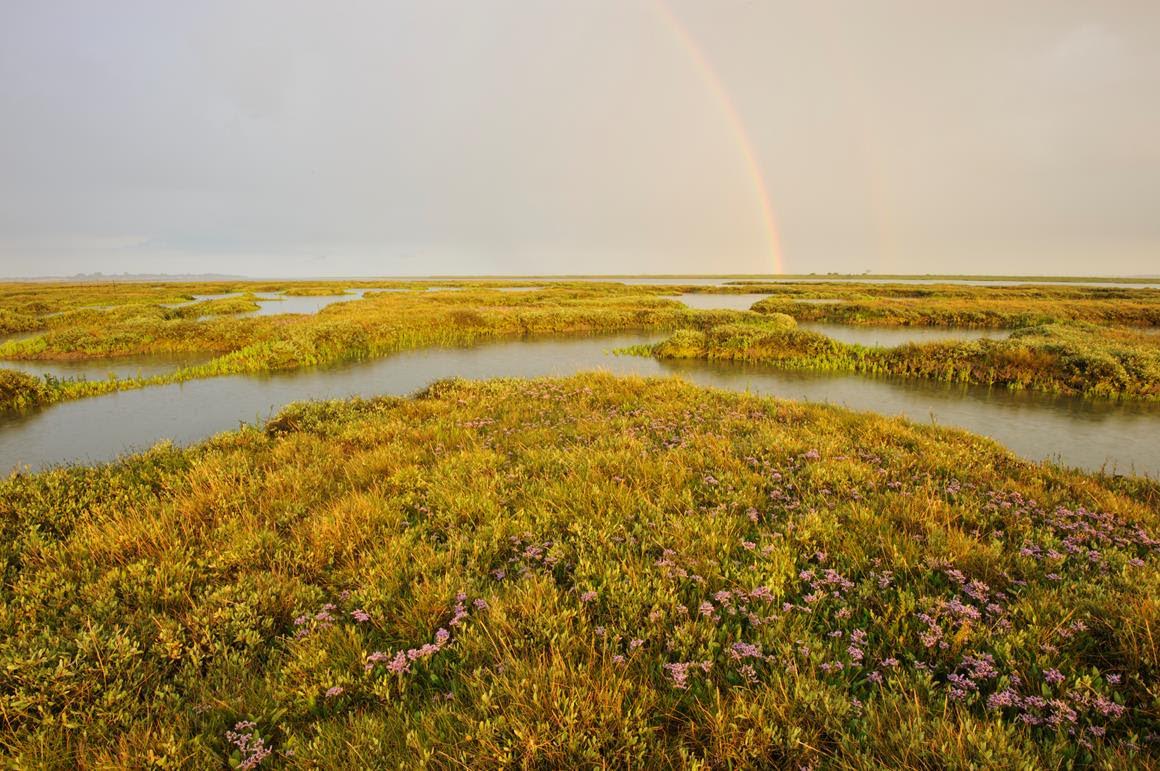
Peatland is a carbon store

Clearly natural solutions have a big part to play in tackling the climate crisis, so restoring these damaged habitats and ecosystems must be a priority. The Wildlife Trusts are playing a leading role in making this happen, with projects around the UK improving, expanding and protecting the wild places that are key for capturing carbon.

Through our work for wildlife, Cheshire Wildlife Trust is restoring and protecting places that store carbon on land and sea. We’re planting thousands of trees and hedgerows, rewetting peatlands and sowing acres of wildflowers meadows each year and every year.

Did you know that our Holcroft Moss Nature Reserve is the only peatland site in Cheshire never to have been cut for peat?

As well as managing our own sites, we also respond to consultations and planning applications that would threaten these important carbon stores on land and at sea.


Working together

As one of 46 Wildlife Trusts across the UK, Cheshire Wildlife Trust are championing a Nature Recovery Network nationally – a coordinated, effective plan to restore and connect habitats across the whole of the country. Essentially, we need to work together for more wild places that are healthier and better connected. This broad, connected approach is vital to reversing the loss of our nature. With 66% of carbon in nature-rich areas lying outside of our protected sites, we need to look at the bigger picture to help combat the climate crisis.

Nature has solutions – and we’re in desperate need of them all. By working together, we can buid and speed up nature’s natural solutions. It is essential we restore these damaged systems. Thank you for helping us to create a wilder future.

Sunday, 28 July 2019

Save Our Seas!


Here is the latest newsletter from Cheshire Wildlife Trust…


By Donal Griffin, Living Seas Officer

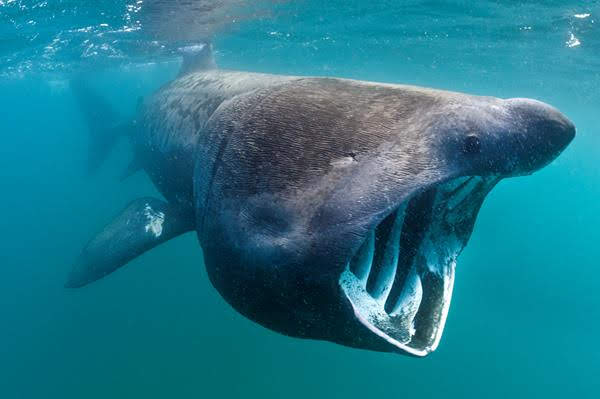
Amazing marine wildlife experiences are sought after the world over. Be it swimming with great white sharks in South Africa or snorkelling with jellyfish in the Lakes of Palau, people flock to marvel at all the weird and wonderful creatures living in our seas. But these experiences are not just limited to distant, exotic countries with an endless supply of sunshine. From stunning blue-rayed limpets and velvet swimming crabs found on our shores, to the world’s second biggest fish, the basking shark, sieving our coastal waters for plankton, our productive seas are home to a beautiful array of marine wildlife.


In recent years, we’ve seen more and more people in the UK recognise the importance of our marine environment and eager to protect it. Our seas supply us with a wealth of resource: photosynthesising plankton in the oceans provide nearly half of the world’s oxygen! The need to keep our seas healthy is clear – we literally rely on the oceans for the air we breathe.

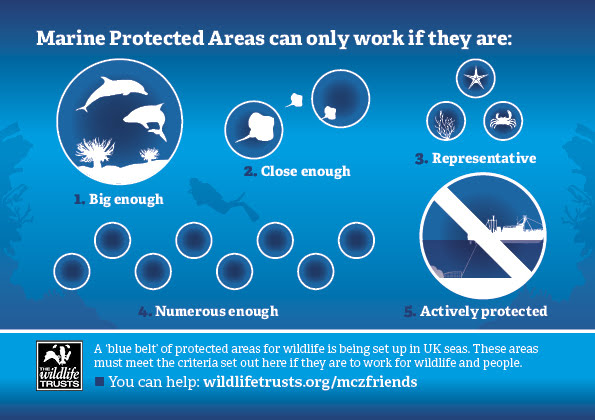
While humans have exploited the marine environment for centuries, in recent decades the ever-growing demand for resources is putting some species and habitats at risk of local, national and even global extinction. As we’ve come to better understand the impact of our activities in recent decades, it has become clear that to improve the overall health of our seas, we need an ecologically coherent network of Marine Protected Areas.


Fast forward to today – and after much campaigning work by The Wildlife Trusts and friends – we are in an incredible position with respect to a UK-wide marine protected network. In May, the Government announced 41 new Marine Conservation Zones. Taken together with the previous 50 designations in 2013 and 2016, the total comes to 89 in English waters, 10 of which are in our very own Irish Sea.


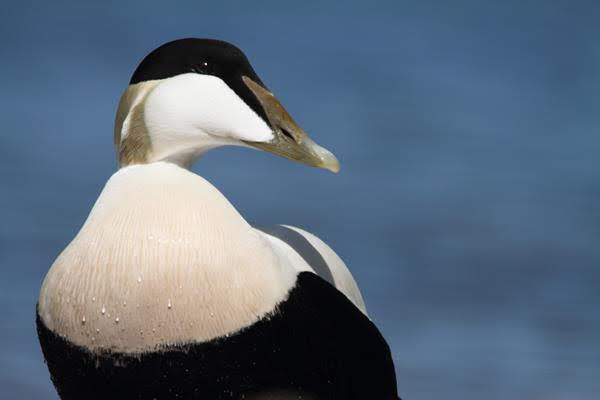
There are seven more in Northern Ireland's waters, one in Welsh waters, and 31 Nature Conservation Marine Protected Areas in Scottish waters. All are put in place to conserve rare, threatened and nationally important habitats and species for future generations. Stretching along much of the Northumberland coast for example, the newly designated Berwick to St Mary’s Marine Conservation Zone will help protect a threatened sea duck, the common eider. While off the coast of Cornwall, the Cape Bank site hosts a diverse range of marine life including granite reefs covered in sponges and algal communities. This is a huge success story for the marine environment and follows a long-fought journey of evidence collection, consultation and lobbying supported by thousands of people.

Thank you to all those that lobbied for our seas!

Whilst some suggest the designations are simply ‘lines on a map’, it is a starting point. Trying to implement useful management measures in these areas without ‘lines on a map’, would prove a much more difficult task. However, given that the designation of broad swathes of our seas will not in itself return these areas to the bountiful and healthy state they once were, the next step must be to ensure suitable management and monitoring of these areas. While there has been some progress on that already, we need to ensure each zone has fully implemented bespoke management, truly benefiting the wildlife and habitats which live there.

As climate change, unsustainable fishing and marine litter (to name only a few) present themselves as some of the greatest risks to the environment in the 21st century, the good news is that protecting nature has never mattered so much to so many. The long-fought journey to care for our environment is not over, but with your help we can act together for the air we breathe, the food that we eat, and the wonderfully diverse range of wildlife and habitats found on our shores and in our seas.

Do you live, work or play on the coast?


Whether it’s walking your dog along the beach, bird-watching or a family day out, we’d love to know how you feel about your local coast.

Our Dee Coastliners project is designed to inspire coastal communities along the Dee Estuary and we want to hear your stories. As we develop the project we’re keen to know more about how people identify with the River Dee coastline; what do you call the area? what are your favourite places to visit? Get in touch and share your stories!

Dee Coastliners is a Tidal Dee Catchment Partnership project led by Cheshire Wildlife Trust and supported by The National Lottery Heritage Fund.

Tuesday, 8 November 2016

Become a Citizen Scientist


Can you spare some time between 13th and 17th November to look for signs of lugworm reproduction on the beach. The Marine Conservation Society want to find out when the lugworm, Arenicola marina, breeds in the UK.

As the worms spend most of their lives buried in the sand the males release sperm which collect as ‘puddles’ on the surface of the sand. The incoming tide washes this into the burrows of the females to fertilise their eggs.

Two people spending 10 minutes on this survey can provide vital information to help scientists work out what environmental factors may trigger spawning.

For full details of how to conduct the survey and where to send your results see:

Monday, 24 October 2016

Become a Friend of Muddy Marine Conservation Zones


Mud habitats in the Irish Sea are home to diverse communities of marine life but these undersea landscapes have already been damaged, fish stocks have declined and species are at risk.

To protect our seas, the UK Government are designating a network of Marine Conservation Zones (MCZs) – areas of seabed where marine wildlife and habitats are protected. The Wildlife Trusts will be working hard to ensure the third and final round of sites is ambitious enough to give our seas the protection they deserve. But we need your help.


Please join our growing team of ‘Friends of muddy Marine Conservation Zones’ and help to ensure our marvellous mud gets the protection it needs.

Become a Friend of muddy Marine Conservation Zones to:

Get email updates to find out more about our mud campaign and our local and regional work to help save marine habitats and wildlife in the Irish Sea
Get guidance on how to respond to the third and final consultation on MCZs in 2017 and ensure your voice is heard
Get additional updates from your local Wildlife Trust


Wednesday, 8 April 2015

Safeguard Our Seas


We need your help to safeguard our seas

Deadline 24th April 2015


There's not long left to add your voice to the consultation

The Government has just opened a public consultation on a second round of areas that are being considered as Marine Conservation Zones (MCZs). We are extremely disappointed that just two of these are in the Irish Sea (off the Cumbrian coast) and five other important sites have been dropped.

The Government is now at risk of failing to achieve its aim of creating a network of nature reserves at sea. It will also delay the desperately needed protection of these areas for years to come.


Save our seas with a letter

Simply write a short letter to the Government with your thoughts and memories about our seas, coast and wildlife – the more personal you can make it the better. Last time it was the personal letters that really made a difference.

Whether you have fond memories of rockpooling in the coast as a child, walking your dog along the beach with your family, angling from a boat, or you feel the marine wildlife that we have off our coast is special in some way, it can all make a difference.

Now is your chance to have your say and influence the Government’s decision.

Send your personal letter to:

MCZ Team, c/o Post Room
Nobel House
17 Smith Square
London
SW1P 3JR

or simply fill in our easy online response form.

Monday, 6 April 2015

Spring Shoresearch - 11 April


Starfish and strawberry anemone. Photo: Emily Baxter


Spring Shoresearch 
New Brighton

Saturday 11th April

10.30 a.m. - 12.30 p.m.


Come and explore the hidden treasures of the Wirral coastline - a great spot for mussels, crabs, seaweed and much, much more!


Discover the delights of the shores and develop your marine ID skills. Please bring appropriate footwear (good grip wellies or waterproof boots) and clothing.


To book, please telephone 01539 816225 or send an email


For more information see the event listing on the Wildlife Trusts' Irish Sea website:


Saturday, 20 December 2014

Stop The Spread


North Western Inshore Fisheries and Conservation Authority (NWIFCA) have produced a Biosecurity Plan to minimise the risk of transmission of marine invasive non-native species (INNS) and shellfish diseases within its district. For more information see the poster below.


If you have spotted any of the species in the poster, report your sightings by email to NWIFCA.

To read the Biosecurity Plan, go to the Science and Research page of the NWIFCA website. There is also information on non-native invasive species on the Non-native Species Secretariat website.