
 |
| Common Heather (Calluna vulgaris) set off by the yellow blooms of the Western Gorse (Ulex Gallii) |
Working in Cleaver over the summer has been very pleasant – the Common Heather (Calluna vulgaris) is coming into prime condition, at least visually! The purple is set off nicely by the yellow blooms of the Western Gorse (Ulex Gallii).
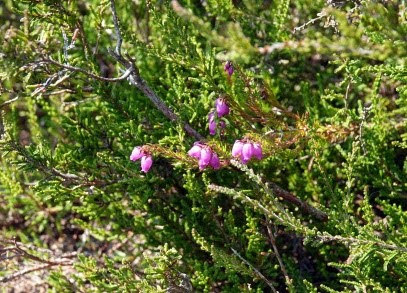 |
| Bell Heather (Erica cinerea) |
I am also pleased to report that the 2 small plants of Bell Heather (Erica cinerea) have survived even though they have been unwittingly trampled a few times by visitors creating an unofficial path right next to them. My diplomatic skills were stress-tested one day when I had to persuade some older visitors to retreat having parked a wheel-chair right on top of them. All ended well after a discussion of wildlife on the reserve and of what exactly I was doing there among the heather! In fact I was making a start on bracken pulling. Having realised we needed reinforcements to do a proper job on the bracken, I submitted a ‘Covid-aware’ risk assessment to the Trust and then sent round an email call to arms. To make it sound like a reasonably attractive proposition, I included some recent photographs of what was currently showing here.
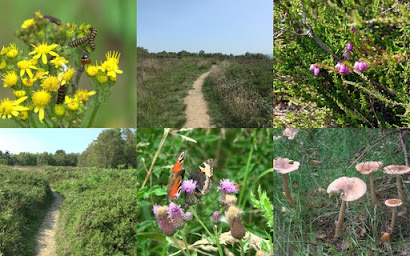 |
| Now showing at Cleaver Heath |
A couple of sessions have broken the back of the work. The strategy was to hand-pull bracken within the heathland panels and around the edges so as to keep the dense stands from further expansion. We may at a later stage do some machine–cutting in areas where we still entertain plans to restore more heathland.
 |
| Volunteers at Cleaver Heath |
I completed the annual Common Bird Census survey visits (10 in April and May) but have only just started on the species maps which can be used to show what is breeding and where. Here is a first go at this year’s Linnet map.
 |
| Map of linnet sightings |
The idea it to transfer observations from each visit map onto a single map using a letter code to indicate the date. D was 15 April and K was 28 May. The symbols indicate if the bird was singing or in flight or if one of a pair. A judgement can then be made over which areas constitute established territories. I think there was only one pair this year with at least 2 fledging – but I could be wrong! The area is roughly the same each year and so we bear this in mind when we do our annual gorse and birch coppicing.
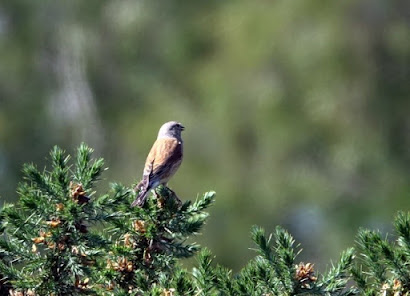 |
| Linnet |
As well as the Linnets (shown above), there is good evidence of breeding by migrants such as Blackcap, Chiffchaff and Willow Warbler. Sadly, Whitethroat seem to visit only rarely. Tits, Wrens, Blackbirds and Robins were all abundant. Swallows, Swifts and House Martins have been feeding over the reserve. I know where the Swallows nest but not the other two species. Sadly my swift box still stands empty.
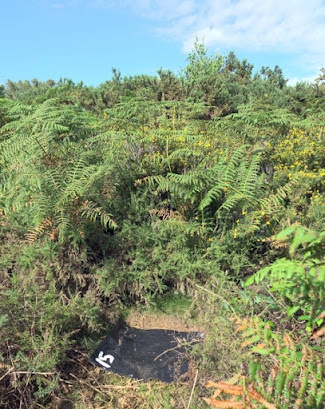 |
| A reptile mat amongst the bracken |
As reported in the spring newsletter, a local reptile expert helped us lay out reptile mats (refugia) in suitable places. This was in early March before lockdown. I tried to keep an eye on them during my lockdown exercise trips: some exposed mats got blown away in the gales; others had been collected by illicit drinkers to sit on and distribute litter; others had disappeared in the bracken forest, beyond the help of GPS; finding others in the heather would have required stumbling about during the bird nesting season. So, it was a pleasant surprise when bracken pullers uncovered matt number 2, to find a rapidly disappearing Common (Viparious) Lizard. Gianfranco Uli then discovered this still frame from a phone-video he was alert enough to take during the unveiling.
 |
| Common lizards running for cover |
He thought he had missed the action, but close examination showed him two lizards scarpering. During his bracken pulling exploits, Gianfranco also had time to picture some fungi (Tawny Grisette) and this young Common Frog hiding in the heather.
 |
| Tawny Grisette (left) and a young Common Frog hiding in the heather (right) |
On sunny days, the heather has been alive with insects of all shapes and sizes. Some of them need a hand lens to appreciate and nearly all of them need greater invertebrate ID skills than I possess. However, I am pretty confident that those shown here are respectively a Tree Bumblebee enjoying the Bramble flower and a Gatekeeper feeding on the Heather.
 |
| Tree Bumblebee on Bramble flower (left) and a Gatekeeper feeding on the Heather (right) |
The extended hot and dry spell in May brought a sharp reminder of the dangers of fire in a heathland area, particularly one in a residential area such as Cleaver. Fortunately, this one started by a still smouldering cigarette was spotted and doused before it extended even further into the bracken litter and gorse.
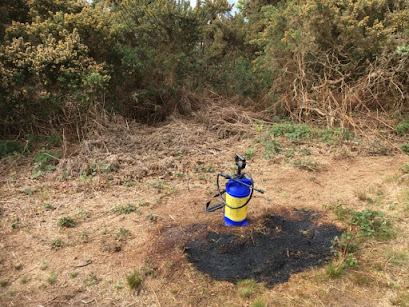 |
| Fire extinguished at Cleaver Heath |
Accidental (?) fires are quite common on Heswall Dales. If the fire does not get too far down into the soil the heather can recover as the pictures below show. The left photo was taken in March on the first day of Lockdown (my morning exercise!) and the second one exactly 4 months later. The main lesson, of course, is that fires on heathland are difficult to control and so are very dangerous to humans, property and of course wildlife. So we all need to be extra vigilant in dry weather.
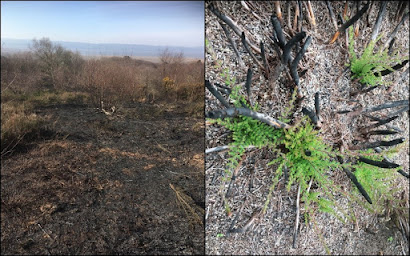 |
| Burnt area in March (left) and in July (right) |
Here is my usual seasonally-updated photo of the reserve entrance. It shows that I will soon need to get the loppers out again.
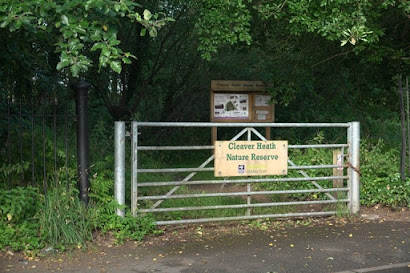 |
| Entrance to Cleaver Heath in summer |
Alan Irving
Volunteer Reserve Warden for CWT
Cleaver Heath
August 2020


