Showing posts with label wildlife gardening. Show all posts

Tuesday, 25 January 2022

Wirral's Wild 50: February Worksheets


Here are the Wirral's Wild 50 activity sheets for February to help you plan activities for the month ahead. Build a mini wildlife pond, look for some early signs of spring and learn to use a key to identify twigs.


February activities


Things to do in February

Look out for buds on trees and blackthorn blossom

Look out for frog spawn

Learn about amphibian life cycles and metamorphosis

Build a mini wildlife pond

Collect some twigs and use a twig key to identify them

Build a nest box

Learn to use a key to identify twigs


Monday, 19 April 2021

Wild About Wildflowers


Are you wild about wildflowers?

Did you watch Cheshire Wildlife Trust’s ‘Wild about Wildflowers’ webinar?

If not here is your chance to watch a recording at https://www.youtube.com/watch?v=OamJDEnrSVE

A panel of speakers shared their knowledge of how to take action to bring back wildflowers to our green spaces, including Dr Hilary Ash talking about New Ferry Butterfly Park. Recommended viewing if you are thinking of setting up your own community project, asking your council to mow less or are simply wanting to create your own meadow patch.


If you are inspired to do something yourself Cheshire Wildlife Trust have plenty of suggestions to help you get started:


We’re giving you early access to our road verge citizen science project! Have you ever looked at the road verges in your neighbourhood and thought they could be great for wildlife? If so, then submit a photo and tell us where it is. We want to map Cheshire’s road verges so we can work out which ones could designated as local wildlife sites and which ones would be great for a local community to adopt.


Wildflower guide from Cheshire Wildlife Trust

If you want to go further and learn how to recognise wildflowers, then download our Wildflowers Guide. Find out which species are most common and get hints and tips on where to find them.


Take action in your outdoor space


Get creative with container gardening

There are loads of ways you can bring wildflowers to your garden, patio or balcony. By growing a range of flowers you can provide a food source for bees and butterflies throughout the year. 

For small spaces, these cornfield pots and hanging baskets will work perfectly and add that dash of colour. If you’ve lots of wall space, then why not turn it into a vertical garden with a pallet planter?


Vertical gardening with a pallet planter


If you’ve a larger space to work with then try creating your own mini-meadow!


Grow a wild patch in your garden


Take action nationally


We’re still calling on the Prime Minister to overturn the lifting of a ban on bee-killing pesticides. Not only that but recommended advice suggests adding weedkillers that will kill off native wildflowers. A bit of cold weather stopped the spraying of thiamethoxam this year but the ban still hasn’t been reinstated. Add your name to reinstate the ban – over 100,000 people have signed so far!


Monday, 21 September 2020

Kathryn's Garden Makeover For Wildlife

Kathryn J Fegan contacted us with news of her garden transformation. Kathryn's achievements are really impressive and provide habitat for a wide range of wildlife. The results are a pleasure to see...


Bee and butterfly service station flower bed
Bee and butterfly service station flower bed in full bloom


I was both inspired and challenged by your articles over the summer to help wildlife in our gardens, and I just wanted to share the changes I’ve made in my back garden and how I’m enjoying the garden coming to life with bees, other insects, butterflies and a hedgehog.


The beginnings of the new flower bed


Filling the bed with topsoil and compost

My garden used to be a big square lawn with green shrubs around the sides. Very little changed through the seasons. Hardly any living things visited despite me putting out bird feeders and we had an ignored blue tit box.


Starting the new bed in the middle of May’s drought

The finished flower bed

Since March I have created a bee and butterfly service station flower bed to one side of the lawn by placing a layer of cardboard over the grass when it was brown in the hot weather, and covering this with a deep layer of topsoil and mushroom compost which I had delivered. The result has been spectacular and I have had fun identifying honey bees, carder bees, red tailed and buff tailed bumble bees and a cuckoo bumble bee.

I followed Charles Dowding’s no dig method from YouTube which preserves the soil structure and fungal connections beneath, is very much less hard work and in 2 months the cardboard is rotting and feeding the soil, and the plants are rooting into the rich soil below.


Perfect foraging for bees


Then opposite to this I have dug a small shallow pond and already have 4 black diving beetles in it, and today a visit from a mating pair of common darter dragonflies.


Kathryn's small pond
Kathryn's small pond providing a home for aquatic insects


Common darter dragonflies


I have scarified the back half-moon of lawn and sown wildflower seed; it was a little late in the season so I expect to see better results next year but field grasshoppers now visit.


Grasshopper
Grasshopper


An area of lawn with longer grass and wildflowers

I have dug up the back border and planted a mixed native hedge with hawthorn, hazel, blackthorn, field maple and dog rose. I planted whips so they’re about 3 feet tall now. I made 2 hedgehog holes in a fence and a gate, and now have hedgehog poo on the lawn. Gradually I am replacing green shrubs with native and bee-friendly plants.

I’ve been fascinated by the arriving insects and have been uploading them to iNaturalist for identification and recording. I’ve identified Green, Hawthorn and Sloe shield bugs in the garden - that started when one literally fell onto my knee as I sat in the garden with a coffee!


Red admiral on ivy flowers


Sloe shield bug
Sloe shield bug


Green shield bug nymph


All this change has been just one person in 7 months! I would like to encourage others to make the change for wildlife. I’ve found it fascinating to see how nature responds to just a little invitation from us, and my garden is now alive with insects and birds.


Monday, 11 May 2020

Insect Friendly Gardening Notes


Primrose
Primroses are a good source of nectar for insects. Photo: Wikipedia

Pollen and Nectar - Spring

We need pollinating insects for many of our food crops. Insects coming out of hibernation need food. For many, that food is nectar for energy and pollen for protein to make their eggs and feed their young. Look around your garden and neighbourhood: are there flowers around to supply their food? Are there bees, hoverflies, butterflies feeding in your garden? If not, maybe you could plant suitable flowers in your garden. Think primroses and cowslips, creeping comfrey, honesty. Include tree fruit and soft fruit, which need the pollinators to yield a good crop. Also spring-flowering shrubs such as hawthorn and cotoneasters. Remember to avoid double varieties, which often lack pollen.


Log pile
Create a log pile to provide shelter for invertebrates. Photo: Andy Roberts, Flickr

Shelter

Our climate is famously variable. Most invertebrates need somewhere to hibernate in winter. Even in summer a wet day can mean butterflies, bees, hoverflies and other creatures need somewhere to hide from the rain. Look round your garden – are there places to shelter? Maybe a dense hedge or group of shrubs, a loose pile of large stones or bricks, or a ‘log-pile’ of larger prunings. Dead leaves heaped in a corner are useful to some species, as are tussocks of unmown grasses such as cocksfoot. If space is limited, how about an evergreen climber up a wall or fence.


Small copper butterfly on knapweed flower
Small copper butterfly on knapweed flower. Photo: Giles Watson, Flickr

Helping Breeding Butterflies

Many of us like to see butterflies in our gardens – except those who grow cabbages! Most gardens can provide food (nectar) and shelter for adult butterflies. Adults (the flying stage) will take nectar from a range of flowers, so long as the nectar is available to their long tongues. Open flat flowers are favourites – think Daisy family (aster, dandelion, knapweed, coneflower, fleabane); the hardy Geraniums; Carrot family (fennel, Eryngium), Mint family (lavender, marjoram). The key thing is to have flowers all season from March to September, so whenever the adults fly there is something to eat. You may not be able to supply that in your own garden, but remember these are flying insects, so look what it in the neighbourhood and try to fill any gaps.


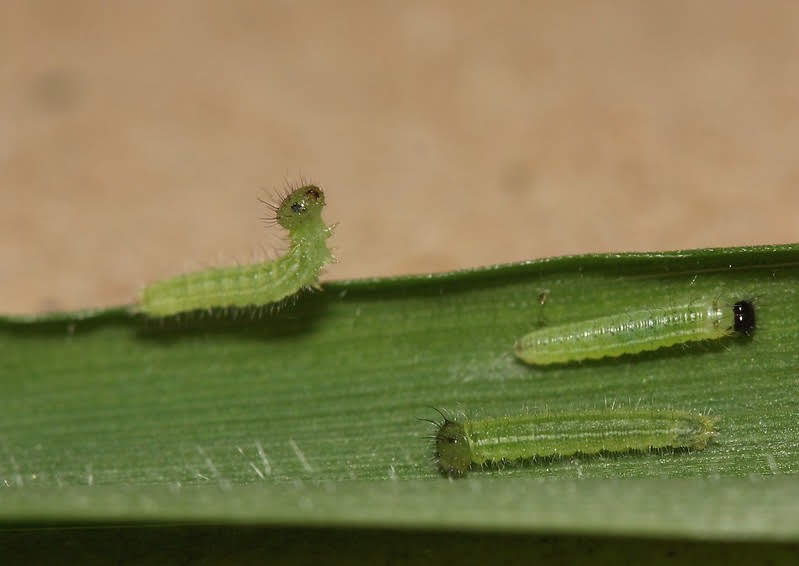
Speckled wood caterpillars
Speckled wood caterpillars. Photo: Dean Morley, Flickr


Provide Food For Caterpillars

Butterflies are very choosy creatures – each species has only one or two food plants which their caterpillars will eat. Not many of these can be grown in the average garden, but one species that often thrives in groups of gardens in Holly Blue. Look for small pieces of blue sky flying head-height and above in spring and late summer. The April-May generation lays eggs on female holly bushes, so the caterpillars can feed on the flowers and developing fruits. The August generation lays on ivy to take advantage of their flowers and fruits. So look around, is there flowering holly and ivy in reach? If not, could you plant some? Ivy rarely needs planting, but could you tolerate some climbing up a fence or wall (it needs to climb to flower)? Dense ivy also makes good shelter and hibernation places.

Several of our butterflies breed on stinging nettles (small tortoiseshell, peacock, red admiral and comma), but they are choosy creatures – they insist on sunny nettle beds. There is plenty of stinging nettle in most landscapes, even urban ones, so unless you have a very large garden, you probably have better uses for a sunny corner than a stinging nettle bed – plant herbs and other nectar-rich plants there instead. Nettles in shade are used by some moths – we have mother-of-pearl and nettle-tap at New Ferry Butterfly Park. The caterpillars roll up a leaf and secure it with silk to make a shelter against being eaten by birds. Look for the rolled-up leaves in June on your local nettle patch.

If you can leave an area of your lawn to grow long, cutting it down only in autumn, then you might be lucky enough to get one of the butterflies whose caterpillars eat grasses. At my allotment set, we have a border along the access path which is a mix of nectar-producing flowers and, because we never manage to keep it too tidy, some clumps of grasses. Also a small wildlife area in one corner, with a pond, large log-pile for shelter, stinging nettles and rough grass. Speckled wood butterflies have taken up residence in recent years – their caterpillars like semi-shaded grasses, mainly Yorkshire fog and Cock’s-foot, which are grasses that grow on fertile garden soils. And yes, we do have frogs breed in the pond (to eat our slugs) and small tortoiseshell butterflies breed on the nettles.


Leafcutter bee
Leaf-cutter bee cutting a circle from a leaf, which it takes back to its nest to use to build cells to lay eggs in.
Photo: The Guardian

Please Don't Use Pesticides Or Peat

Insect populations have dropped drastically in the last 50 years – some studies say the amount of flying insects has dropped by 75%! This impacts us (they pollinate our crops and process dead plants and animals), and all animals that feed on insects (birds, bats, spiders, etc). So we all need to help our insect friends where we can. So please, don’t use pesticides if you can possibly help it! In most gardens, they are unnecessary. Even herbicides such as glyphosate can have side-effects on insects, and no insecticide is specific to a given species, whatever the packaging claims. Tolerate a bit of damage – you are not Tatton flower show! Admire the perfect circles cut by leaf-cutter bees and the wiggle traces made by leaf miners on holly. Encourage predators such as spiders, earwigs, small birds – a pair of blue or great tits nesting in your garden will hoover up a lot of aphids and gooseberry sawfly caterpillars to feed their young. And please don’t use peat-based compost or buy plants grown in peat: peat bogs support specific rare insects like Large Heath butterflies, and are large stores of carbon, vital to the fight against climate change.


Dr Hilary Ash

Friday, 8 May 2020

Water – Use It Wisely


water butt


This long spell of dry sunny weather is good for our spirits, but not so good for our gardens and fields. Tap water takes a lot of energy to pump and clean, so do use rainwater in the garden (and for house plants) whenever possible. If you don’t have a water butt but do have a downspout, perhaps you could get one now ready for when rain does arrive. Get one with a cover to deter mosquitoes (and for safety if children are around). Reasonably clean “grey water” can also be used e.g. from washing vegetables.

Bathing blackbird
A bathing blackbird. Photo: RSPB

In the garden:

If you don’t have a pond, keep a shallow dish of water, such as a large plant saucer, on an open piece of ground away from cat-cover such as shrubs. Brush it out and refill daily, preferably with rainwater. Put it where you can see it from inside and be amused by watching the birds bathing.

Water only plants that need it: newly-planted trees and shrubs, seedling and newly-planted vegetables, and as we get into summer, leafy crops such as lettuce. Water beans and courgettes once they are flowering and fruiting.

Water the soil not the plant. Water thoroughly every 3-4 days, not a dribble each day. Sprinklers waste a lot of water, so use a can or, if needs be, a hose you hold on to.

Self heal and clover

Don’t water the lawn – grass is amazingly resilient to drought. Cut it on the longest setting, and only when really essential. Maybe now is the time to keep the mower off some parts, and see what wild flowers come up to flower. Try a “meadow” patch which is left long until late July. Insects will relish some long grass and any wild flowers.

Dr Hilary Ash


Sunday, 3 May 2020

Hedgehog Awareness Week


Thank you to Steph for sharing this video of a hedgehog in her garden in Irby.

Steph has a wildlife blog on Instagram: www.instagram.com/nessiesnaturenotebook/

She will be giving a talk about hedgehogs on Instagram Live at 4.30pm on Tuesday 5th May for Hedgehog Awareness Week.

Steph has also created a video to show how to find out if there are hedgehogs in your garden.


Monday, 20 April 2020

April Notes on Wildlife-Friendly Gardening


Encourage hedgehogs into your garden. Photo: Gibe, Wikipedia


Hedgehogs

I’m writing this in early April - Hedgehogs are emerging from their winter sleep. There has been a huge decline in hedgehog numbers over the last few decades, driven by loss of habitat, loss of connections between habitats, road traffic and pesticides. Gardens can be good habitat, but a hedgehog needs around 10-20ha of habitat to roam in, so getting between gardens is essential. Make sure your fences have holes near the base to let them move around – a hole the size of a CD case (13cm square) is enough, and will not let any children or dogs through.

Do not use metaldehyde slug pellets, as they leave the dead slugs poisonous to birds and hedgehogs. If you use garden netting (I do when the soft fruit is ripening) then make sure it is checked twice daily, and that it is secured firmly to the ground so hedgehogs do not try to get under it.

If you do hear our prickly friends (they sound like small pigs, of course), then try putting out a small amount of tinned cat food to encourage them to come where you can see them after dusk and maybe photograph them. Do let Cheshire Wildlife Trust or Record (local biological records centre know) – hedgehogs are often not recorded, especially in urban areas.

Growing Food In Wildlife Friendly Ways: Getting Started

My main gardening interest is growing food. I am also lucky enough to have a half-allotment (20 years ago they could be had for the asking). With global climate change escalating, growing even a small amount of your food is good for the planet (no food miles) and for your health (allotment growers stay healthier longer). There is no reason why food-growing cannot be friendly to wildlife, especially on a garden scale. If you are new to food growing, start small: maybe a herb bed in a sunny corner with chives, marjoram, thyme or whatever you like to use in cooking.

Most herbs are good nectar plants when in flower, and the perennial ones are very easy to look after (just a weed and tidy away of dead stems in spring). Also easy to look after are soft and tree fruit, and will yield you far more than you would buy. Some will tolerate light shade e.g. raspberries, gooseberries, red currants. All soft fruits freeze well raw, tree fruits mostly freeze well once cooked. Get stock from a reputable supplier, plant properly, mulch with garden compost and read up about pruning.

Salads and vegetables need a well-lit area and more fertile soil, so choose your spot and spread it well with garden compost. If you don’t have a compost bin, start one! Raise from seed for cheapness, and be prepared to weed and harvest as needed. Easy ones to start with, which give a good yield, include broad beans, tomatoes, lettuce, dwarf beans (known to the allotment world as French beans). Take the chance to plant unusual varieties. And of course – no pesticides, no peat!

Dr Hilary Ash

Wednesday, 8 April 2020

Garden Mammals on My Patch


RECORD's theme for this weeks My Patch campaign is garden mammals.


Hedgehog


MY PATCH Week 3 - Mammal Theme
These are often the most elusive garden visitors and we usually only know they're around because we notice signs, like poo or footprints. There are 108 UK species of mammal, from field voles (most numerous with ~60 million) to the Greater Mouse Eared Bat (only 1 individual!).
1 in 5 mammal species face a high risk of extinction in the UK and some have declined by up to 66% in the last 20 years! Recording garden mammals can help scientists understand what's happening to their populations which informs decisions on how to protect them.
Owl Pellets: has anyone ever tried dissecting owl pellets? You can find the answers to some of the most frequently asked questions about owl pellets here.
Mammal poo - not everyone's favourite topic, but its often the main evidence that mammals have been visiting a garden. If you know any young mammal detectives with a particular interest, we have a downloadable activity here perfect for them. They might also enjoy learning the basics of mammal detecting here.

QUIZ of the WEEK: Mammals
Sadly no prizes but email info@record-lrc.co.uk with your answers!
1) How many mammal species do we hold Cheshire records for from the last 10 years?
2) What is our most commonly recorded mammal in the last 10 years?
3) What was our most commonly recorded bat species in the last 10 years?
4) Can you name these mammal footprints?

Mammal footprints

5) Can you name these mammal faeces?
Mammal faeces


A reminder of how to join in My Patch

Upload your garden wildlife sightings here OR email info@record-lrc.co.uk if you'd prefer

You can find resources and useful links on this page of our website.
Where you can, we'd love you to share our posts, news etc. about the campaign with your contacts and encourage as many people as possible to get involved. You can also post your own sightings with the hashtag #MyPatch to help spread the word and share with others what you've been up to.

Sunday, 5 April 2020

Wild Wellbeing Whilst In Isolation


Some excellent advice from Cheshire Wildlife Trust…


During this difficult time, it’s more important than ever that we look after ourselves and each other. As your local Wildlife Trust, we want to make sure that all our communities keep connected, keep happy and keep healthy, as well as protecting the natural world we all cherish so much.

From experience as well as scientific research, we know the five natural ways to wellbeing are:

1. Being active
2. Connecting with other people
3. Giving to help your local community
4. Taking notice of nature
5. Learning something new


With the current lockdown and social distancing, it’s very hard for us all at to practise these at the moment. However, we all must make an extra effort to get as much sunshine, fresh air and nature as we can.


Whether you’re working from home, looking after children or doing chores, it’s important that you take breaks to go outside or look through your windows. Close your eyes and listen to the birds for 30 seconds. Follow the early queen bumblebees as she flies searching for food and places to nest. Take notice as the plants begin to sprout new life seemingly overnight. These things are all going to help manage stress, re-energise and refocus your busy mind.

Exercise is also great and one of the reasons we can leave our homes each day if we’re able. Whether it’s a walk, a spot of gardening or a run around your local park (whilst maintaining safe distances from others), anything that raises your heart rate will help. Outside on a balcony or inside with a window open, wherever you feel happiest will make the world of difference.

We’re continuing to send out our weekly e-newsletter to bring a little joy and inspiration into your inbox, as well as daily posts on social media. Our social media channels are brilliant online communities to share photos, ideas, thoughts and videos with other likeminded people. This is a really important way of not feeling alone.

We also have a host of online activities you can do at home or in your surrounding outdoor space. Below are just three to get you started.

Remember – share with us anything ‘wild’ you get up to, to inspire others.


1. Provide water


Despite the rainfall of last month, puddles and bird baths are already starting to dry up. Clean and refill your birdbaths, or simply put out a bowl of water on the ground for mammals as well as birds. Just make sure it’s near a window so you can enjoy all the visitors stopping by for a drink.


2. Build a bird box


Got some old untreated wood lying about the place? Using a few tools, you can upcycle it into a shiny new bird nesting box. Take a look at our website for step-by-step instructions.


3. Enjoy your magazines


We were just able to get out the latest issue of Your WildLife and Wildlife Watch to our existing members before we were asked to stay at home. Therefore, your latest magazines should be with you next week, ready for you to flick through, learn some new facts and read about what you are making possible for local wildlife through your vital support.

Send us through pictures of you enjoying the magazines to social media and let us know what you think.


Keep in touch

Become our friend on Facebook, join in the conversation on Twitter or find out more about our work on our website.

Wednesday, 1 April 2020

Birds on My Patch


For just over a week RECORD have been encouraging people to connect with nature at home, through recording garden wildlife as part of the My Patch campaign. The theme for last week was 'Becoming a Wildlife Recorder' and this week's theme is.....BIRDS!


Female House Sparrow
Female House Sparrow, Passer domesticus.
Did you know... a group of sparrows is called a 'Quarrel'.
We think it's the perfect name for these noisy garden visitors!

Observations

So far, we have over 100 Garden Wildlife observations on our iNaturalist page, which is brilliant! Thank you to everyone who's joined in and please keep your records coming in.

Add your Garden Wildlife Sightings here:
https://www.inaturalist.org/projects/my-patch-from-record-lrc


Online Resources

We're trying to make it easier for those people who might not regularly record wildlife to get involved (as well, of course, as those of you who are already pros!). This includes young wildlife enthusiasts and their families. Take a look at our online resources page for some helpful guides, tips and activities and feel free to share these with anyone you think might be interested. Perhaps you know someone who is looking for homeschooling ideas or similar?

INCLUDING:

Garden Explorers Collection - activities for young wildlife recorders great for ages 5+

What makes up a Wildlife Record? - learn about what information is needed to make your records as useful as possible

Out and about recording sheet - useful to note down what you've seen whilst out in the garden, all ages

AND MORE...


This week is BIRDS. We'll be adding more bird-related resources and links and would love you all to get involved by telling us about the birds you see in your garden.


QUIZ of the week... Bird Records!

Sadly there are no prizes, but we thought this might be a fun addition to our weekly email, reply to info@record-lrc.co.uk with your answers.

1) How many Cheshire bird records in total do we hold from the last 10 years?

2) Which bird species do we hold the most records for in Cheshire (in the last 10 years)?

3) How many different species of bird do we hold Cheshire records of (within the last 10 years, including sub-species)?


A reminder of how to join in My Patch

Upload your garden wildlife sightings here: https://www.inaturalist.org/projects/my-patch-from-record-lrc

You can find resources and useful links on this page of our website.

Follow us on facebook or twitter for the latest updates.


Where you can, we'd love you to share our posts, news etc. about the campaign with your contacts and encourage as many people as possible to get involved. You can also post your own sightings with the hashtag #MyPatch to help spread the word and share with others what you've been up to.