Showing posts with label Common Bird Census. Show all posts

Sunday, 9 August 2020

Summer 2020 at Cleaver Heath


Common heather
Common Heather (Calluna vulgarisset off by the yellow blooms of the Western Gorse (Ulex Gallii)


Working in Cleaver over the summer has been very pleasant – the Common Heather (Calluna vulgaris) is coming into prime condition, at least visually! The purple is set off nicely by the yellow blooms of the Western Gorse (Ulex Gallii).
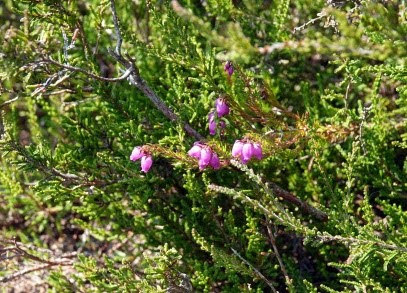

Bell Heather (Erica cinerea)


I am also pleased to report that the 2 small plants of Bell Heather (Erica cinerea) have survived even though they have been unwittingly trampled a few times by visitors creating an unofficial path right next to them. My diplomatic skills were stress-tested one day when I had to persuade some older visitors to retreat having parked a wheel-chair right on top of them. All ended well after a discussion of wildlife on the reserve and of what exactly I was doing there among the heather! In fact I was making a start on bracken pulling. Having realised we needed reinforcements to do a proper job on the bracken, I submitted a ‘Covid-aware’ risk assessment to the Trust and then sent round an email call to arms. To make it sound like a reasonably attractive proposition, I included some recent photographs of what was currently showing here.
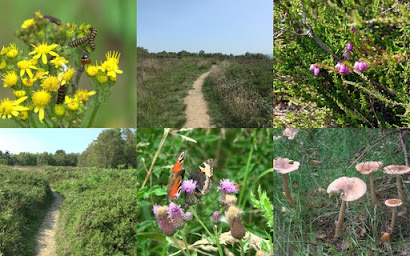

Now showing at Cleaver Heath


A couple of sessions have broken the back of the work. The strategy was to hand-pull bracken within the heathland panels and around the edges so as to keep the dense stands from further expansion. We may at a later stage do some machine–cutting in areas where we still entertain plans to restore more heathland.


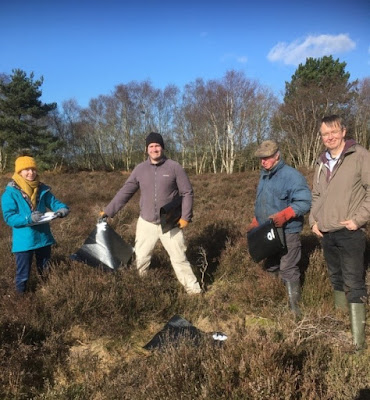
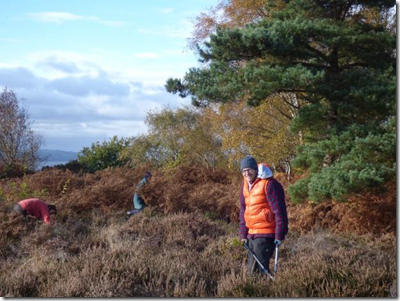
Volunteers at Cleaver Heath


I completed the annual Common Bird Census survey visits (10 in April and May) but have only just started on the species maps which can be used to show what is breeding and where. Here is a first go at this year’s Linnet map.


Map of linnet sightings


The idea it to transfer observations from each visit map onto a single map using a letter code to indicate the date. D was 15 April and K was 28 May. The symbols indicate if the bird was singing or in flight or if one of a pair. A judgement can then be made over which areas constitute established territories. I think there was only one pair this year with at least 2 fledging – but I could be wrong! The area is roughly the same each year and so we bear this in mind when we do our annual gorse and birch coppicing.
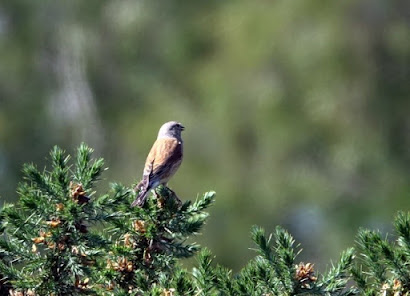

Linnet
Linnet


As well as the Linnets (shown above), there is good evidence of breeding by migrants such as Blackcap, Chiffchaff and Willow Warbler. Sadly, Whitethroat seem to visit only rarely. Tits, Wrens, Blackbirds and Robins were all abundant. Swallows, Swifts and House Martins have been feeding over the reserve. I know where the Swallows nest but not the other two species. Sadly my swift box still stands empty.
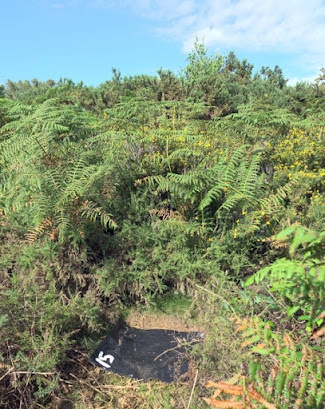

A reptile mat amongst the bracken


As reported in the spring newsletter, a local reptile expert helped us lay out reptile mats (refugia) in suitable places. This was in early March before lockdown. I tried to keep an eye on them during my lockdown exercise trips: some exposed mats got blown away in the gales; others had been collected by illicit drinkers to sit on and distribute litter; others had disappeared in the bracken forest, beyond the help of GPS; finding others in the heather would have required stumbling about during the bird nesting season. So, it was a pleasant surprise when bracken pullers uncovered matt number 2, to find a rapidly disappearing Common (Viparious) Lizard. Gianfranco Uli then discovered this still frame from a phone-video he was alert enough to take during the unveiling.


Common lizards running for cover

He thought he had missed the action, but close examination showed him two lizards scarpering. During his bracken pulling exploits, Gianfranco also had time to picture some fungi (Tawny Grisette) and this young Common Frog hiding in the heather.


Tawny Grisette (left) and a young Common Frog hiding in the heather (right)


On sunny days, the heather has been alive with insects of all shapes and sizes. Some of them need a hand lens to appreciate and nearly all of them need greater invertebrate ID skills than I possess. However, I am pretty confident that those shown here are respectively a Tree Bumblebee enjoying the Bramble flower and a Gatekeeper feeding on the Heather.


Tree Bumblebee on Bramble flower (left) and a Gatekeeper feeding on the Heather (right)


The extended hot and dry spell in May brought a sharp reminder of the dangers of fire in a heathland area, particularly one in a residential area such as Cleaver. Fortunately, this one started by a still smouldering cigarette was spotted and doused before it extended even further into the bracken litter and gorse.
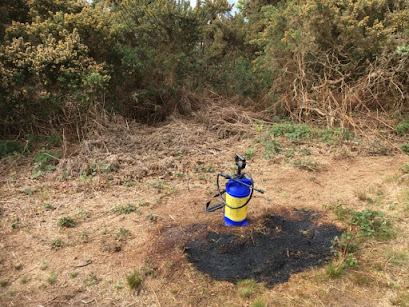

Fire extinguished at Cleaver Heath


Accidental (?) fires are quite common on Heswall Dales. If the fire does not get too far down into the soil the heather can recover as the pictures below show. The left photo was taken in March on the first day of Lockdown (my morning exercise!) and the second one exactly 4 months later. The main lesson, of course, is that fires on heathland are difficult to control and so are very dangerous to humans, property and of course wildlife. So we all need to be extra vigilant in dry weather.
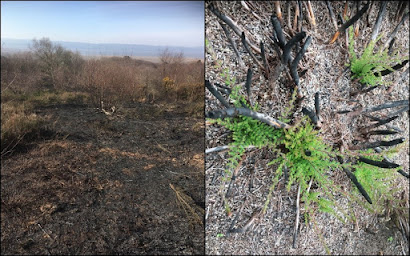

Burnt area in March (left) and in July (right)


Here is my usual seasonally-updated photo of the reserve entrance. It shows that I will soon need to get the loppers out again.
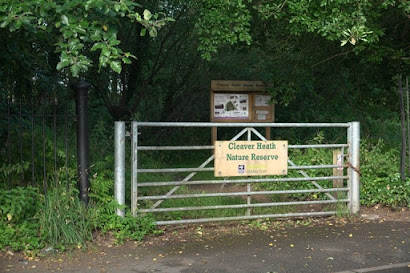

Entrance to Cleaver Heath in summer


Alan Irving
Volunteer Reserve Warden for CWT
Cleaver Heath
August 2020

Wednesday, 22 April 2020

Spring 2020 at Cleaver Heath


Installing reptile refugia at Cleaver Heath

On the last Sunday workday of the season on Cleaver, one of the tasks was to deploy 32 reptile refugia or ACO (Artificial Cover Objects) in preparation for a Common Lizard survey. This was on 1st March before things went crazy. Local reptile expert Tom Doherty-Bone showed us how to set out the refugia in suitable locations. Most of them were within the heather panels in the upper and lower part of the reserve. The others were placed in the relatively bare areas earmarked for our heathland restoration project. We deployed them in a sequence allowing reasonably convenient checking in a subsequent transect. They were all numbered and the GPS coordinates recorded (4 digit OS grid).  Cheshire Wildlife Trust has provided guidance from ARG UK on the best way to carry out surveys including weather conditions and timing. I have been keeping an eye on the ACO as I pass round the reserve and did dedicate one of my day-release ‘exercise’ walks in April, to a proper survey. Although, I have seen nothing, Tom tells me of third party reports of sightings, including the photo of a dead lizard he thinks might have been regurgitated. Ugh. I found lots of ants however. It is a shame that Green Woodpeckers (unlike dogs) are not able to lift the ACOs (squares of roofing felt) as they would have an endless supply of tasty food, without having to queue for it or have it delivered. In fact, there has been constant Green Woodpecker activity within the reserve and in the nearby gardens over the last month.


Green Woodpecker

Local resident Frank Burns has kindly supplied me with this excellent photo of a male which he and my wife watched climbing the large Scots Pine one afternoon. I am pretty sure there is at least a pair present as, during one of my early morning Common Bird Census ‘exercise walks’, I watched a female posing on a tree while another called from some distance away.  I am also pleased to report that we have at least one singing linnet present again. This means that all the usual birds that we think breed here are back in town. The first dates when I heard the visitors singing in the reserve this year were:
Chiffchaff, March 20th
Blackcap, April 1st
Willow Warbler, April 15th


Linnet singing at Cleaver Heath

Whitethroats have been a bit scarce on the reserve in recent years. I have watched one singing on Heswall shore this week but have so far seen none up here. The Oldfield Farm Swallows’ arrival pattern has been slightly different this year. The first arrived on April 6th (a few days early) followed by sporadic sightings since. It might be that some of these are just passing through.  Normally, by mid-April the numbers have grown to around a dozen making use of the farm stables. I haven’t seen any House Martins in Oldfield yet, although I have seen them feasting on insects above Heswall sewage works – always a good place to look for birds.


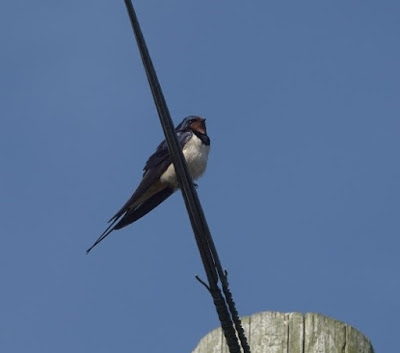
Swallow


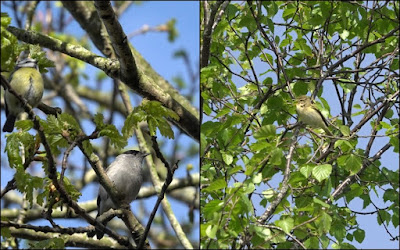
Sadly, the annual Dawn Chorus Walk through Cleaver and Heswall Dales has had to be cancelled this year, so here are a couple of photos of this year’s singing warblers instead: Blackcap and Willow Warbler. We were shocked one morning to find a deceased Blackcap below our dining room window. It had presumably flown into the glass. I am happy to report that there are still at least two males singing on the reserve following this.


Blue Tit and Blackcap (left) and Willow Warbler (right)

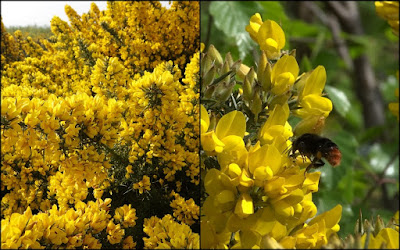
The European Gorse has been looking stunning this spring. As you can see, there are plenty of insects, including this Red-Tailed Bumble Bee, taking advantage of the blossom. 


European Gorse with Red-Tailed Bumble Bee

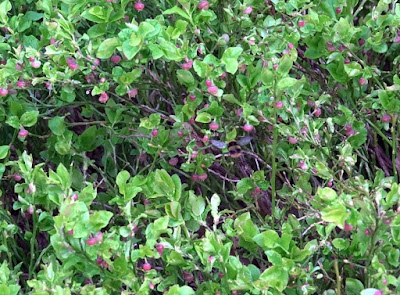
Another plant doing really well is Bilberry. As previously noted, this plant grows widely in the main Heswall Dales but is restricted to a small, but expanding, panel within our managed scrub area. It is currently developing flowers and is also being heavily used by insects.


Bilberry

On the subject of insects, while conducting one of our 3-yearly heathland condition surveys last September, we came across this lovely green and yellow caterpillar. I sent the photo to our county moth recorder, Steve Holmes, who confirmed that it was the larva of a Beautiful Yellow Underwing moth and, as a relatively rare sighting, has been included, with photo, in his annual report.


Beautiful Yellow Underwing moth caterpillar

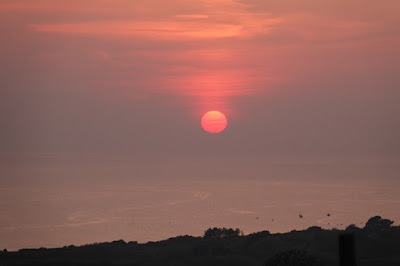
As a parting shot, I leave you with a recent sunset photo - now well over Liverpool Bay. Compare this with the Clwyd Hills photo of the Winter Newsletter.


Sunset over Liverpool Bay

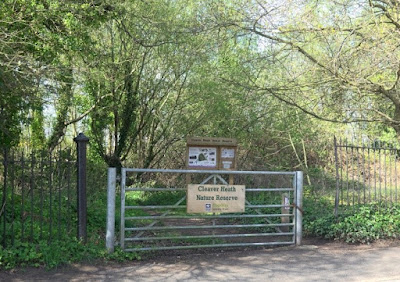
You may also notice that the traditional reserve entrance photo has been seasonally adjusted.


Cleaver Heath entrance


Alan Irving
Volunteer Reserve Warden for CWT
Cleaver Heath
April 2020

Saturday, 10 November 2018

Autumn 2018 at Cleaver Heath


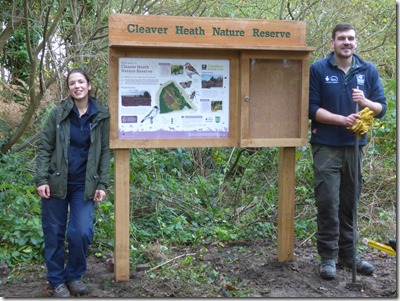
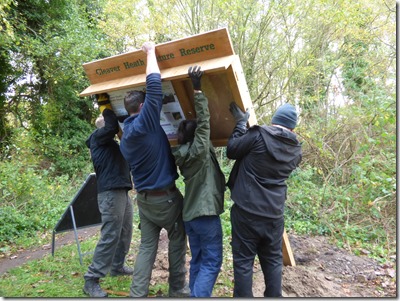
Cleaver Heath Notice Board

Recent visitors to the reserve will have noticed our smart new signage made possible largely by the Tesco Bags of Help grant described in our summer newsletter. At the end of October, some of our expert staff from CWT: Sarah Bennet (Area Manager West), Kevin Feeney (Living Landscape Officer West and author of the original Tesco bid), Fiona Megarrell (Community Conservation Co-ordinator) and their volunteer helpers completed the installation of the major parts of the new signage and access improvements.

Putting up the Notice Board

This involved quite a bit of hard work – digging 1m down through layers of tarmac, builders’ rubble (the old hospital visitors’ car park), sandy soil and boulder clay. Then we manhandled the high quality, and very heavy, wooden sign and notice board into the carefully measured holes. The experts then positioned and stabilised it with millimetre precision using spirit levels - a work of art.

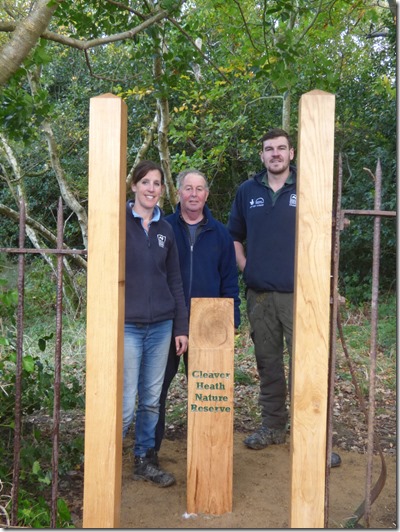
Northern Entrance at Cleaver Heath

The unofficial reserve entry from Oldfield Drive has now become official and rather smart. My memory of the old one goes back to the late 70s. Some enterprising resident (not me!) took it upon themselves to crowbar the railings apart to enable entry to the Cleaver Hospital site by those with a reasonably slim and flexible physique. Repeated attempts by authorities to straighten the railings were quickly undone. The new entry will give dog-walkers convenient access to the nearby litter bin and also help those who wish to incorporate the reserve paths into a linear walk. The main entrance gate has a fine quality routed wooden sign leaving no doubt that this is a Cheshire Wildlife Nature Reserve. To help orient visitors and encourage them in keeping to the main paths, there are some tasteful new way markers. When the finishing touches have been made, the Trust will be organising some appropriate publicity.

The winter work parties have now started – these are on the first Sunday of the month from 10.00. We are making good progress on the ‘bread and butter’ tasks of removing unwanted vegetation from the heathland panel. We have also removed a few more of the non-native saplings such as Sweet Chestnut and Sycamore.

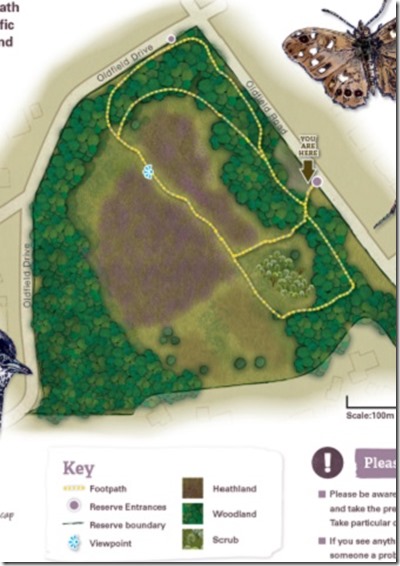
Interpretation Board Map

As last year, we have been making good use of the tree poppers where possible and stump treatment of things we cut. There are, however, places where the best thing is to coppice i.e. cut but not treat. For example, we have an area of ‘managed scrub’ which you can see on the snapshot of our new interpretation board (above). We will also be carrying out more coppicing of European Gorse stands where we are happy to keep them provided they thicken out at the base rather get old and lanky. Gorse provides important shelter for some of our nesting birds. We think we had two pairs of breeding Linnets this year.

My overall conclusion from this year’s Common Bird Census survey at Cleaver is of a lower presence of summer warblers. I made 10 early morning visits to the reserve noting where the birds were visible or singing.

Bird Census Map

The number of Willow Warbler territories was certainly down this year. I had only sporadic sightings of Whitethroat this year – not enough to do any sort of territory analysis. The map above summarises sightings of Linnets and Willow Warblers. I also do some Breeding Bird Survey work for the BTO (British Trust for Ornithology) and noticed a similarly poor turnout this year on my 1km square near Thornton Hough. I don’t know if this was due in part to our poor UK weather conditions in spring or to some other effects on the migration routes.

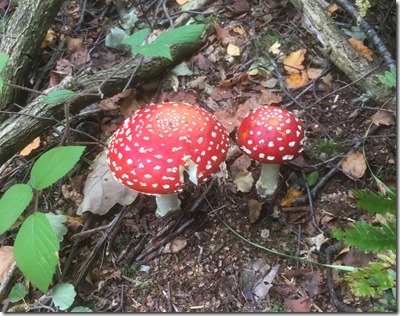
Fly Agaric

Many of us associate autumn not just with colourful tree leaves but also with fungi. The autumn colours we see in the UK are often due to non-native trees e.g. Maples. Since Cleaver is primarily a Lowland Heath habitat, with only a limited amount of native woodland, we don’t expect to have spectacular autumn colour displays. However, like others who have walked around the Cleaver paths from September onwards, I have instead been enjoying the displays of colourful fungi.

Fly Agaric

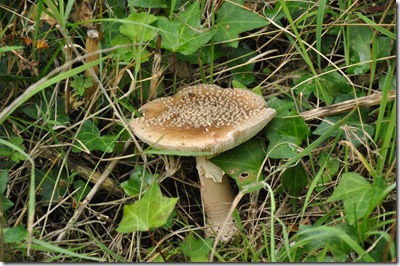
Most of us are familiar with Fly Agaric (Amanita muscaria). When the fruits first emerge they have orange or red hemispherical caps which then flatten out as they grow. These are still showing along many of the woodland paths segments. I have also spotted examples of another member of the Amanita genus, commonly known as a species of Blusher (Amanita rubescens). This also has white spots, but on a less threatening grey background. The development of its cap follows a similar pattern.

Blusher (Amanita rubescens)

Blusher (Amanita rubescens)

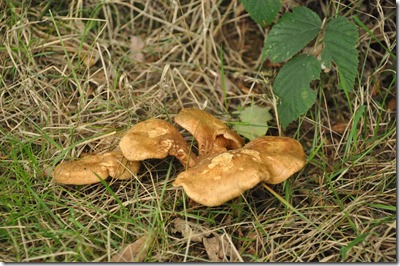
There have been plenty of fine examples of False Chanterelle (Hygrophoropsis aurantiaca). The example below seems to have developed in four segments.

False Chanterelle (Hygrophoropsis aurantiaca)

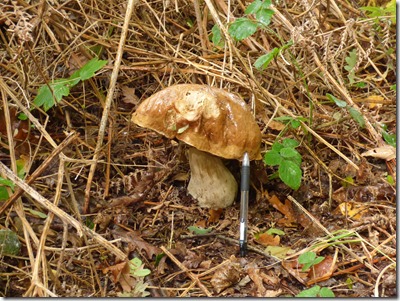
I am told they are very sensitive to nearby plants. Even a blade of grass flapping against the cap edge can lead to permanent deformation. I am not sufficiently confident of identifying edible to test my judgements. However, this large toadstool shown below (next to a ballpoint pen for scale) has as one of its common names Penny Bun and is commonly eaten. In Tesco, it would be called a porcini and you would get charged more than a penny. It is Boletus edulis.

Penny Bun (Boletus edulis)

I had occasion to seek help from Trust staff when a mature birch, attacked by fungus at the base of the trunk, fell across one of our paths in an October gale. The trunk structure had been damaged by a Southern Bracket fungus (Ganoderma australe).

Southern Bracket fungus (Ganoderma australe)

The Aminita fungi shown above get their nourishment from the soil, particularly in rich woodland soil. Bracket fungi like this one get their food from trees and in so doing, turn the fibres into a mush. The layers on this bracket count the number of years it has lived. When the food runs out the underside turns white as shown below.

Southern Bracket fungus (Ganoderma australe)

The birch seen here then tipped over. We didn’t even need a chain saw to complete the job. My helpful Trust staff member Kevin, used his superior strength to push it all the way down into a safe place.

Not all fungi are harmful to plants. In fact, it is quite the reverse for many of them. I am looking forward to the November Wirral Wildlife talk which will be all about Symbiotic Mycorrhizal Fungi. Large classes of plants benefit from such fungi which facilitate the absorption of soil nutrients via their root systems. The plant gets minerals from the soil and the fungi get sugars and carbohydrates from the plant. Such fungi are also important in helping with plant to plant communication. Trees find out if there is some threat on the way. Fungi are not nearly as well understood as most other life forms. They are quite fascinating. Next time you walk in the reserve think about all the activity going on in the soil under your feet – all year round, not just in autumn.

Alan Irving
Volunteer Reserve Warden for CWT
Cleaver Heath

November 2018

Monday, 6 August 2018

Summer 2018 at Cleaver Heath


Volunteers laying down gritstone at Cleaver Heath

The Tesco 'Bags of Help' grant is now making an impact on site. This grant along with Natural Futures funding provides help with new signage, an interpretation board, a proper northern gateway and some approved gritstone to reinforce the vulnerable main path through the heather.

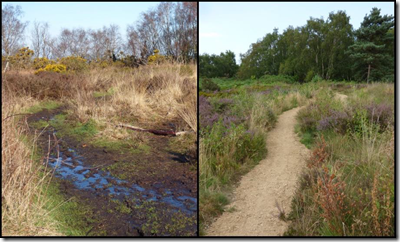
Last week, some kind CWT volunteers helped lay down the first load of gritstone. It turned out to be the hottest day of the year. However, this hard work should make a real difference, turning what can be a mud bath in winter (below left) into an attractive path (below right) which will encourage visitors to respect the fragile heathland all year round.

New path at Cleaver Heath (before and after)

The grant will also provide us with signage to identify the recommended route to maximise visitors’ enjoyment of the reserve and its stunning views. No wildlife or visitors were harmed during those activities although I almost ran over a Common Lizard with my wheelbarrow full of stone.

Summer has now really arrived. We have had a continuous sequence of flowering plants and shrubs - from the Oxeye Daisies, Red Campion and Ragwort in our ‘insect nursery’ (ex-carpark) to the Common Heather (Calluna) and Western Gorse out on the reserve. The Bell Heather (both plants!) bloomed defiantly in June and then lapsed back into obscurity. The Common Heather is now starting to turn from white to purple.

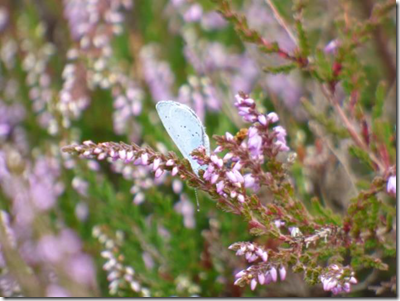
Holly blue butterfly

The small butterfly shown above is a male Holly Blue. This has a blue underwing with black spots. It was photographed during a brief rest period in the stoning! There were plenty of Common Blue butterflies on the wing as well. We were also surrounded by Swallows and House Martins which were feeding low over the heather showing just how productive the heathland is in summer.

Swallows in flight over Cleaver Heath

Swallows in flight are very hard to photograph for us amateurs, as the photograph above  demonstrates. What with humming bees, swarms of insects, fluttering butterflies and swooping swallows, the reserve seems very alive following several weeks of warm weather. The downside of course is that some of the vegetation is visibly starting to wilt.

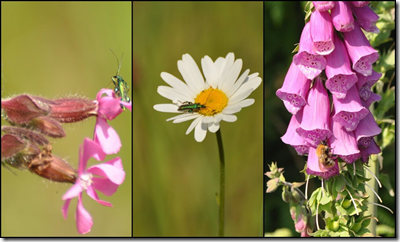
Swollen-thighed Beetle on Red Campion and and Oxeye Daisy and Buff-tailed Bumble bee on Foxglove

A new beetle for me this summer has been the Swollen-thighed Beetle seen on both Red Campion (above left) and Oxeye Daisy above centre). The shiny green colouring is quite striking and the name perfectly describes it. The Buff-tailed Bumble bee on the Foxlove (above right) is of course more familiar. There have been spectacular displays of Foxgloves around the woodland path edges providing a popular source of nectar. Foxgloves like the disturbance associated with paths.

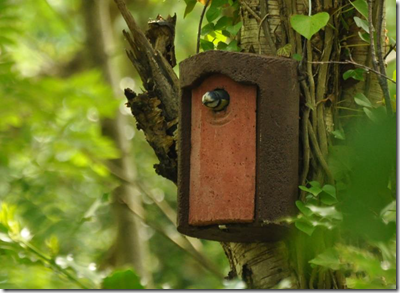
Blue Tit in nest box at Cleaver Heath

The nest boxes installed last winter - see the Winter Newsletter - seem to have been used. I had firm sightings of Blue Tits (above) and Great Tits using at least 6 of the 10 boxes. No sign of occupancy at the Tawny Owl box however.

Linnet and Song Thrush

This year’s Common Bird Census took place between 5th April and 11th June. The overall numbers were down on 2017 probably due to the poor weather in the early breeding season. The Linnets were here again this year (above left) – possibly 2 pairs? Both Mistle and Song Thrush (above right) bred. We had the usual warblers holding territory – Chiffchaff, Blackcap and Willow Warbler. I am not sure if the Willow Warblers actually bred. They seemed to disappear at the end of May but returned in late June. I even heard one singing in the last week of July!

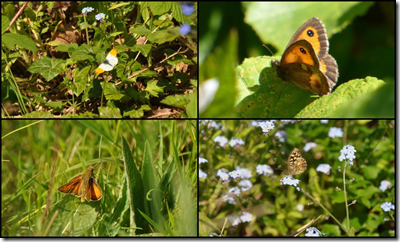
Butterflies at Cleaver Heath

Butterfly sightings have picked up after a slow start – the Cleaver to Thurstaston survey numbers are now running at roughly double those to the same point in 2017: 800 up from 400. Top left is a rare (for me) photo of a male Orange Tip at rest. These were quickly replaced by the other small whites then Meadow Brown and Gatekeeper (top right) and other smaller things such as the Small and Large Skipper (bottom left) and the Blues. The Speckled Woods (bottom right) have been present throughout the surveys. We have had the odd Small Copper, Peacock and Red Admiral and a few Commas, but still no Painted Ladies (as of end July). Our Species Count for the transect this summer remains stubbornly at 15.

Further activities in the pipeline include another round of bracken spraying. This needs to be done annually in a relatively narrow window in time and weather conditions. We also hope to get some of the new signage infrastructure installed in the autumn.

Looking ahead to the monthly workdays, there is plenty to be done. We need to check and clean out the bird boxes, tidy up some path work, remove some non-native shrubs and saplings, start on the annual birch control work using the new pull or cut and treat methods. The first date is Sunday 2nd September from 10 a.m.

Volunteers at a workday at Cleaver Heath

This year’s ‘Beauty of Heswall’s Heathland’ guided walk will take place from 2 to 4 p.m. on Sunday 19th August. More details on the Wirral Wildlife website at www.wirralwildlife.org.uk or on the main Cheshire Wildlife site at www.cheshirewildlifetrust.org.uk.

Alan Irving
Volunteer Reserve Warden for CWT
Cleaver Heath

Wednesday, 16 August 2017

Late Summer at Cleaver Heath


The sights and sounds of summer


Now that summer is coming to an end, I am already missing the melodious background sounds of bird-song on the reserve. There are compensations however, both aural and visual. The heather is coming into its purple prime and, when the sun shines, the hum of insects around the heather and other shrubs grabs your attention. We are also now enjoying the wonderful scent of heather. Numbers of butterflies have built up – 18 species along the full length of our transect. Within the reserve itself, we were pleased to spot some small but very attractive visitors: small skipper, small copper and holly blue. 

Small skipper


Small copper


Holly blue


You can tell that this Holly Blue is a female because the upper side of the wing has some broad dark edge bands. We know it is not a common blue because the underside is light blue with spots rather than the brownish pattern of the common.

In July, we had lots of stunning Cinnabar Moth larvae on the Ragwort in our ‘ex-carpark’ which is now managed (successfully?) for insects. These striped larvae have by now turned into very stylish red and black moths. 


The natural hedge featured in the last (Early Summer) update is now sporting some good looking Blackthorn sloes!


Common Bird Census Update

The earlymorning bird census described in the last update ran from 2 April to 19 June. As described last time, the output for each species is a map showing where they were observed. I have now completed one for the Willow Warbler which shows clusters of activity on 3 or 4 territories.


The letters A,B,…..K indicate the 10 weekly observations. The circles round each letter denote a male singing. The singing is typically from the upper braches of a tree (the blank areas on the map) while the nesting typically takes place in low dense scrub (hatched areas). 


Willow warbler


I heard a Willow Warbler still singing in the last week of July in the well populated area at the top left of the map! They have now gone silent but I was still hearing a few contact calls from Chiffchaff and Willow Warbler in the first two weeks of August.  Now the ‘dead birch’ song post where warblers queued to sing is less heavily used.


Song post , heather and birch


Below the song post one can see lovely heather and a timely reminder of the threat posed by pioneering birch saplings of the kind we will be waging war on in the winter work parties (more on this below).  I had a recent welcome sighting in this area of two pairs of Linnets.


Linnet


The Linnets featured from time to time in my bird census. There was no evidence of breeding this year but we can be hopeful. They make a great sight and sound.

Other signs of the coming autumn are provided by all the Fungi popping up in the grassy and woodland areas.

Fly agaric


This dangerous looking Fungus is one that even I can identify – Fly Agaric. Some young children on a hunt last week reckoned they counted 7 different species. I must ask them to help me identify them. 

Many fungi are obviously providing a welcome food source for the reserve’s wildlife. This one might be a Meadow Waxcap?

Meadow waxcap?


Conservation work goes on

There is always something needing to be done, even on a small reserve like Cleaver Heath. Over July, the bracken growth was reaching its peak. Where it is shaded (the woodland fringe) it is naturally controlled. On the previously sprayed areas near heather it is gratifyingly stunted.

 Bracken re-growth in the area which had been stripped over the winter


However, the pictures show spectacular summer growth after 12 person-days of volunteer effort last winter were used to remove the previous bracken litter - the accumulation of dead bracken over the last several years. 


 Bracken re-growth in the area which had been stripped over the winter


Follow-up work is always required when trying to regenerate heathland. So, we have now had an experienced contractor conduct bracken spraying (with Asulox) over the entire reserve. We will be back to remove the dead bracken again this winter. Normally the bracken rhizomes get the message after a 2 or 3-year cycle.

The first order of priority when the monthly winter work groups start again, will be to get among the heather (gingerly of course) and start removing birch saplings previously missed, such as the one in the ‘song post’ picture featured earlier.   

There is clearly a lot waiting for us as you see from this recent photo of the main path along the top part of the reserve.

Main path


There are various reasons for attacking the birch in the autumn. An obvious one is that you can still actually see the little birch saplings. You can then pull them out by hand, or use more serious methods if that fails. The more serious methods include cutting and, where possible, stump-treating them with a herbicide. In autumn, the sap has stopped rising but many trees then absorb other chemicals (their own natural ones) back down into the root systems. One can make use of this behaviour to ensure the stump treatment is more effective. 


After treatment of birch root system


This picture shows effective treatment of birch root system which had regrown multiple times after cutting with loppers. It finally succumbed when recut and immediately painted with herbicide 2 years ago. The heather, previously shaded, is now starting to grow back around it. This area is part of what we call the ‘lower reserve’ which like the publically accessible part has a heathland mosaic of heather and Western gorse along with many mosses, grasses and stands of European gorse which we coppice from time to time.

We try to disturb this area as little as possible, so as to encourage as much wildlife as possible to make a home there. You can see from the bird census results for the Willow Warbler (above) that they do indeed make use of it.  I am looking forward to the winter work programme and will report on our activities in due course.


Alan Irving, August 2017