Showing posts with label Heswall Dales. Show all posts

Wednesday, 23 June 2021

Heswall Dales Local Nature Reserve


Alan Irving (Reserve Manager for Cleaver Heath) recently wrote an article about Heswall Dales for RECORD to put in their newsletter.


Heswall Dales Local Nature Reserve
Heswall Dales


Heswall Dales Local Nature Reserve (LNR) is owned and managed by Wirral Borough Council and forms part of the Heswall Dales SSSI (Site of Specific Scientific Interest). Access is from Oldfield Road, Heswall CH60 6SN (SJ 2595 8242) where there is a notice about both Heswall Dales LNR and Dale Farm. The nearest parking is on Oldfield Road itself. The Friends of Heswall Dales website contains information about what can been seen there. You can find maps both for locating the reserve and for navigating the main paths. Look particularly at the ‘Your Visit’ page where there is a season-by-season guide to flora and fauna.

The main Dales LNR occupies 70 acres of which some 50 are classified as lowland heath. It overlooks the Dee Estuary and is popular with local residents, particularly dog-walkers, who are encouraged to stick to the main paths. Thus there is quite a lot of undisturbed habitat for recording purposes which, conversely, means access to the dedicated recorder can be quite challenging, requiring stout footwear and thorn-proof clothing. As well as attractive heather, Western gorse (Ulex galli) and Bilberry (Vaccinium myrtillus) panels, there are sandstone outcrops, dense scrub areas and birch/oak woodland. The Council web page also contains a copy of the Dales Management Plan. Amongst other things, this contains an overview of the physical characteristics of the Dales and the SSSI citation.


Botanical surveying taking place at Heswall Dales


Botanical surveys of the SSSI are conducted on a 10-year cycle, the last one of which was in 2020. In these, non-plant species are not systematically recorded but only as occasional observations. A small area near the Bush Way entrance (south-east corner) is designated as a Site of Biological Importance.

Complete species bird counts over a fixed route along the main paths have been conducted throughout 2020, yielding some 50+ species. These have been logged using the BTO BirdTrack system. In the breeding season there is plenty of activity by the visiting warblers, and in the winter, Woodcock (Scolopax rusticola) are known to be hiding out and are occasionally flushed during conservation work. Various raptors are found all year round including Sparrowhawks (Accipiter nisus), Tawny owls (Strix aluco), Kestrels (Falco tinnunculus) and Buzzards (Buteo buteo), which make use of the healthy small mammal populations. Other mammals known to be present are Red foxes (Vulpes vulpes), Badgers (Meles meles) and bats about which little is known. Local birders fondly remember the Dartford warbler (Curruca undata) found once in the Dales leading to traffic jams in Heswall, so one never knows what might show up.


Views of heathland and woodland at Heswall Dales


It is not well known how much other recording has been done historically, so there is plenty of scope for further work. We are particularly keen to find out more about invertebrates of all kinds, including butterflies, moths and beetles. The heather is thought to be rich in spider species and merits a proper survey.

For more information about the latest state of recording and further local advice, check with the Friends of Heswall Dales (see their website for contact details) and the Ranger
The reserve is open 24/7 all year round.

Thursday, 20 August 2020

Surveying Heswall Dales


Hilary Ash surveying the heathland at Heswall Dales

Recording teams from Wirral Wildlife, led by Dr Hilary Ash, have just spent three, mostly enjoyable, days on a major botanical survey of Heswall Dales. The recording group make a point of surveying all SSSI sites on Wirral on a 10-year cycle. The idea is to keep track of all species growing there, with particular attention to the features listed in the SSSI citation. In the case of Heswall Dales, the main features relate to its Lowland Heath characteristics.

At this time of year one sees a beautiful palette of colours: the light pink is the Common Heather, the yellow is Western Gorse in bloom and the deep purples and browns are the Bell Heather now moving into the seeding stage. This was a real treat for us. The weather was wonderful on the first day, so the only real hardship was cutting our way through encroaching scrub to reveal these lovely panels and wading through the mostly healthy and vigorous heather and compact western gorse.


Part of our duties was to assess the level of scrub encroachment and so identify scrub control priorities to help with site management. For reporting purposes, the entire site of some 50 acres or so of heathland was divided up into compartments where complete lists of species were recorded along with estimates of relative abundance.  In the case of the heather we also noted the condition and age structure, again with a view to site management. The data and associated notes will be made available to the land owner, in this case Wirral Borough Council, as well as Natural England who are entrusted with monitoring the status of sites with special designations.


Interesting finds at Heswall Dales

The woodland areas will be surveyed next spring when the bracken has died back and the woodland plants start to bloom making identification easier. While on the heathland survey, we also noted down anything interesting we happened to come across, for example: birds, bees, dragonflies, butterflies, lizards, lichens and fungi. The young lizard pictured above was discovered hiding in a bag the day after the survey was completed when bracken pulling restarted in the Dales. There seems be lots of interesting stuff around in Heswall Dales just waiting to be discovered. Overall, the impression of the heathland was that quite a lot of it is in a very healthy state but a lot of management effort is needed both to protect these areas and to reduce the rate of further succession into scrub of the heathland fringes.


Monday, 13 May 2019

Spring 2019 at Cleaver Heath


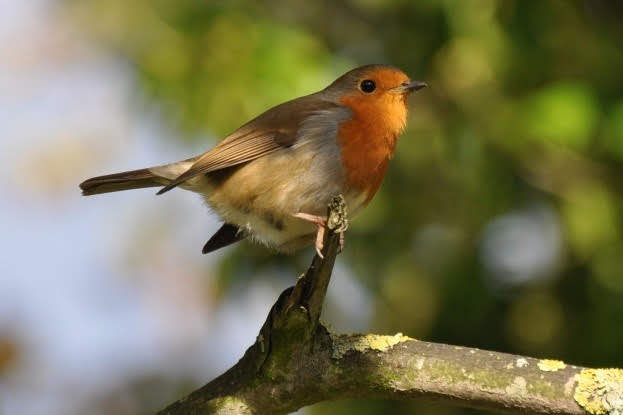
Robin

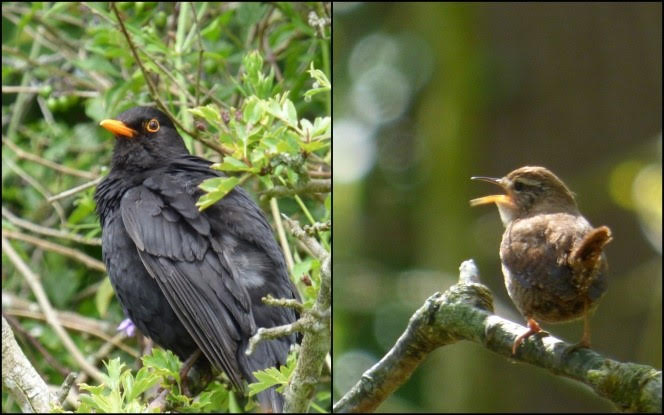
On the first Sunday in May each year, I get up well before the lark for our annual Dawn Chorus Walk starting at Cleaver. A 4:30am start is not for everyone but, once you are out there, you are usually glad you did make the effort. This year, a group of 12 brave souls shivered in the cold. As always, the Robins and Blackbirds started the ball rolling closely followed by the Wren.

Blackbird (left) and wren (right)

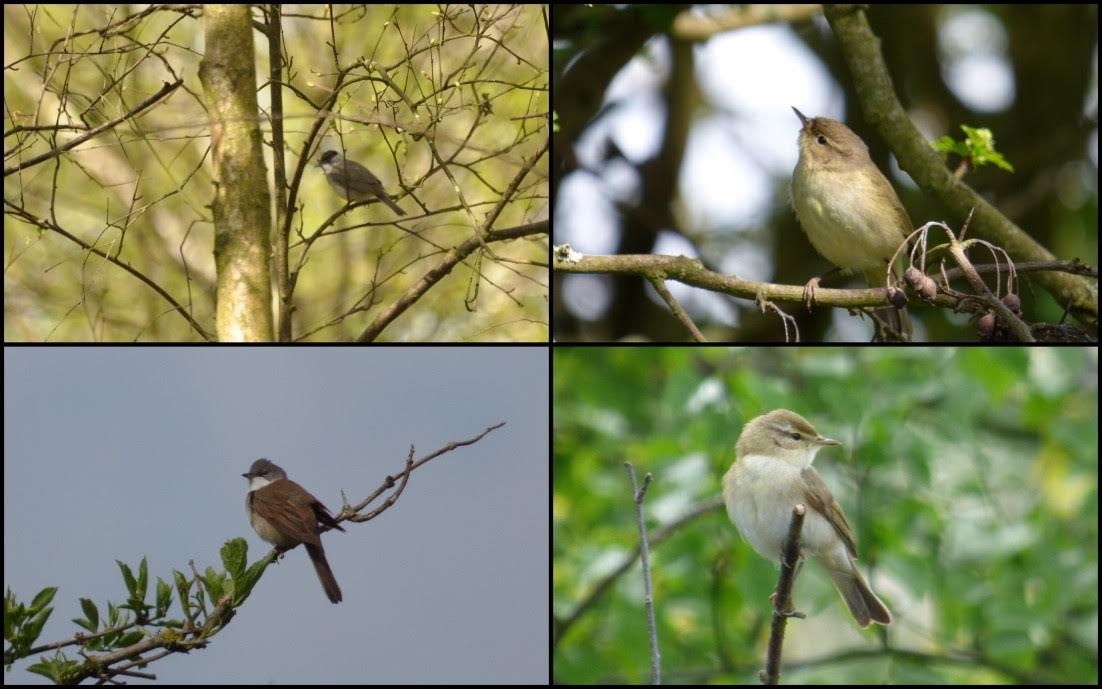
We heard and/or saw some 20 species in our 2 hour walk through Cleaver Heath and Heswall Dales. As the light came up, we started to hear more from the visiting summer warblers; first Blackcaps then Chiffchaffs, Willow Warblers and Whitethroat (shown in that order clockwise from the top left).

Blackcap, chiffchaff, willow warbler, whitethroat (clockwise from top left)

Of course, some of these are very hard to spot in the leafy spring trees, so it is very good to get to know their distinctive songs. For example, the Chiffchaff and Willow Warbler are clearly very similar to look at but their songs are totally different. If you have a smart-phone and point the camera at the QR code shown here, your phone will take you to a web page where you can play the bird song. We used this trick to help visitors to our ‘Spring in Heswall Dales’ Open Day on May 11 identify what they were hearing.


The arrival dates of various migrant birds at Oldfield this year were not too different from usual: Chiffchaff (March 1), Blackcap (April 6), Willow Warbler (April 7), Swallows (April 11), House Martins (May 2). The Chiffchaff singing on March 1 was a bit early but it might have flown only from its wintering grounds in scrub beside Heswall water treatment plant rather than from Africa! Target Road Heswall is a well-known home to Blackcap and Chiffchaff over winter.

Buff-tailed bumblebee (top) and wasp (bottom) on bilberry

Compared with Heswall Dales, we have quite small amounts of Bilberry in Cleaver but our bushes are now being well used by insects such as the Buff-tailed Bumblebee and Wasp shown above.

Scarce Fungus Weevil (Platyrhinus resinosus)

In early April, we had a group of entomologists from RECORD doing an invertebrates study on Cleaver and, I am told, they found a Scarce Fungus Weevil (Platyrhinus resinosus). The photo above (© Leanne Dixon) is taken from page 4 of the RECORD Spring Newsletter. It certainly is a strange-looking creature. The adjective ‘Scarce’ is not out of place as this was in fact the first record for Cheshire. The group tell me their visit was very productive and they will re-visit in May.

Stumps at Cleaver Heath

Speaking of insects and fungus, we often neglect the importance of leaving dead wood lying about our gardens and reserves. At Cleaver, I am regularly disappointed to find that a lot of the wood which has either fallen down or been coppiced over winter has gradually disappeared by spring, presumably into people’s wood burning stoves. On one occasion a few months ago, we interrupted someone systematically loading sections of birch trunks and branches into the rear of his SUV. Following a brief introductory course on the value of dead wood to a reserve and on theft from private land, we left him returning the wood to precisely where he found it. He seemed genuinely ignorant on both counts. The photo above shows a couple of stumps remaining after we dropped the rotting trunks overhanging the path following a storm. There were a dozen segments of birch trunk of which only one remained by spring when this was taken.

Rotten wood

If left, the pieces of birch rot down into something like that in the picture above where it provides a rich environment for insects, birds and other wildlife such as badgers. Let’s hear it for rotting dead wood.

Orange tip butterflies: male (left) and female (right)

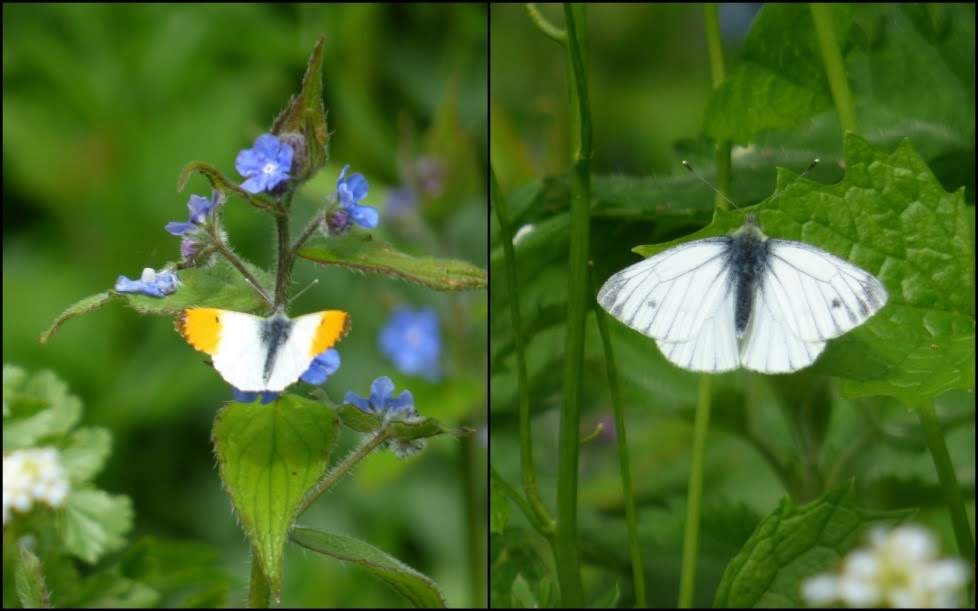
This year’s butterfly transect from Cleaver to Thurstaston has begun. This will be the first year we will have missed at least 1 week out of the 26. There has been some very cold and/or wet and windy weather recently. However, things are looking up again. Initially on the wing were a few species that over-winter as adults such as Red Admiral and Peacock. Numbers have been quite low. Now we are starting to see the whites led, as usual, by the Orange Tip. Most of us instantly recognise a male Orange Tip. The clue is in the title. However the female, shown alongside here, can be easily mistaken for a Small White or Green-veined White which are also starting to be on the wing. The secret to identifying these is to look (much good luck and presistence required) at the underwing.

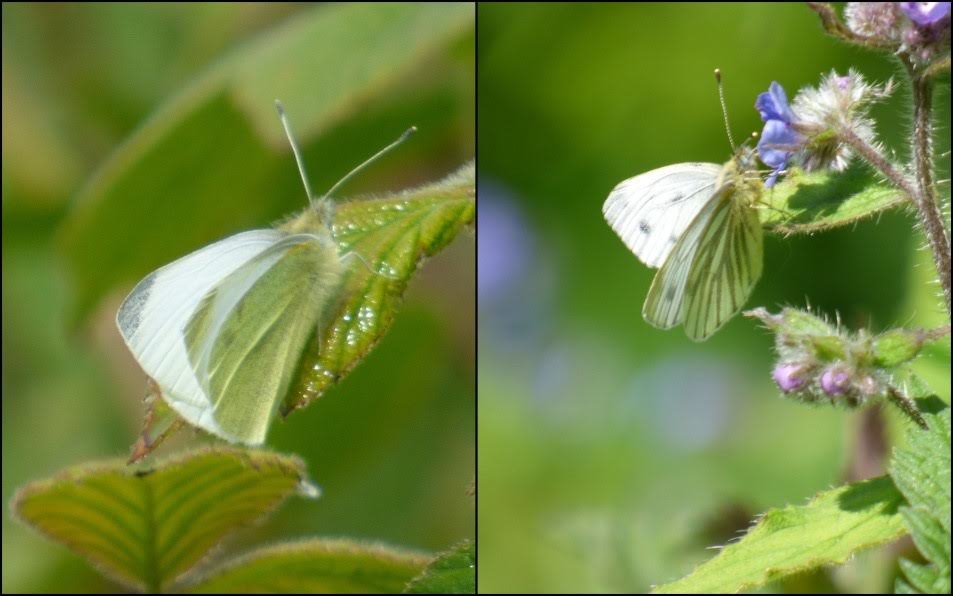
Small White (left) and Green-veined White (right) butterflies

The two shown together here are Small White (left) and Green-veined White (right). Notice the relatively bland yellowy-green underwing in one and the heavy green vein markings of the other. The photo below is of the underwing of the female Orange Tip which is actually rather like the underwing of its male partner – a quite attractive green on white pattern. So, you can see that we have our work cut out trying to identify the small white things as they flash by. These are the analogues of the ‘little brown jobs’ in the bird world.

Underwing of  female Orange Tip butterfly

The next guided walk starting in Cleaver will be the summer one on August 11 this year – our annual Heathland WalkThe Beauty of Heswall’s Heathland’ which takes in both Cleaver and Heswall Dales Nature Reserves. It is timed to take full advantage of the purple Heather and yellow Western Gorse which sould be in full bloom. Bookings for this are taken at the Cheshire Wildlife Trust web site:

Hedgehog

It is several years since I have seen a (non-flattened) hedghog. Since there is quite a lot of badger activity in my garden and in the Reserve, I have been consoling myself that this is because hedgehogs and badgers are not best friends. So, I was pleasantly surprised the other day to find this large hedgehog walking through my garden. After watching its rather unsteady progress for a bit, we realised that it was probably not in good health. However, I am pleased to report that the creature is now recovering well in expert hands at the Hog Centre at Larton. Cilla (they apparently all get names) is one of 20 patients currently in their hedgehog infirmary.

Pipistrelle bat

Another mammal starting to wake up to spring is the pipistrelle. If you look closely at the bottom right of this photo you will see one of a pair of bats feeding in the ex-carpark area of the reserve at dusk the other evening. You are almost certain to see bats there at dusk right through the summer. Just stand by the new interpretation board and enjoy. Combine it with a late sunset view over the estuary.

The entrance and interpretation board at Cleaver Heath

Alan Irving
Volunteer Reserve Warden for CWT
Cleaver Heath
May 2019

Thursday, 25 April 2019

Spring In Heswall Dales


Open Day Saturday 11th May 11.00 am - 3.00 pm


Come and experience ‘Spring in the Dales’ - enjoy woodland walks, rare lowland heath and stunning views over the Dee estuary, surrounded by the sights and sounds of spring.

  • Self-guided walking routes with information boards
  • Quiz sheets and species tick-lists
  • Bird song via QR/smart phones
  • Refreshments and toilets available at Dale Farm

Join in outside the Ranger’s Cottage next to Dale Farm off Oldfield Road - families and children welcome

Stout footwear and suitable outdoor clothing is recommended.

For more information check the Friends’ website: www.heswalldalesfriends.co.uk
or

Monday, 3 September 2018

Open Day on the Heswall Dales


Saturday 15th September
11.00 am - 3.00 pm

Come and discover the ‘Treasures of the Dales’ - enjoy woodland walks, rare lowland heath and stunning views over the Dee estuary, surrounded by the sights and sounds of nature.

The Friends of Heswall Dales and the Ranger will be on hand to point out some of the interesting features of this beautiful local nature reserve.

Walking maps and information will be available from outside the Ranger’s Cottage, off Oldfield Road.

Go around our self-guided walk looking out for the ‘Treasures’ while learning a bit about the natural history of this jewel of Wirral as you go.

For more information check the Friends’ website:

Thursday, 9 November 2017

Support Heswall Dales!


Help us to support Wirral Council in making the most of this unique space – with SSSI status – in the heart of Heswall.

The Friends of Heswall Dales will hold its second meeting at Heswall Hall on 22nd November at 7pm.

* Find out what’s happening in the Dales.
* Become a member.

For more information please email Neil Irvine

Wednesday, 7 June 2017

Heswall Dales


Here is some breaking news about our ‘sister’ Local Nature Reserve – Heswall Dales.


Historically, Heswall Dales and what is now known as Cleaver Heath were part of a single SSSI-designated area of Lowland Heath which was also home to Cleaver Hospital. Following the redevelopment of the Hospital site itself and rescue, by Cheshire Wildlife Trust, of the Northern part of the site, the two parts have become a little separated by some intervening private residential ownership.  Nevertheless, Wirral Borough Council who own and manage the 70 acre Southern Dales site and Cheshire Wildlife Trust who own the Northern (Cleaver Heath) site face similar problems in maintaining their valuable Lowland Heath status.

 A group of Dales conservation Volunteers have now started up a Friends of Heswall Dales support group (launched at Heswall Hall on May 31) to provide focus for support activities on what is locally known as ‘The Dales’. The contact address is friendsheswalldales@gmail.com


The idea is to ensure that the needs, hopes and expectations of all user groups can be met and in such a way that the conservation status of The Dales is properly protected. Like Cleaver Heath, Heswall Dales is a local nature reserve whose conservation status places a statuary obligation on its owners. It is not a park or other public space where users may have different recreational priorities. We wish the Friends of Heswall Dales every success in raising the profile of The Dales and helping local users to make good and appropriate use of this perhaps under-appreciated Wirral treasure.

Heather on the Dales


Tuesday, 23 May 2017

Support Heswall Dales


Join the Friends of Heswall Dales at their inaugural meeting at Heswall Hall on 31st May at 7 p.m.

Find out more about the Dales and how you can help support Wirral Council to protect this SSSI in Heswall.

For more information, please email Neil Irvine