Showing posts with label Tesco Bags of Help. Show all posts

Sunday, 10 February 2019

Winter 2018-19 at Cleaver Heath


Cleaver Heath sunset

Visitors continue to come to Cleaver Heath in all weathers. Many come regularly to exercise their dogs and others stumble across it while exploring the rural delights of west Wirral. All enjoy the stunning views which vary according to the weather, light conditions and tides in the Dee Estuary. The sunset photo here is just as it came out of my camera – no funny business, I swear.

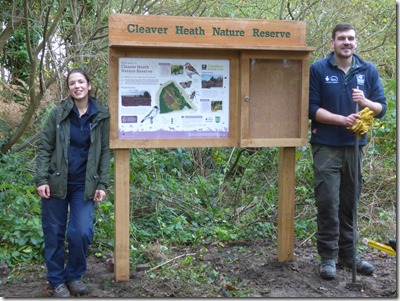
The fine new interpretation board, whose installation I highlighted in the Autumn Newsletter, has been joined by strategically placed arrowed way markers.
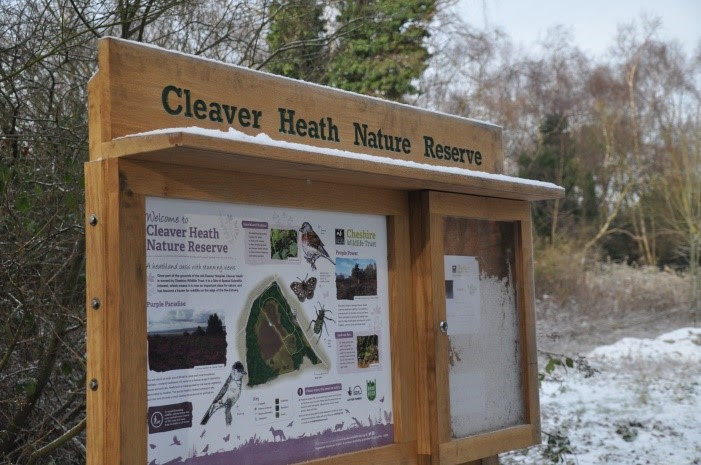
Cleaver Heath noticeboard

Waymarker

As you can see, the noticeboard has now been baptised with snow as well as rain.

Reassuringly, the newly stoned path has stood up very well to rain/sleet/snow and heavy usage. This was another key part of the Tesco Bags of Help scheme (more later).

Path on Cleaver Heath

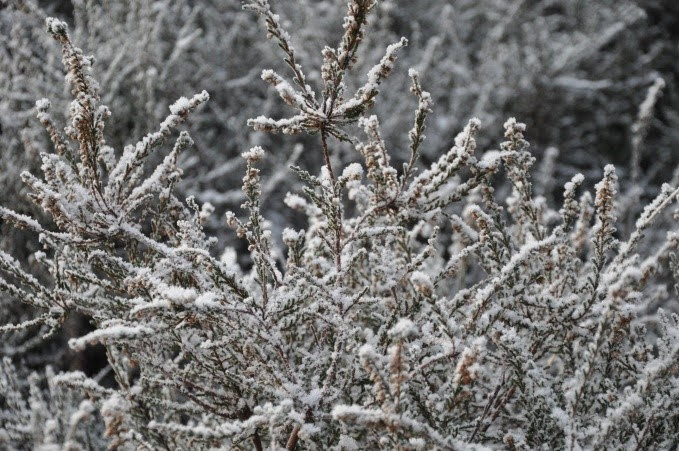
Snow on heather

Fewer visitors are finding it necessary to deviate from the main path. The close-up photo of the heather covered in snow was taken from the official path now signed through the north-east section of the heather panel. Likewise, the sunset view photo was taken from the path without resort to trampling across the heather.

Nevertheless, we do have to venture off-piste when carrying out our main conservation work.

Woodcock. Photo: Mark Hamblin/2020VISION

This year, I have to confess to disturbing a Woodcock on 3 occasions this winter. Two were down in the lower heathland panel - labelled B in the habitat/working area map shown below. These lovely winter visitors resemble a snipe in general shape and come from Eastern Europe. They lie low during daylight and feed after dusk. The third occasion on which I disturbed one was when collecting piles of dog waste in the woodland edge of area G. It shot out on its typical 20° flight path, weaving between the trees until it got to Oldfield Road where it swerved sharply and shot up the road. You can easily see that this fine photo is not one of mine, as usually featured in these newsletters, but is a professional one from the Wildlife Trust’s stock (c. Mark Hamblin/2020VISION).

On the topic of dog waste, the presence on the main noticeboard of a sign about keeping dogs on a lead has been very helpful, but there are still regular users failing to pick up. In an 8-day period last week I collected an unbelievable 34 piles. I have put up a temporary notice drawing dog owners’ attention to the nearness of a regularly emptied litter bin just outside the new northern entrance. My volunteers deserve to have clear paths and verges from which to work and the heather deserves a quiet life on unenriched soil.

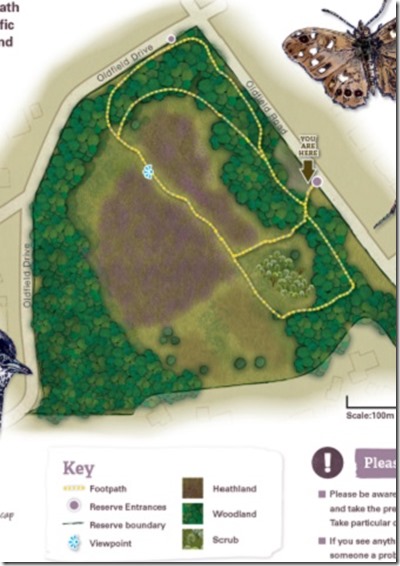
Winter work parties have gone well this year. I like to think that the systematic cutting and stump treatment really is having an effect. In years gone, by it took us until the end of the cutting season to complete our work. This season we had completed it before Christmas. The regrowth was much reduced. This was a direct benefit of the Trust’s Natural Futures programme which paid for herbicide training and the purchase of related equipment. As a result, we have been able to make use of volunteer effort on more varied tasks! People who want to get a better idea of what work is done where may find the following map helpful.
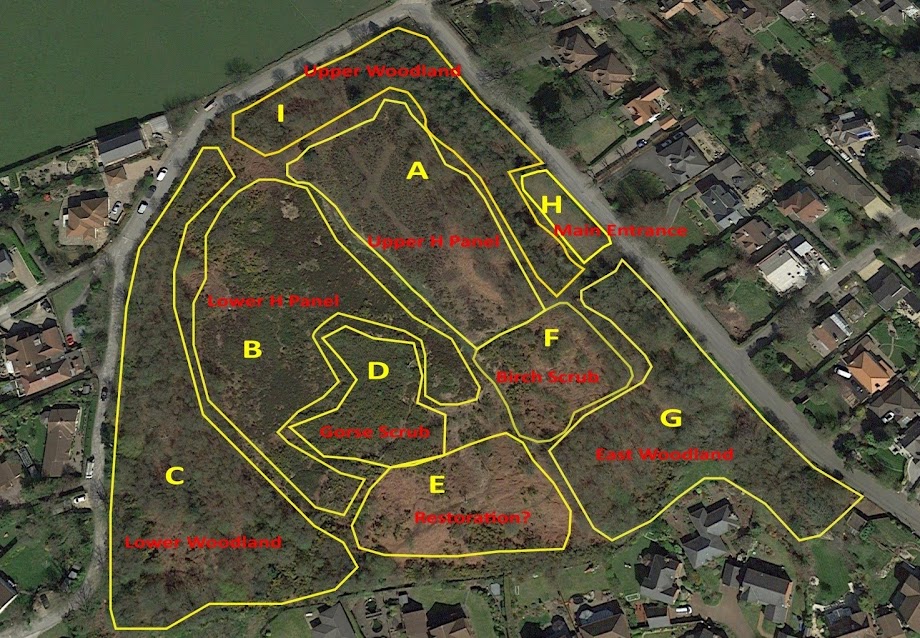
Map of Cleaver Heath

The main manual work removing birch, bramble, bracken and European gorse is in the heathland panels labelled A and B. In these areas saplings are pulled (sometimes with the ‘Tree Poppers’) or cut and painted with glyphosate. The ‘scrub’ areas such as D and F are coppiced selectively i.e. we cut the older/taller birch and gorse. The aim is to hinder the natural succession which would take place in this small heathland area while keeping good low-level shelter for wildlife. The nest boxes in the woodland areas C, I and G have now been given a final clear-out ready for spring. We hope to get help again this year with removing the bracken litter from area E (listed as ‘Restoration?’. This has been sprayed twice and raked twice. It would be a shame if we don’t manage to keep on top of it. Natural England has been very keen that we try to extend the heathland areas. We know from the soil sampling that this is feasible - in principle.
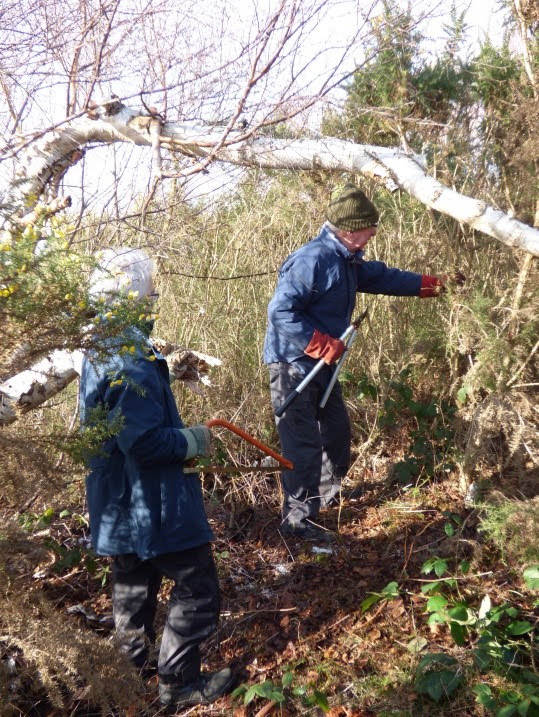
Volunteers at Cleaver Heath

Finally, I should offer a big thank you to Tesco for their ‘Bags of Help’ scheme and to all of you Tesco shoppers who put their blue tokens in the correct box. The Trust’s Living Landscape Officer Kevin Feeney, in particular, put a lot of effort into leading multiple bids to the Bags of Help Scheme for several Trust reserves and then leading the installation.

Tesco Bags of Help

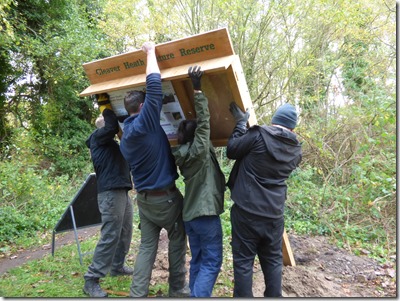
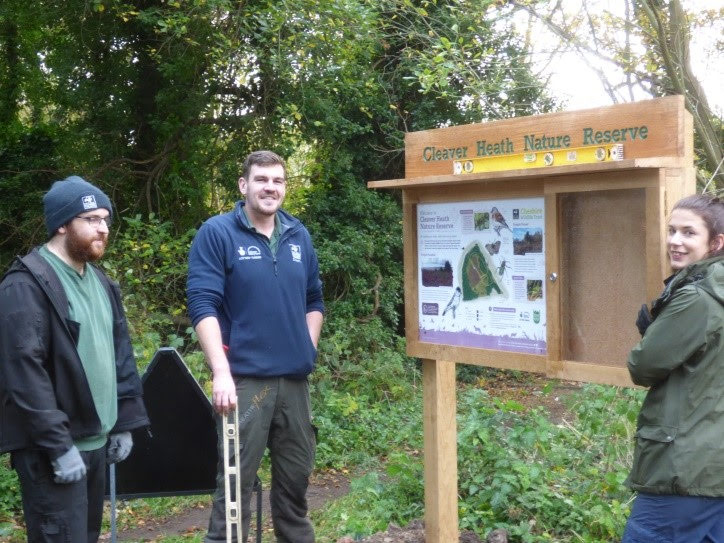
Putting the noticeboard in place at Cleaver Heath

Notice the attention to detail here – not just one spirit level but two. Community Conservation Coordinator Fiona Megarrell (on the right here) will be back later in February to welcome some staff from Tesco to check out the reserve and perhaps also help with some suitable practical work.

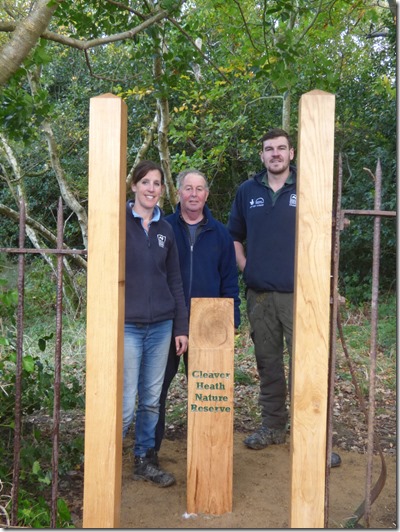
Cleaver Heath sign

Alan Irving
Volunteer Reserve Warden for CWT
Cleaver Heath
February 2019

Saturday, 10 November 2018

Autumn 2018 at Cleaver Heath


Cleaver Heath Notice Board

Recent visitors to the reserve will have noticed our smart new signage made possible largely by the Tesco Bags of Help grant described in our summer newsletter. At the end of October, some of our expert staff from CWT: Sarah Bennet (Area Manager West), Kevin Feeney (Living Landscape Officer West and author of the original Tesco bid), Fiona Megarrell (Community Conservation Co-ordinator) and their volunteer helpers completed the installation of the major parts of the new signage and access improvements.

Putting up the Notice Board

This involved quite a bit of hard work – digging 1m down through layers of tarmac, builders’ rubble (the old hospital visitors’ car park), sandy soil and boulder clay. Then we manhandled the high quality, and very heavy, wooden sign and notice board into the carefully measured holes. The experts then positioned and stabilised it with millimetre precision using spirit levels - a work of art.

Northern Entrance at Cleaver Heath

The unofficial reserve entry from Oldfield Drive has now become official and rather smart. My memory of the old one goes back to the late 70s. Some enterprising resident (not me!) took it upon themselves to crowbar the railings apart to enable entry to the Cleaver Hospital site by those with a reasonably slim and flexible physique. Repeated attempts by authorities to straighten the railings were quickly undone. The new entry will give dog-walkers convenient access to the nearby litter bin and also help those who wish to incorporate the reserve paths into a linear walk. The main entrance gate has a fine quality routed wooden sign leaving no doubt that this is a Cheshire Wildlife Nature Reserve. To help orient visitors and encourage them in keeping to the main paths, there are some tasteful new way markers. When the finishing touches have been made, the Trust will be organising some appropriate publicity.

The winter work parties have now started – these are on the first Sunday of the month from 10.00. We are making good progress on the ‘bread and butter’ tasks of removing unwanted vegetation from the heathland panel. We have also removed a few more of the non-native saplings such as Sweet Chestnut and Sycamore.

Interpretation Board Map

As last year, we have been making good use of the tree poppers where possible and stump treatment of things we cut. There are, however, places where the best thing is to coppice i.e. cut but not treat. For example, we have an area of ‘managed scrub’ which you can see on the snapshot of our new interpretation board (above). We will also be carrying out more coppicing of European Gorse stands where we are happy to keep them provided they thicken out at the base rather get old and lanky. Gorse provides important shelter for some of our nesting birds. We think we had two pairs of breeding Linnets this year.

My overall conclusion from this year’s Common Bird Census survey at Cleaver is of a lower presence of summer warblers. I made 10 early morning visits to the reserve noting where the birds were visible or singing.

Bird Census Map

The number of Willow Warbler territories was certainly down this year. I had only sporadic sightings of Whitethroat this year – not enough to do any sort of territory analysis. The map above summarises sightings of Linnets and Willow Warblers. I also do some Breeding Bird Survey work for the BTO (British Trust for Ornithology) and noticed a similarly poor turnout this year on my 1km square near Thornton Hough. I don’t know if this was due in part to our poor UK weather conditions in spring or to some other effects on the migration routes.

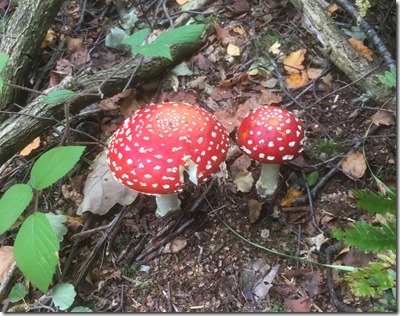
Fly Agaric

Many of us associate autumn not just with colourful tree leaves but also with fungi. The autumn colours we see in the UK are often due to non-native trees e.g. Maples. Since Cleaver is primarily a Lowland Heath habitat, with only a limited amount of native woodland, we don’t expect to have spectacular autumn colour displays. However, like others who have walked around the Cleaver paths from September onwards, I have instead been enjoying the displays of colourful fungi.

Fly Agaric

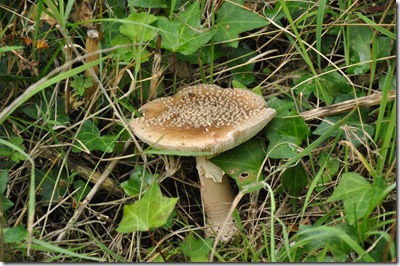
Most of us are familiar with Fly Agaric (Amanita muscaria). When the fruits first emerge they have orange or red hemispherical caps which then flatten out as they grow. These are still showing along many of the woodland paths segments. I have also spotted examples of another member of the Amanita genus, commonly known as a species of Blusher (Amanita rubescens). This also has white spots, but on a less threatening grey background. The development of its cap follows a similar pattern.

Blusher (Amanita rubescens)

Blusher (Amanita rubescens)

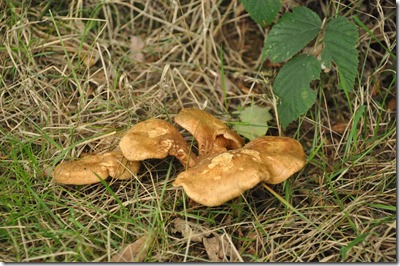
There have been plenty of fine examples of False Chanterelle (Hygrophoropsis aurantiaca). The example below seems to have developed in four segments.

False Chanterelle (Hygrophoropsis aurantiaca)

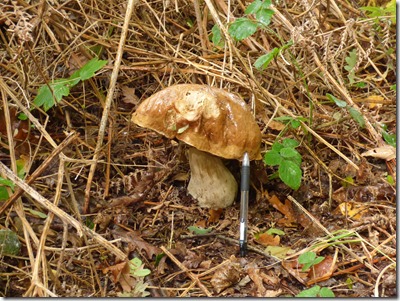
I am told they are very sensitive to nearby plants. Even a blade of grass flapping against the cap edge can lead to permanent deformation. I am not sufficiently confident of identifying edible to test my judgements. However, this large toadstool shown below (next to a ballpoint pen for scale) has as one of its common names Penny Bun and is commonly eaten. In Tesco, it would be called a porcini and you would get charged more than a penny. It is Boletus edulis.

Penny Bun (Boletus edulis)

I had occasion to seek help from Trust staff when a mature birch, attacked by fungus at the base of the trunk, fell across one of our paths in an October gale. The trunk structure had been damaged by a Southern Bracket fungus (Ganoderma australe).

Southern Bracket fungus (Ganoderma australe)

The Aminita fungi shown above get their nourishment from the soil, particularly in rich woodland soil. Bracket fungi like this one get their food from trees and in so doing, turn the fibres into a mush. The layers on this bracket count the number of years it has lived. When the food runs out the underside turns white as shown below.

Southern Bracket fungus (Ganoderma australe)

The birch seen here then tipped over. We didn’t even need a chain saw to complete the job. My helpful Trust staff member Kevin, used his superior strength to push it all the way down into a safe place.

Not all fungi are harmful to plants. In fact, it is quite the reverse for many of them. I am looking forward to the November Wirral Wildlife talk which will be all about Symbiotic Mycorrhizal Fungi. Large classes of plants benefit from such fungi which facilitate the absorption of soil nutrients via their root systems. The plant gets minerals from the soil and the fungi get sugars and carbohydrates from the plant. Such fungi are also important in helping with plant to plant communication. Trees find out if there is some threat on the way. Fungi are not nearly as well understood as most other life forms. They are quite fascinating. Next time you walk in the reserve think about all the activity going on in the soil under your feet – all year round, not just in autumn.

Alan Irving
Volunteer Reserve Warden for CWT
Cleaver Heath

November 2018