Showing posts with label recording. Show all posts

Friday, 23 January 2026

2025 Butterfly Recording Results at New Ferry Butterfly Park

Peacock butterfly
Peacock butterfly

With great pleasure, we would like to share with you the information on butterflies we recorded in our transect walks between April and September 2025 at New Ferry Butterfly Park. 

Small Copper butterfly

2025 was a good year for butterflies thanks to the dry and sunny weather: we recorded 1151 individual butterflies, contrasting 553 in 2024! Almost all the species did well: in particular, Green-veined White, Common Blue, Peacock and Gatekeeper, followed by Speckled Wood, Large White, Holly Blue, Red Admiral, Comma, Meadow Brown, and Ringlet. Even some that are historically rare increased in number too: 8 Small Coppers (3 in 2024), and 5 Dingy Skippers during one walk (2 in 2024 in two sperate walks). 

Orange Tip butterfly

The species whose number remained more or less the same between 2024 and 2025 were Small Skipper, Essex Skipper, Painted Lady, and Small Tortoiseshell, while there was a fall in Orange Tip (from 23 to 11), and Small White (from 123 to 78).

Brimstone butterfly
Brimstone butterfly

Brimstone butterflies have always been a steady and pleasant sighting for visitors in the Park.  Strangely their number in 2025 was less spectacular: we only recorded 47, in contrast with 53 the year before. The good news is that we saw quite a few Brimstone butterfly eggs and caterpillars in 2025 on Alder Buckthorn (their favourite food plant). Fingers crossed there will be more in the next recording season.

A Brimstone caterpillar

2025 saw us gratefully receiving exclusive personal training in the Park from Dave Costello and Eric Davies, whose superb photos made their way to the Butterfly Park's Facebook page. Thank you both for your support!  Our thanks also go to Claire Lyon and Paul Loughnane who stepped in when we were away, which made 26 out of 26 walks during the recording season.

Finally, we wish all the very best to all of you for a fantastic 2026!


Yan and Charles

(Photos by Roy Lowry, taken at New Ferry Butterfly Park)


Friday, 3 October 2025

Recorders at Red Rocks


Recorders from Wirral Wildlife and the Cheshire branch of
Botanical Society of Britain and Ireland at Red Rocks


Wirral Wildlife’s recording team have been busy all summer recording wildlife - mostly plants and fungi, with some insects and other animals where we have the knowledge! 

The photo above shows our largest event - a joint meeting with the Cheshire branch of Botanical Society of Britain and Ireland (BSBI) at Red Rocks nature reserve. Plenty of expert botanists were on hand to instruct our newer recorders, and a large reserve to explore. Most places have to be done with much smaller groups.

This year's sites have included Thornton Wood in Dibbinsdale, Chester Zoo nature reserve, continuing work on Prenton Dell Claypit, and Thurstaston Common monitoring.

Most plants are moving into winter state now, and most invertebrates are in hibernation, so the group are busy writing up the records and putting them to use in management plans and guidance to land managers. However, anyone who wants to get out and about - our colleagues the birders will be busy all winter counting the thousands of birds on our estuaries. They always welcome new people.


Wednesday, 23 October 2024

Butterfly Transects at New Ferry Butterfly Park - 2024

Small tortoiseshell
Small tortoiseshell

September marks the end of the butterfly transect recording season by UKBMS (UK Butterfly Monitoring Scheme). Generally, a transect is a site of butterfly habitat, and a method to monitor the changes of butterfly abundance and variety over the years. The data from each transect is incorporated into the national database, evidencing how well each butterfly species is faring in terms of number and distribution. This in turn informs conservation strategies.

Comma
Comma

This year at NFBP (New Ferry Butterfly Park) transect, we recorded 20 butterfly species and 553 individuals. Delightfully, Brimstone (53), Small White (123), Speckled Wood (100), Large White (45) and Orange Tip (23) were doing well and scored higher than last year. We were very pleased to see some species absent in the Park in the past turned up this year: Small Tortoiseshell (5), Painted Lady (1) and the rarity Ringlet (2). Dingy Skipper (2) was still hanging on in small numbers. Sadly, Holly Blue (11), Common Blue (18), Comma (19) and Gatekeeper (19) scored lower than last year, and no Small Coppers at all throughout the season.

Dingy skipper
Dingy skipper

As transect recorders we carry out weekly walks for 26 weeks between April and September. Following a pre-determined route and walking at a steady and slow pace, we scan the area and record the butterflies we see.

Brimstone

Butterflies use sunlight to warm up their flying muscles. Therefore, transect walks need to be done during daytime between 10.45am and 3.45pm and under suitable weather conditions to maximising the sighting of butterflies. Recording is avoided if it is raining, too cloudy, too cold, and too windy. When the weather become more unpredictable (like this year), a recorder needs to check the weather forecast and grab the first suitable opportunity to do the job. 

Common blue
Common blue

Needless to say, identification skills are crucial to accurately record each butterfly species. This can be challenging and frustrating, particularly when butterflies are in flight. Having a butterfly guidebook can help to recognise different species, and understand their habitats, flight times, and behaviours. Field trips with an expert is an excellent way to learn. Fortunately, during our “formative” years in butterflies, we had the support from Kathryn Fegan and Dave Costello (Butterfly Conservation Society) at Hoylake Willows transect in 2023, and Pat Thurston at NFBP in 2024. We are ever grateful for their help. Next year, we will carry on the transect walks together - two pairs of eyes are better than one!

Small white
Small white

Learning butterflies (or any other wildlife species) gets people closer to nature and can be very rewarding.  At NFBP, butterfly ID sheets are available for visitors, and wardens are there to help whenever they can. We look forward to meeting more butterfly enthusiasts in the new season!

Ringlet
Ringlet


Blog article: Yan and Charles

Photos: Roy Lowry

Wednesday, 4 January 2023

Invertebrate Recording at New Ferry Butterfly Park

Thanks again to Roy Lowry who has sent us another great report, illustrated by his photographs. This time he explains his recording process using photographs to identify the invertebrates he finds at New Ferry Butterfly Park.


Anybody involved in the management of a nature reserve needs to know the species of insect that live there and how this list changes from season to season and from year to year. During 2022 I aimed to provide this information for New Ferry Butterfly Park through regular photo-recording surveys. These involve walking around the reserve photographing every insect I see. Date and time of each photograph are automatically recorded by the camera together with high-accuracy positions (if needed) from a Bluetooth-connected phone. Back home the insects are identified, and the observations recorded on either iRecord or iNaturalist.

Of course, the hardest part of this is identification of the observation subjects from the photographs, which need to show the critical identification features of the specimen at high magnification and in perfect focus. Frequently, this requires several photographic viewpoints. The two problems here are knowing the viewpoints required and persuading the subject insect to allow those viewpoints to be accessed. Even something as straightforward as a face shot can require a lot of patience. Sometimes, things come good such in Photo 1 below. Here, a female common flower fly (Syrphus ribesii) is displaying her ’hairy armpits’, well-separated eyes and all-yellow hind femur in a single shot facilitating confident identification to species level.


Photo 1: Female common flower fly (Syrphus ribesii)


However, quite often the result is like Photo 2 where a male Syrphus manages to hide his hind femur under his wing and the photo quality is insufficient to show whether the eyes are hairy. Consequently, identification is only possible to genus level.


Photo 2: Male Syrphus sp.

This surveying method has both advantages and disadvantages. The main disadvantages are selective sampling and the identification uncertainties. Sampling is selective because the only invertebrates recorded are those that I can photograph. Coverage is good for flying insects, especially those that visit flowers but most crawling insects such as beetles and bugs spend most of their time out of sight. The problem can be overcome by sweeping nets through the vegetation or by beating bushes with sticks whilst holding a large net underneath. The catch is transferred into plastic pots where they can be identified using a hand lens or photographed. I have tried photographing insects in pots, but the results have been poor quality as the subjects rarely sit still and the pots aren’t perfectly clear. I have thought of building a field studio – a box with a glass front holding insect perches – so that specimens can be released from the pots and better-quality photos obtained using a macro flash setup. I may try a few experiments during 2023.

The identification uncertainty can be reduced by catching specimens, killing them, mounting them, and examining them under a microscope. Facilities for examination, including an extensive collection of identified specimens for comparison, are provided by the Tanyptera project at Liverpool World Museum. For even greater identification certainty samples from specimens may be used for DNA barcoding, but this is expensive and would only be used in circumstances such as confirmation of a rare find. As a photographer rather than a zoologist I prefer not to harm my subjects.

The advantages of photo-recording are its speed, the resulting by-product, and the lack of damage caused to both subjects and their environment. Speed means that the Butterfly Park can be surveyed in about an hour, making weekly or more frequent surveys possible. Such frequency catches both seasonal changes in the fauna and transient species passing through the reserve. The survey by-product is an ever-increasing photo-library of the Butterfly Park and its invertebrates that has been organised into OneDrive folders which are available to those who can make use of them for research or illustration. Over 600 images of varying quality were added during 2022. Photo 3 was one of my favourites showing a dingy skipper butterfly (Erynnis tages) in a visually interesting setting.


Photo 3: Dingy skipper butterfly (Erynnis tages)

I plan to continue the surveys through 2023 and will try to take a fixed set of wide-angle views of the Butterfly Park at monthly intervals, as I do on Chester Zoo Nature Reserve, to show how it looks through the seasons.

All photographs were taken by me in New Ferry Butterfly Park during 2022 and are published under cc-by licence.


Roy Lowry


Monday, 21 November 2022

Cleaver Heath Invertebrate Survey


Cleaver Heath and some of the invertebrates recorded on 6th July. Photos: The Tanyptera Trust
Cleaver Heath and some of the invertebrates recorded on 6th July.
Photos: The Tanyptera Trust

The Tanyptera Trust is funding a 7.5 year project to promote the study and conservation of insects and other invertebrates in the Lancashire and Cheshire region of NW England. This project is hosted by National Museums Liverpool. Every year, the Trust runs an invertebrate recording day programme to bring together the invert recording community and increase the coverage of invert records on selected important and under-recorded sites.

On July 6th this year, the Trust organised a recording day at Cleaver Heath on the Wirral and a detailed species list obtained has recently been published and can be viewed on their website.

https://www.northwestinvertebrates.org.uk/cleaver-heath/


Summary of number of species by invertebrate order

48 species of spider (Araneae)

51 species of beetle (Coleoptera)

92 species of fly (Diptera)

38 species of true bug (Hemiptera)

18 species of bee/wasp/ant (Hymenoptera)

15 species of butterfly/moth (Lepidoptera)

2 species of centipede (Lithobiomorpha)

2 species of lacewing (Neuroptera)

1 species of harvestman (Opiliones)

1 species of grasshopper(Orthoptera)

1 species of booklouse (Psocoptera)


Notable records in terms of scarcity

Two flies, Helina ciliatocosta and Dolichopus virgultorum - New to VC58 (Cheshire)

A spider, Cheiracanthium virescens - Nationally scarce, only 3rd record for VC58 (Cheshire). On heathland, favours areas with short heather growth.

A true bug Alydus calcaratus  - Nationally scarce.  Very local distribution in the North West, only 3rd record for VC 58 (Cheshire),  one previous Wirral record on Thurstaston Common and  recorded on Cleaver this year prior to this event. Nymphs are ant-mimics and are often found in ant nests.

There were also six separate records of the impressive Emperor moth caterpillars (Saturnia pavonia) on heather and other plants.


Overall a very impressive list of species for a single recording day. Looking through the list, inverts associated with all the main vegetation types such as heather, gorse, wild flowers and birch/oak are evident as well as those found in the ground/litter layer. The former car park, now a nectar-rich wildflower area, was of particular interest for hoverflies and butterflies.

As a general rule regarding the management of lowland heathland for invertebrates, structural diversity across all the vegetation is important to support the greatest range of species and included in this would be the need to create and maintain a range of different age structures within the dominant plant species. These objectives are well accounted for within the Cleaver management plan and are also reflected practically in the work day tasks carried out by the volunteers.


John McGaw, Cleaver Heath Reserve Manager

Friday, 22 July 2022

Royal Society of Biology Medal for Botanist Eric Greenwood


Eric Greenwood, with his wife Barbara, in their garden at the presentation of the medal from the Royal Society of Biology
Eric Greenwood, with his wife Barbara, in their garden
at the presentation of the President's Medal from the Royal Society of Biology


Eric Greenwood CBiol, FRSB has been presented with the President’s Medal of the Royal Society of Biology. He was awarded the Medal in 2020 in recognition of his work with the local RSB branch, but was unable to receive it due to Covid restrictions. However at a recent happy event in his Heswall garden, Eric was presented with the Medal by members of the North Western branch of the RSB surrounded by friends and family.


Back row, L - R: Jean Wilson (RSB), Dr Alan Bedford (RSB), Chippy Wielopolska, Dr Hugh McAlister, Mike Clapham (RSB), Stephen Ross, Robert Freath, Dr Hilary Ash, Dr Thomas Evans (son-in-law). Front row, L - R: Barbara Greenwood, Eric Greenwood, Dr Emma Greenwood (daughter). Photo: Lesley Sutherland.

Back row, L - R: Jean Wilson (RSB), Dr Alan Bedford (RSB), Chippy Wielopolska, Dr Hugh McAlister, Mike Clapham (RSB), Stephen Ross, Robert Freath, Dr Hilary Ash, Dr Thomas Evans (son-in-law).
Front row, L - R: Barbara Greenwood, Eric Greenwood, Dr Emma Greenwood (daughter).
Photo: Lesley Sutherland.


Eric was Keeper of Botany at the Liverpool Museum, becoming Keeper of the World Museum Liverpool. He was largely responsible for securing the large Lottery grant to enable the Museum’s major redevelopment, before retiring in 1998. He was responsible for setting up the North West Biological Field Data Bank ensuring that local naturalists’ records did not get lost. This eventually led to Record and Mersey Biobank, who today do the same work electronically, and pass records to the National Biodiversity Network. Eric is the author of Hunting Plants and Flora of North Lancashire, the latter being an accumulation of systemic survey work of the region’s plants over the course of 46 years.


Eric's President’s Medal from the Royal Society of Biology

Following retirement, Eric remains an active member of the botanical community, even though he has retired as the Botanical Society of Britain and Ireland’s vice-county recorder for VC60 (West Lancaster). He has acted as botanical advisor to Wirral Wildlife’s recording team for years, identifying difficult plants especially grasses, sedges and orchids. He is still doing much botanising in Wirral, finding new plants and re-finding old records.


The other side of Eric's Medal

Eric was nominated by Jean Wilson MBE CBiol FRSB, current vice chair of the North Western branch of the RSB. She commented: “I would describe Eric as a gentleman biologist, always polite and completely professional. He is still passionate and committed to the natural world, and is a man for whom I have the greatest respect.”


Professor Sir Ian Boyd FRSB, President of the RSB writes: “I want to offer you my sincere congratulations on your award and to thank you for your hard work over many years’ association with the North Western branch, and for your extremely long-term Fellowship support over many years. Your significant contribution to the Society is very much appreciated and I hope that this is reflected in the award of your President’s Medal”.


Thursday, 16 June 2022

A Most Unusual Visitor to New Ferry Butterfly Park


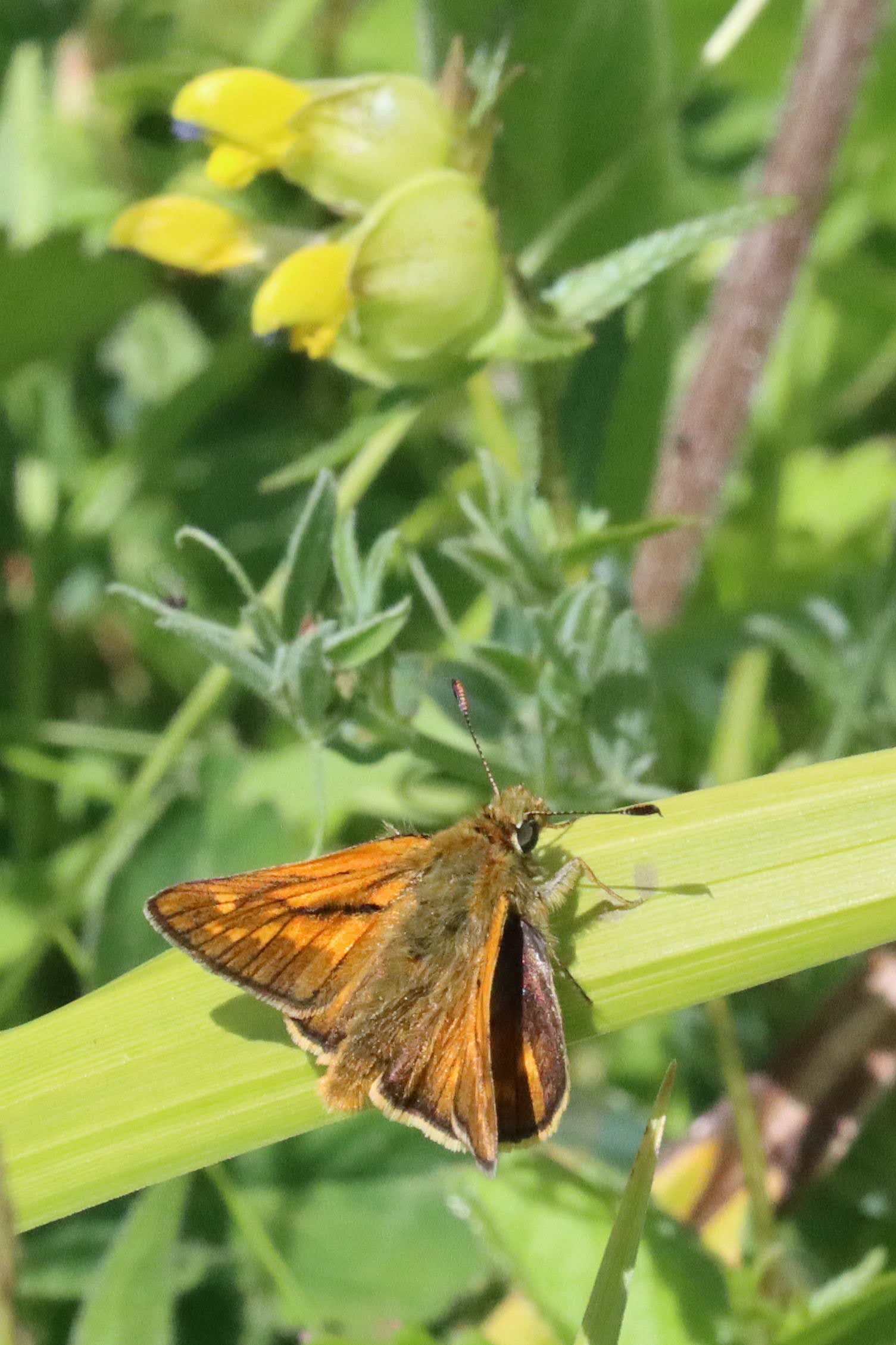
Large skipper at New Ferry Butterfly Park. Photo: Roy Lowry
Large skipper at New Ferry Butterfly Park.
Photo: Roy Lowry

On the morning of Sunday 12th June Roy Lowry came down to New Ferry Butterfly Park with his camera.

He managed to spot and photograph the first Large Skipper butterfly of the season.


Locust blowfly, a new visitor to the Butterfly Park.
Photo: Roy Lowry

His most unusual photograph was of a fly which struck him as very different. Roy thought he recognized it as a locust blowfly - an African species that has been reported more frequently in recent years as a vagrant in the south of England.  One was seen in Southport in 2020. It did indeed turn out to be a correct identification so this is definitely a first at the Butterfly Park.

Thanks Roy for your keen observation and excellent photos.


Friday, 6 May 2022

Two New Sets of Wings for Butterfly Park


The Silver Jubilee gates at New Ferry Butterfly Park


New Ferry Butterfly Park celebrated the 27th open season to the public with the unveiling of the Silver Jubilee entrance gates. Delayed due to the pandemic, these are to celebrate the first 25 years of the park being open to the public.


A reminder of the old gates at the Butterfly Park. Quite the transformation!
A reminder of the old gates at the Butterfly Park.
Quite the transformation!

The spectacular gates were opened by Her Majesty’s Lord Lieutenant of Merseyside, Mr Mark Blundell, who said “New Ferry faces the many challenges of an inner-city area and this was compounded further by the explosion of March 2017 which destroyed a third of the main precinct. The Butterfly Park is seen as an emblem of hope and re-birth, in fact New Ferry sees itself as a butterfly town, with #Love New Ferry graffiti art by the former Co-op and the “I love New Ferry stickers in the shops” both with a butterfly theme. These spectacular gates will help secure the site and offer the opportunity to provide a welcoming entrance and celebrate the continued success of New Ferry Butterfly Park.”


The gates being opened by Her Majesty’s Lord Lieutenant of Merseyside, Mr Mark Blundell
The gates being opened by
Her Majesty’s Lord Lieutenant of Merseyside, Mr Mark Blundell

The Lord Lieutenant and his wife Suzanne were given an hour tour of the park and took an interest in the environmental stalls, especially the spider stall. The Lord Lieutenant immersed himself fully in the activities and wanted to make a fruit smoothie drink for his wife and himself using a cycle powered blender to chop up the fruit of her choice. No mean feat when you have a sword to steady as you pedal. Who says chivalry is dead!


The Lord Lieutenant of Merseyside making a bicycle-powered smoothie

Nearly a thousand guests enjoyed the day at the park amongst the stalls, wildlife and refreshments.

Stalls at the Open Day at the Butterfly Park

Under the gazebo at the Open Day


Visitors at the Open Day


These gates have been the Park committee’s most ambitious project to date with support from a broad range of sources: a legacy from the late Frank Cottrell who was instrumental in getting Cheshire Wildlife Trust to take on board New Ferry Butterfly Park, an online Crowdfunder appeal, Wirral Borough Council, Wirral Wildlife, Wirral Farmers’ Market Community Fund, Poulton Hall Walled Garden Trust and the largest part by The Duchy of Lancaster Benevolent Fund i.e. Her Majesty The Queen.

Edd Snell, the designer of the gates, who engaged the various contractors to make this bespoke and functional art work said “It has been a pleasure to be part of this project. I am extremely pleased with the entrance gates, they are vibrant, welcoming, and interpretative and do exactly what we set out to achieve. I hope the gates help create a warm welcome to the park and encourage more people to visit, volunteer and experience the wonderful offer here. It was an ambitious project and only possible with the dedication of volunteers at the Park and the skilled workforce of Flintshire Fabrication and Dunkil Developments.” The gates were carefully painted by Carol and Ian Ramsay who added their own inspired signature of the stripped antennae.


Dingy skipper, photographed at the Butterfly Park by Roy Lowry

As well as the fresh comma wings on the gate, another new set of wings seen at the park this week was a Dingy Skipper Butterfly, which has not been seen at the park for over two decades. This is a great endorsement of our habitat management for butterflies at the park. What could be better! Come to the park, have your photograph taken by the Silver Jubilee Gates and see what wildlife you can spot. We are still spotting new creatures 29 years on from starting to manage the site.

The park is now open every Sunday, 12noon to 4pm, until Sunday 11th September. Please come and enjoy the park’s wildlife at a more tranquil pace (and maybe spot a dingy skipper!). The Wirral Wildlife plant sale continues weekly whilst stocks last and new stocks are being propagated.

Monday, 18 April 2022

Take part in the 2022 City Nature Challenge


City Nature Challenge 2022


Friday 29th April to Monday 2nd May

Help put our region on the map in this global nature recording event.

Record your wildlife sightings at any location of your choosing using your phone and the iNaturalist app. Don't worry if you're not sure of the species, other observers will help with ID from your photos.

RECORD are running drop in events, with 2 taking place in Wirral


RECORD are running two events in Wirral to help you get involved. Drop in to find out how you can be part of this amazing international Citizen Science project.


Saturday 30th April
10am - 3pm
Port Sunlight River Park


Sessions all day: Take part in a bug hunt.
11am: Beginners birdwatching walk (meet at the cafe)
2pm: Plant Detectives Walk (meet at the cafe)


Monday 2nd May
10am - 3pm
Wirral Country Park, Thurstaston


Sessions all day: Take part in a bug hunt.
11am: Beginners birdwatching walk (meet outside the visitor centre)


How to take part in the City Nature Challenge and upload your sightings to iNaturalist
How to take part in the City Nature Challenge
and upload your sightings to iNaturalist


Find out more about these events and how to add your sightings to the Liverpool CIty Region iNaturalist results on the RECORD website:

Wednesday, 23 June 2021

Heswall Dales Local Nature Reserve


Alan Irving (Reserve Manager for Cleaver Heath) recently wrote an article about Heswall Dales for RECORD to put in their newsletter.


Heswall Dales Local Nature Reserve
Heswall Dales


Heswall Dales Local Nature Reserve (LNR) is owned and managed by Wirral Borough Council and forms part of the Heswall Dales SSSI (Site of Specific Scientific Interest). Access is from Oldfield Road, Heswall CH60 6SN (SJ 2595 8242) where there is a notice about both Heswall Dales LNR and Dale Farm. The nearest parking is on Oldfield Road itself. The Friends of Heswall Dales website contains information about what can been seen there. You can find maps both for locating the reserve and for navigating the main paths. Look particularly at the ‘Your Visit’ page where there is a season-by-season guide to flora and fauna.

The main Dales LNR occupies 70 acres of which some 50 are classified as lowland heath. It overlooks the Dee Estuary and is popular with local residents, particularly dog-walkers, who are encouraged to stick to the main paths. Thus there is quite a lot of undisturbed habitat for recording purposes which, conversely, means access to the dedicated recorder can be quite challenging, requiring stout footwear and thorn-proof clothing. As well as attractive heather, Western gorse (Ulex galli) and Bilberry (Vaccinium myrtillus) panels, there are sandstone outcrops, dense scrub areas and birch/oak woodland. The Council web page also contains a copy of the Dales Management Plan. Amongst other things, this contains an overview of the physical characteristics of the Dales and the SSSI citation.


Botanical surveying taking place at Heswall Dales


Botanical surveys of the SSSI are conducted on a 10-year cycle, the last one of which was in 2020. In these, non-plant species are not systematically recorded but only as occasional observations. A small area near the Bush Way entrance (south-east corner) is designated as a Site of Biological Importance.

Complete species bird counts over a fixed route along the main paths have been conducted throughout 2020, yielding some 50+ species. These have been logged using the BTO BirdTrack system. In the breeding season there is plenty of activity by the visiting warblers, and in the winter, Woodcock (Scolopax rusticola) are known to be hiding out and are occasionally flushed during conservation work. Various raptors are found all year round including Sparrowhawks (Accipiter nisus), Tawny owls (Strix aluco), Kestrels (Falco tinnunculus) and Buzzards (Buteo buteo), which make use of the healthy small mammal populations. Other mammals known to be present are Red foxes (Vulpes vulpes), Badgers (Meles meles) and bats about which little is known. Local birders fondly remember the Dartford warbler (Curruca undata) found once in the Dales leading to traffic jams in Heswall, so one never knows what might show up.


Views of heathland and woodland at Heswall Dales


It is not well known how much other recording has been done historically, so there is plenty of scope for further work. We are particularly keen to find out more about invertebrates of all kinds, including butterflies, moths and beetles. The heather is thought to be rich in spider species and merits a proper survey.

For more information about the latest state of recording and further local advice, check with the Friends of Heswall Dales (see their website for contact details) and the Ranger
The reserve is open 24/7 all year round.

Wednesday, 7 April 2021

50 Years of Wirral Wildlife


In the early days of the Cheshire Conservation Trust (how Cheshire Wildlife Trust was originally known), Wirral group was part of the West group based in Chester. Sixty members living in Wirral were needed before the Group could become autonomous. That happened at a meeting at Bebington Oval on 7th April 1971. We now have over 2250 members.

The original committee consisted of Chairman Major Frank White, Margaret Gilmour, Henry Larsen, Nora MacMillan (Mrs Mac), David Mills, Jane Ratcliffe, Richard Smith and Graham Taylor.

The group manned two caravans each summer weekend, one at Thurstaston Visitor Centre and one at Eastham Country Park and meetings were held at a variety of venues. Jim Gilmour, a previous Secretary to the committee, remembered passing a queue waiting for our jumble sale in Liscard and hearing a woman wondering what a ‘Conversation Trust’ actually did. After Wirral became part of Merseyside in 1974 we changed our name to Wirral Wildlife.

We had little base data on species distribution in 1971 – an essential pre-requisite of conservation action. Recording of species in Sites of Special Scientific Interest (SSSIs) and Local Wildlife Sites has been carried out regularly since then. The information accumulated by our recorders has been of value to the Planning Department and Ranger Service. Our records and plans have been incorporated into management plans and used to obtain grants. They have enabled us to contribute knowledgeably to Council initiatives like the Local Plan and make recommendations when we scrutinise planning applications for their impact on wildlife.

We are now involved with six Wirral nature reserves and practical work is led by honorary wardens and teams of volunteers. Our urban reserve, New Ferry Butterfly Park, celebrated being open to the public for 25 years in 2020.


A busy day at New Ferry Butterfly Park


We have also created a programme of talks and guided walks open to the public. Monthly talks from September to April are held in Heswall Hall and feature a wide range of speakers.  In the summer guided walks include a (very early) Dawn Chorus and a bluebell walk.  Each autumn we hold an Apple Day at Eastham Country Park where visitors can taste locally grown varieties of apples and help to make juice using our traditional wooden apple press. Our group also attends events like Science Day at Ness Gardens, Ness Children’s Day and Science under the Stars.


Our display at Ness Science Day


None of these things would be possible without a dedicated team who form the Wirral Wildlife committee and the host of volunteers who help out in so many different ways. We value their support and we are all committed to a Wirral richer in wildlife.


Science Under The Stars


We are currently considering what we can do to celebrate this 50 year milestone. For our 40th anniversary we met in November at Brotherton Park, Dibbinsdale and planted two native black poplars.

Tree planting at Dibbinsdale to mark our 40th Anniversary


When the newly formed committee left the Oval in April 1971 they could have had no idea of how the world would change. In 2017 we were awarded the Queens Award for Voluntary Service in recognition of the impact the group has had in protecting nature in Wirral. Our aim is to inspire, inform, educate and encourage people to protect nature in Wirral – values that were as true in 1971 as they are today.


Acknowledgment: most of the early information was taken from an article written by Jim Gilmour for our 40th anniversary.


Friday, 27 November 2020

Help Wanted To Plan Our Wildlife Survey Programme


A quadrat at Thurstaston Common, one of the sites we survey
A quadrat at Thurstaston Common, one of the sites we survey.


Help needed! One of the key activities of local naturalists is the surveying and monitoring of local wildlife. Here in Wirral some of this is undertaken and managed by the Wirral Wildlife group. We are lucky to have many sites of special wildlife interest in the Wirral and need to monitor how they are doing over the years. This lets us spot any changes including new species and losses of biological diversity in our area.

We need someone to help our team with the planning and management of our ongoing program of surveys and recording. All our records contribute to national wildlife recording databases which are key to preserving our wildlife for future generations. The task is not onerous but does require some basic computing skill, as records are now all held electronically. Most of the work is January - March each year as the surveys are planned.

If you think you may be able to help us with this important aspect of our work for local wildlife please contact Hilary, Margaret and Ron via email info@wirralwildlife.org.uk or ring Hilary on 0151 327 5923.


Friday, 2 October 2020

Socially Distanced Surveying at Thurstaston Common


Belinda and Natasha with a quadrat taped up at Thurstaston Common


Just before restrictions tightened in Wirral again, we managed to get the Thurstaston Common annual monitoring done. This is its 39th year for the oldest 5 quadrats. Wirral Wildlife recorders have been doing the monitoring since 1992. The results are currently being analysed by Prof Rob Marrs. The quadrats measure 5m x 5m, so social distancing is easy!


If you find a metal bar sticking out of the ground on Thurstaston Common - please leave it alone, it is probably marking one of the 12 quadrats!

Thursday, 20 August 2020

Surveying Heswall Dales


Hilary Ash surveying the heathland at Heswall Dales

Recording teams from Wirral Wildlife, led by Dr Hilary Ash, have just spent three, mostly enjoyable, days on a major botanical survey of Heswall Dales. The recording group make a point of surveying all SSSI sites on Wirral on a 10-year cycle. The idea is to keep track of all species growing there, with particular attention to the features listed in the SSSI citation. In the case of Heswall Dales, the main features relate to its Lowland Heath characteristics.

At this time of year one sees a beautiful palette of colours: the light pink is the Common Heather, the yellow is Western Gorse in bloom and the deep purples and browns are the Bell Heather now moving into the seeding stage. This was a real treat for us. The weather was wonderful on the first day, so the only real hardship was cutting our way through encroaching scrub to reveal these lovely panels and wading through the mostly healthy and vigorous heather and compact western gorse.


Part of our duties was to assess the level of scrub encroachment and so identify scrub control priorities to help with site management. For reporting purposes, the entire site of some 50 acres or so of heathland was divided up into compartments where complete lists of species were recorded along with estimates of relative abundance.  In the case of the heather we also noted the condition and age structure, again with a view to site management. The data and associated notes will be made available to the land owner, in this case Wirral Borough Council, as well as Natural England who are entrusted with monitoring the status of sites with special designations.


Interesting finds at Heswall Dales

The woodland areas will be surveyed next spring when the bracken has died back and the woodland plants start to bloom making identification easier. While on the heathland survey, we also noted down anything interesting we happened to come across, for example: birds, bees, dragonflies, butterflies, lizards, lichens and fungi. The young lizard pictured above was discovered hiding in a bag the day after the survey was completed when bracken pulling restarted in the Dales. There seems be lots of interesting stuff around in Heswall Dales just waiting to be discovered. Overall, the impression of the heathland was that quite a lot of it is in a very healthy state but a lot of management effort is needed both to protect these areas and to reduce the rate of further succession into scrub of the heathland fringes.