Showing posts with label heathland. Show all posts

Friday, 26 June 2026

Cleaver Heath Update

John McGaw is the Volunteer Warden at our Cleaver Heath nature reserve in Heswall and passed on some good news.

He has seen significant growth of new heather seedlings across the burnt areas of Cleaver recently, following the fire in August last year.

https://wirralwildlife.blogspot.com/2025/09/green-shoots-at-cleaver-heath-following.html
Heather seedlings on burnt ground

There is also some new heather growth within the experimental regeneration area that was cleared by contractors last year (reported on February 4th).

Heather regeneration

Let's hope the new heather can compete successfully with the birch and gorse seedlings which are unfortunately also growing vigorously!

Cleaver Heath was also a focal point at Cool Heswall in May. John had a selection of plants that grow at Cleaver Heath to show visitors. 

Heathland plants found on the reserve, as seen at Cool Heswall

He also took some Cleaver Heath spiders along!


Wednesday, 4 February 2026

Cleaver Heath 2025 - An Eventful Year

Two significant events occurred at Cleaver Heath during 2025 that largely determined the nature of the work carried out by the volunteers during the year. Firstly the contractor led heathland restoration project which was part-funded by a very generous grant from Woodchurch High School and which was carried out in February and secondly, the fire which severely damaged the main heather panels during August.

For the restoration project, an area approximately 0.25 hectare in size within the southern part of the reserve that had been covered in bracken and gorse with some birch and very little heather present, was cleared of vegetation to ground level by specialized contractors. After this initial scrape, the plan was for the volunteers to clear regenerating scrub, monitor any existing heather regrowth and spread heather seed collected from other areas of the reserve over the site later in the year to encourage new heather growth.

Contractors working on site at Cleaver Heath

More machinery to help clear the ground for heather regeneration

Although the contractor scraping had removed a significant amount of bracken rhizome, much still remained deeper in the soil and initial volunteer work during March involved digging out and removing as much of the dense underground rhizome network as possible.

Volunteers clearing bracken rhizome

Bracken rhizome
Bracken rhizome

During April and May, sprouting gorse stumps and the first young unfurling bracken fronds from the remaining rhizomes were removed. Further clearance work continued monthly throughout the summer dealing with even more bracken pulling and rosebay willow herb, birch, oak, bramble and fresh gorse seedling removal. A few pioneer stage heather plants were observed.

Removal of gorse stumps using tree-poppers

Uprooted gorse seedlings

In October, seed-containing heather shoots were harvested from other areas of the reserve and spread across the cleared restoration site. Germination and growth of the new heather will be monitored while continuing to keep the site clear of unwanted scrub regrowth.

Fresh heather shoots spread over the restoration area

Heather seeds
Heather seeds

The second main but very much unwanted event of the year occurred during August when after many weeks of hot dry weather, significant areas of the heath were severely damaged by fire.

Fire damage at Cleaver Heath

An extensive area of heather was burnt

Remarkably within a couple of months, fresh regrowth of vegetation was apparent across the blackened surfaces. Initially purple moor grass tussocks sprouted followed by other grasses, rosebay willow herb, extensive coverage of germinating gorse seedlings and some bracken.

Regrowth of grasses along edge of footpath

Rosebay Willowherb regrowth

Volunteers are working to control this regrowth to prevent the return of excessive amounts of scrub and invasive species and allow for the hopeful germination of existing heather seed and the growth of underground heather shoots already in the soil They are also cutting down and removing large blackened gorse bushes especially within the lower slopes of the reserve.

Volunteers scraping out surface regrowth

Blackened gorse
Blackened gorse

One undesirable effect of the fire was to totally remove a significant area of the surface vegetation within the lower heathland slopes thus allowing easy access to this previously inaccessible area for visitors and their dogs. In order to limit this access we have constructed a dead hedge along the edge of the main public footpath which together with some appropriate signage will explain to members of the public why it is important to keep off the burnt areas to encourage the natural recovery of important plants and animals.

Thanks are due to both the Wirral Wildlife and Cheshire Wildlife Trust volunteers who together with Graham Borden-Long, Living Landscape Officer at CWT, have worked hard throughout the year to progress the restoration project and deal with the aftermath of the fire.

John McGaw
Volunteer Reserve Warden Cleaver Heath


Sunday, 16 February 2025

Cleaver Heath Regeneration Project

Nationally, lowland heathland is a well known type of habitat occurring on acid sandy or peaty soils of low fertility. It is characterised by the presence of a range of plant species such as heather, gorse and bracken together with scattered trees such as birch, oak and pine and mosses, lichens and grasses. In prime condition it is also home to a wide range of both vertebrate and invertebrate animals.

Heathland is one of our most threatened habitats and by 1997 Britain had lost 60% of it's lowland heath, mainly to agriculture and construction. Locally on Wirral, heathland is restricted to areas such as Cleaver Heath, Heswall Dales and Thurstaston Common.

Lowland heathland habitats are typically relatively fragile and susceptible to succession by woodland trees or bracken which out compete and smother plants such as heather. At Cleaver Heath, this situation is exacerbated by the fact that the open lowland heathland habitat is surrounded by silver/downy birch dominated woodland with a ground flora dominated by bracken. Management work at Cleaver carried out mainly by volunteers, involves controlling birch, gorse and bracken growth in the areas dominated by heather, so preventing succession to dense scrub and woodland.

The site at Cleaver Heath before the gorse, bracken and birch were cleared (photo: Ben Patterson)
The site at Cleaver Heath before the gorse, bracken and birch were cleared
(photo: Ben Patterson)

In 2019 the possibility of carrying out a heathland regeneration project at Cleaver was discussed with the aim of increasing the overall amount of lowland heath habitat within the reserve. A site of approximately 0.25 hectares in area, covered in gorse, bracken and some birch and with some heather also present was selected for clearing. The plan was to employ specialized contractors to clear gorse, bracken and birch to ground level with machinery within the experimental site and then monitor the regeneration of the heather over time whilst controlling any regrowth of gorse, bracken and birch. To encourage the regrowth of heather after clearing, the additional application of fresh heather seed or heather litter from within the site containing seed would be carried out.

Although at the time, the project was supported by Cheshire Wildlife Trust and Natural England, the onset of the pandemic, together with funding issues, prevented the project from going ahead. However, Wirral Wildlife received a very generous financial gift from Woodchurch High School which has now been used to help fund the project. This was carried out by experienced habitat management contractors at the beginning of February.

The work in progress at Cleaver Heath (photo: Ben Patterson)
The work in progress at Cleaver Heath
(photo: Ben Patterson)

After clearing existing vegetation from the selected site, any unwanted regrowth of bracken and gorse occurring during the Spring and Summer will be removed and heather seed from within other areas of the reserve will be collected and applied to the new site during the coming Autumn and Winter months. Regeneration of the heather will be closely monitored and managed by Cheshire Wildlife Trust and Wirral Wildlife volunteer teams.

More work in progress (photo: Ben Patterson)


If successful this project will result in a significant increase in important heath habitat within the reserve.

John McGaw (Honorary reserve manager) 


Monday, 18 September 2023

Late Summer Activity at Cleaver Heath


The main heather panel at Cleaver Heath

During late August and early September two volunteer task days were organized at Cleaver Heath to deal with the annual problem of bracken re-growth within the upper heather panel. Bracken fronds were removed by stem pulling - rewarding work but laborious, especially in the recent very warm weather! After the main panel was cleared, we concentrated on clearing bracken and pruning overhanging trees along the edge of the Eastern woodland to allow more light to fall onto the nearby heather and encourage fresh growth.


The woodland edge after bracken pulling

While working we took the opportunity to look out for any interesting wildlife especially as the weather was warm and sunny.

Gall wasps had been busy during the year and young oaks along the woodland edge displayed a variety of galls.

Clock-wise from top left : Marble Gall, Artichoke Gall, Cola-nut Gall, Spangle Gall, Knopper Gall
Galls on oak trees.
Clockwise from top left:
Marble Gall, Artichoke Gall, Cola-nut Gall, Spangle Gall, Knopper Gall

The young oaks were also providing shelter and home to some spiders.


Lesser Garden spider (Metellina sp.)
Lesser Garden spider (Metellina sp.)

The 'Sputnik spider' (Paidiscura pallens) so-called because of the spiky shape of its eggsac which is attached to the underside of an oak leaf
The 'Sputnik spider' (Paidiscura pallens)
so-called because of the spiky shape of its eggsac
which is attached to the underside of an oak leaf

By far the most interesting 'find' during the day was the Heather Ladybird (Chilocorus bipustulatus).


Heather Ladybird (Chilocorus bipustulatus)

This very small ladybird was found on mature heather close to where we were working along the woodland edge. It is black and shiny with two or three red spots, sometimes fused, running in a line across the body. It is more likely to be found on mature heather on heathland as at Cleaver, but has been occasionally recorded on coastal dunes. It was recorded in the Wallasey sand dunes in 1991. Nationally it is classed as local and declining so we are very fortunate to have it with us! It feeds on aphids and scale insects and overwinters in litter at the base of heather and gorse.

Future work at Cleaver before the end of the year includes the regeneration project next month, birch cutting and stump treatment with Graham from Cheshire Wildlife Trust and coppicing within the managed scrub area. A lot to keep us busy.


John McGaw
Volunteer Warden, Cleaver Heath


Wednesday, 23 June 2021

Heswall Dales Local Nature Reserve


Alan Irving (Reserve Manager for Cleaver Heath) recently wrote an article about Heswall Dales for RECORD to put in their newsletter.


Heswall Dales Local Nature Reserve
Heswall Dales


Heswall Dales Local Nature Reserve (LNR) is owned and managed by Wirral Borough Council and forms part of the Heswall Dales SSSI (Site of Specific Scientific Interest). Access is from Oldfield Road, Heswall CH60 6SN (SJ 2595 8242) where there is a notice about both Heswall Dales LNR and Dale Farm. The nearest parking is on Oldfield Road itself. The Friends of Heswall Dales website contains information about what can been seen there. You can find maps both for locating the reserve and for navigating the main paths. Look particularly at the ‘Your Visit’ page where there is a season-by-season guide to flora and fauna.

The main Dales LNR occupies 70 acres of which some 50 are classified as lowland heath. It overlooks the Dee Estuary and is popular with local residents, particularly dog-walkers, who are encouraged to stick to the main paths. Thus there is quite a lot of undisturbed habitat for recording purposes which, conversely, means access to the dedicated recorder can be quite challenging, requiring stout footwear and thorn-proof clothing. As well as attractive heather, Western gorse (Ulex galli) and Bilberry (Vaccinium myrtillus) panels, there are sandstone outcrops, dense scrub areas and birch/oak woodland. The Council web page also contains a copy of the Dales Management Plan. Amongst other things, this contains an overview of the physical characteristics of the Dales and the SSSI citation.


Botanical surveying taking place at Heswall Dales


Botanical surveys of the SSSI are conducted on a 10-year cycle, the last one of which was in 2020. In these, non-plant species are not systematically recorded but only as occasional observations. A small area near the Bush Way entrance (south-east corner) is designated as a Site of Biological Importance.

Complete species bird counts over a fixed route along the main paths have been conducted throughout 2020, yielding some 50+ species. These have been logged using the BTO BirdTrack system. In the breeding season there is plenty of activity by the visiting warblers, and in the winter, Woodcock (Scolopax rusticola) are known to be hiding out and are occasionally flushed during conservation work. Various raptors are found all year round including Sparrowhawks (Accipiter nisus), Tawny owls (Strix aluco), Kestrels (Falco tinnunculus) and Buzzards (Buteo buteo), which make use of the healthy small mammal populations. Other mammals known to be present are Red foxes (Vulpes vulpes), Badgers (Meles meles) and bats about which little is known. Local birders fondly remember the Dartford warbler (Curruca undata) found once in the Dales leading to traffic jams in Heswall, so one never knows what might show up.


Views of heathland and woodland at Heswall Dales


It is not well known how much other recording has been done historically, so there is plenty of scope for further work. We are particularly keen to find out more about invertebrates of all kinds, including butterflies, moths and beetles. The heather is thought to be rich in spider species and merits a proper survey.

For more information about the latest state of recording and further local advice, check with the Friends of Heswall Dales (see their website for contact details) and the Ranger
The reserve is open 24/7 all year round.

Friday, 2 October 2020

Socially Distanced Surveying at Thurstaston Common


Belinda and Natasha with a quadrat taped up at Thurstaston Common


Just before restrictions tightened in Wirral again, we managed to get the Thurstaston Common annual monitoring done. This is its 39th year for the oldest 5 quadrats. Wirral Wildlife recorders have been doing the monitoring since 1992. The results are currently being analysed by Prof Rob Marrs. The quadrats measure 5m x 5m, so social distancing is easy!


If you find a metal bar sticking out of the ground on Thurstaston Common - please leave it alone, it is probably marking one of the 12 quadrats!

Thursday, 20 August 2020

Surveying Heswall Dales


Hilary Ash surveying the heathland at Heswall Dales

Recording teams from Wirral Wildlife, led by Dr Hilary Ash, have just spent three, mostly enjoyable, days on a major botanical survey of Heswall Dales. The recording group make a point of surveying all SSSI sites on Wirral on a 10-year cycle. The idea is to keep track of all species growing there, with particular attention to the features listed in the SSSI citation. In the case of Heswall Dales, the main features relate to its Lowland Heath characteristics.

At this time of year one sees a beautiful palette of colours: the light pink is the Common Heather, the yellow is Western Gorse in bloom and the deep purples and browns are the Bell Heather now moving into the seeding stage. This was a real treat for us. The weather was wonderful on the first day, so the only real hardship was cutting our way through encroaching scrub to reveal these lovely panels and wading through the mostly healthy and vigorous heather and compact western gorse.


Part of our duties was to assess the level of scrub encroachment and so identify scrub control priorities to help with site management. For reporting purposes, the entire site of some 50 acres or so of heathland was divided up into compartments where complete lists of species were recorded along with estimates of relative abundance.  In the case of the heather we also noted the condition and age structure, again with a view to site management. The data and associated notes will be made available to the land owner, in this case Wirral Borough Council, as well as Natural England who are entrusted with monitoring the status of sites with special designations.


Interesting finds at Heswall Dales

The woodland areas will be surveyed next spring when the bracken has died back and the woodland plants start to bloom making identification easier. While on the heathland survey, we also noted down anything interesting we happened to come across, for example: birds, bees, dragonflies, butterflies, lizards, lichens and fungi. The young lizard pictured above was discovered hiding in a bag the day after the survey was completed when bracken pulling restarted in the Dales. There seems be lots of interesting stuff around in Heswall Dales just waiting to be discovered. Overall, the impression of the heathland was that quite a lot of it is in a very healthy state but a lot of management effort is needed both to protect these areas and to reduce the rate of further succession into scrub of the heathland fringes.


Wednesday, 22 April 2020

Spring 2020 at Cleaver Heath


Installing reptile refugia at Cleaver Heath

On the last Sunday workday of the season on Cleaver, one of the tasks was to deploy 32 reptile refugia or ACO (Artificial Cover Objects) in preparation for a Common Lizard survey. This was on 1st March before things went crazy. Local reptile expert Tom Doherty-Bone showed us how to set out the refugia in suitable locations. Most of them were within the heather panels in the upper and lower part of the reserve. The others were placed in the relatively bare areas earmarked for our heathland restoration project. We deployed them in a sequence allowing reasonably convenient checking in a subsequent transect. They were all numbered and the GPS coordinates recorded (4 digit OS grid).  Cheshire Wildlife Trust has provided guidance from ARG UK on the best way to carry out surveys including weather conditions and timing. I have been keeping an eye on the ACO as I pass round the reserve and did dedicate one of my day-release ‘exercise’ walks in April, to a proper survey. Although, I have seen nothing, Tom tells me of third party reports of sightings, including the photo of a dead lizard he thinks might have been regurgitated. Ugh. I found lots of ants however. It is a shame that Green Woodpeckers (unlike dogs) are not able to lift the ACOs (squares of roofing felt) as they would have an endless supply of tasty food, without having to queue for it or have it delivered. In fact, there has been constant Green Woodpecker activity within the reserve and in the nearby gardens over the last month.


Green Woodpecker

Local resident Frank Burns has kindly supplied me with this excellent photo of a male which he and my wife watched climbing the large Scots Pine one afternoon. I am pretty sure there is at least a pair present as, during one of my early morning Common Bird Census ‘exercise walks’, I watched a female posing on a tree while another called from some distance away.  I am also pleased to report that we have at least one singing linnet present again. This means that all the usual birds that we think breed here are back in town. The first dates when I heard the visitors singing in the reserve this year were:
Chiffchaff, March 20th
Blackcap, April 1st
Willow Warbler, April 15th


Linnet singing at Cleaver Heath

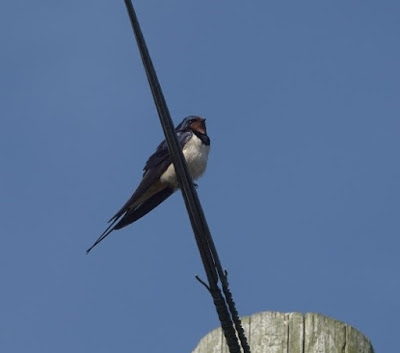
Whitethroats have been a bit scarce on the reserve in recent years. I have watched one singing on Heswall shore this week but have so far seen none up here. The Oldfield Farm Swallows’ arrival pattern has been slightly different this year. The first arrived on April 6th (a few days early) followed by sporadic sightings since. It might be that some of these are just passing through.  Normally, by mid-April the numbers have grown to around a dozen making use of the farm stables. I haven’t seen any House Martins in Oldfield yet, although I have seen them feasting on insects above Heswall sewage works – always a good place to look for birds.


Swallow


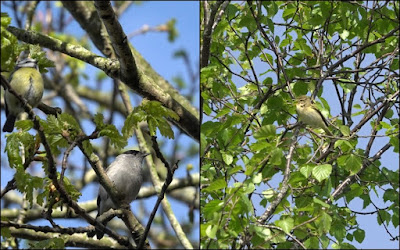
Sadly, the annual Dawn Chorus Walk through Cleaver and Heswall Dales has had to be cancelled this year, so here are a couple of photos of this year’s singing warblers instead: Blackcap and Willow Warbler. We were shocked one morning to find a deceased Blackcap below our dining room window. It had presumably flown into the glass. I am happy to report that there are still at least two males singing on the reserve following this.


Blue Tit and Blackcap (left) and Willow Warbler (right)

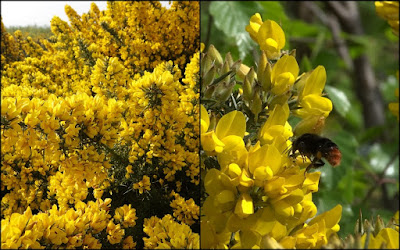
The European Gorse has been looking stunning this spring. As you can see, there are plenty of insects, including this Red-Tailed Bumble Bee, taking advantage of the blossom. 


European Gorse with Red-Tailed Bumble Bee

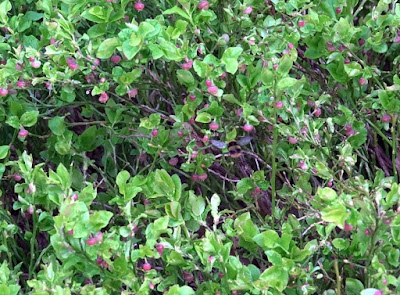
Another plant doing really well is Bilberry. As previously noted, this plant grows widely in the main Heswall Dales but is restricted to a small, but expanding, panel within our managed scrub area. It is currently developing flowers and is also being heavily used by insects.


Bilberry

On the subject of insects, while conducting one of our 3-yearly heathland condition surveys last September, we came across this lovely green and yellow caterpillar. I sent the photo to our county moth recorder, Steve Holmes, who confirmed that it was the larva of a Beautiful Yellow Underwing moth and, as a relatively rare sighting, has been included, with photo, in his annual report.


Beautiful Yellow Underwing moth caterpillar

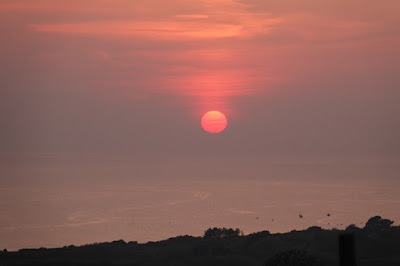
As a parting shot, I leave you with a recent sunset photo - now well over Liverpool Bay. Compare this with the Clwyd Hills photo of the Winter Newsletter.


Sunset over Liverpool Bay

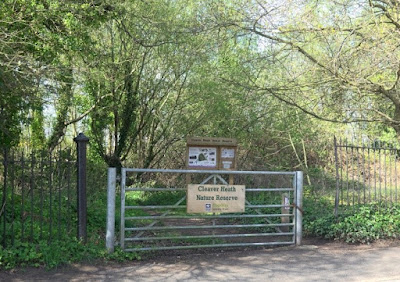
You may also notice that the traditional reserve entrance photo has been seasonally adjusted.


Cleaver Heath entrance


Alan Irving
Volunteer Reserve Warden for CWT
Cleaver Heath
April 2020

Wednesday, 19 February 2020

Winter 2019-20 at Cleaver Heath


Flooded paths at Cleaver Heath


So far, at mid-February, there has been no ‘Beast-from-the-East’. The frosts have been few, no snow but plenty of wind and rain, as the pictures above demonstrate.

We have now used up the remaining pile of approved stone to reinforce some more of the main paths. The weather on the monthly work party days has been kind, allowing us to complete our planned birch and gorse control. The birch and selected European gorse within the main heath panels was cut and treated. Our volunteers helped us coppice the taller birch within the manged scrub area and we made a start on further coppicing of European gorse in the lower part of the reserve. The gorse strategy is to prevent further incursion, improve the age structure and hence provide more valuable wildlife cover. 


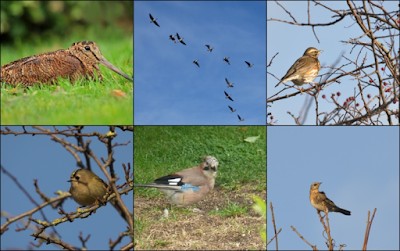
Birds at Cleaver Heath

Winter is generally thought of as a quiet time on a nature reserve like Cleaver Heath but here is a list of 20 bird species seen at Cleaver in the last few weeks: Pink-footed Goose, Woodcock, Herring Gull, Woodpigeon, Great Spotted Woodpecker, Jay, Magpie, Carrion Crow, Raven, Coal Tit, Blue Tit, Great Tit, Wren, Blackbird, Fieldfare, Redwing, Robin, Dunnock, Chaffinch, Goldcrest. 


Some, like the Woodcock (top left in the above photo) which is normally hiding in the heather and the Pink-footed Geese flying overhead, are obviously winter visitors. So too are Redwing (top right) and Fieldfare (lower right). Birds such as the Jay (centre lower) and the tiny Goldcrest are here all year round. However the numbers of some resident species including Blackbird and Robin are greatly swollen by visitors from continental Europe. I am told this will still happen after January 2021.
I have again started to record bird sightings more regularly outside of formal surveying activities. The BTO (British Trust for Ornithology) has been promoting the value of ‘complete lists’. In many ways, the information from these is just as, if not more, useful than random casual records of ‘interesting’ sightings. The online resource BirdTrack (www.bto.org/birdtrack) is very simple to use. When you are out for a walk, perhaps along a favourite route, you keep track of how many goldfinches, blackbirds, curlew etc. you have seen or heard. You can enter them on a smartphone app as you go or, as I do, keep them in a handy notebook and enter them back at home. It can be strangely satisfying if you are of that sort of mind and, possibly, a source of intense irritation for your walking companion. I don’t remember hearing as many birds singing in January and February as I have in walks this year. They are as confused as us about the weather patterns.

Cramp-Ball Fungus Weevil

Talking of surveys, Tony Parker of the Liverpool World Museum and rECOrd (http://www.record-lrc.co.uk/) has kindly helped me assemble a list of all the sightings which he and his fellow naturalists accumulated during four field visits to Cleaver this last summer. These are all now publically available as part of the huge wildlife and plant rECOrd database covering Cheshire and its surroundings. The groups made 474 confirmed sightings including over a hundred invertebrate species, 31 birds, 64 plants, 3 mammals as well a frog and 4 sightings of Common Lizard. I had no idea just how many species of hoverfly, wasps and bees there were! The star was probably the ‘first for Cheshire’ finding of this Cramp-Ball Fungus Weevil (Platyrhinus resinosus © Leanna Dixon).


Most of the sightings were well beyond my abilities to identify. However, there were two common species reported which do not appear in my own Cleaver records: a Skylark and a Rabbit!

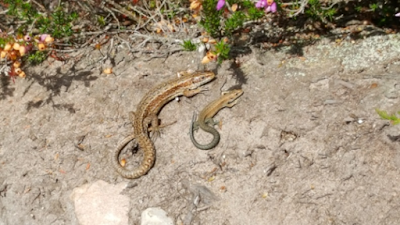
Common lizard

I am looking forward to re-starting the annual butterfly transect surveys at the end of March/beginning of April. Another survey which we hope to start in the spring is for Common Lizard. We have taken advice on how best to do this and, on our March work day, we will be deploying a new set of ‘refugia’ in an orderly manner within the reserve. You may have previously seen small sheets of corrugated iron lying about in Cleaver. These provide cover and indeed basking areas on sunny days.  The lizards shown here were actually photographed in the Dales where the sandstone outcrops provide many basking opportunities. In the planned heathland restoration area in the SW corner of the reserve, we hope to provide bare ground patches on the south facing slope and ‘hibernacula’ for winter refuge.


FAQs - Let me try to answer a couple of questions I often get asked:

Q1: Why is heathland management done only in the autumn and winter months?

A1: Cleaver is of course a SSSI and so its management is regulated by Natural England (NE). NE specifies when we can work in habitats like heathland and woodland. The timing is based on the notional bird-nesting season.  But surely birds nest in trees so you should be able to carry on working in heather and gorse? No, a lot of the birds using Cleaver nest very close to the ground in the cover provided by the heathland. Warblers, for example, are most obvious while singing in the trees but are actually nesting in the gorse and bramble cover. 

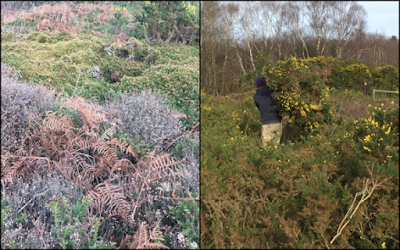
Western and European Gorse at Cleaver Heath

Q2: How can you tell the difference between Western and European Gorse?

A2: The most obvious difference is that the Western Gorse is very compact and rarely grows tall enough to shade the heather. The left photo above shows a carpet of Western with a stand of (flowering) European in its top right. The willing volunteer on the right photo is carrying off some cut European Gorse giving the shaded heather a better chance. On closer inspection, the stalk of the Western is quite densely covered with prickles whereas the barer European stalks can been seen quite clearly.  Most of the Western gorse flowers at the end of summer rather than the beginning. 


Heathland Management


We are working with the Friends of Heswall Dales to run a Wirral Workshop on Lowland Heath Management on February 29. With the cooperation of delegates from Wirral Borough Council, Cheshire Wildlife Trust, the National Trust and Natural England, we are exploring opportunities for greater cooperation in the management of Wirral heathland.  On April 21 there will be a Cheshire Lowland Heath Forum hosted by Heswall Dales. These Forums are an excellent opportunity for conservation people to see each other’s reserves and share good ideas as well have a joint hand-wringing session about how hard it all is. When cattle used Wirral heathland for grazing, the conservation of this resource was ensured. Now, if we wish to keep this habitat, we have to intervene directly. We need volunteers to do the work of the cattle. 


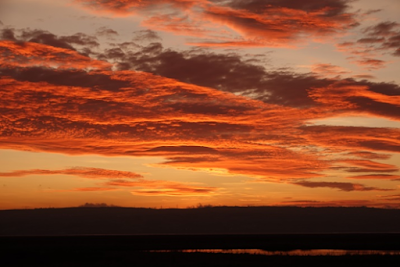
Sunset at Cleaver Heath


Colleagues at CWT are in the process of updating our reserve websites, including that for Cleaver. Among the attractions listed, is that Cleaver is a ‘perfect reserve for an evening stroll at sunset’.  Indeed, this winter has seen a regular sequence of spectacular sunsets as this recent photo demonstrates.


Cleaver Heath entrance


Alan Irving
Volunteer Reserve Warden for CWT
Cleaver Heath

February 2020