Showing posts with label Ash Dieback Disease. Show all posts

Tuesday, 23 June 2020

Ash Dieback


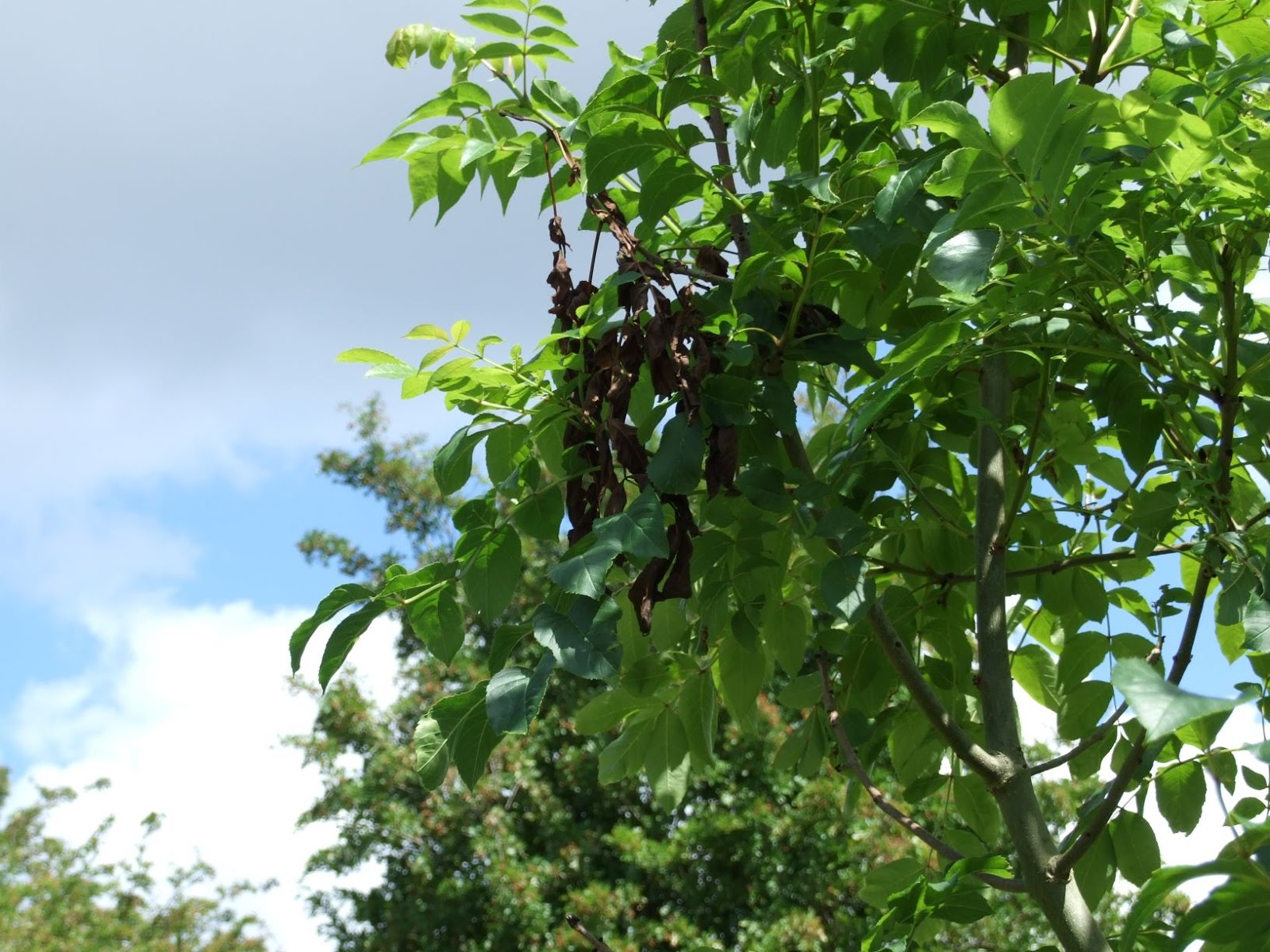
Ash tree showing signs of ash dieback in the blackened leaves

Last July we alerted you to the presence of Ash Dieback. It is still with us this year and you can recognise it by the wilting and blackened leaves on ash trees.

Ash tree with dead shoots

The photographs above were taken at New Ferry Butterfly Park on 20th June.

Please look out for it.

Here is a poster reminding you what to look out for and how to report it.


Homeowners can get guidance at

Friday, 19 July 2019

Ash Dieback Signs and Advice


Ash dieback has now been confirmed on the Wirral. It causes leaf wilting and blackening. Diseased trees often have dead tops and side shoots and lesions around the side shoots.

If you spot signs of the disease please report it to info@record-lrc.co.uk

The disease will kill many trees but some will recover. Do not fell trees without expert advice as it is vital that we retain trees with resistance to the disease.

For more information visit the Forestry Commission website:

Friday, 23 November 2012

National Tree Week


Saturday 24th November - Sunday 2nd December

Recent events have confirmed that the view across the countryside and in our towns is set to change faster than anyone could have expected.  In recent years, pests and diseases have started to threaten some of our most loved trees, such as oak and horse chestnut, but the spread of Chalara fraxinea (ash dieback) and the anticipated devastation of the UK population of ash trees has left everyone considering what the next steps should be. 

National Tree Week was launched in 1975 to maintain the tree planting momentum to replace the losses resulting from Dutch elm disease, which had already wiped out more than 20 million of our most significant landscape trees.  The Tree Council has run the festival every year since, encouraging everyone to celebrate the tree planting season in a variety of ways, not least of which is by planting more trees.  This year, once again, the landscape is being altered. We are facing losses that will change the view out of our windows, from town pavements, country footpaths and across fields and woods. Since trees make a difference to so many aspects of life, wildlife and biodiversity – and that includes people – will be affected. We need to act to change our view, both figuratively and literally.

“Anyone with land of their own, whether a garden, woodland or field, can make a difference to their view by adding a tree”, said Pauline Buchanan Black, Director-General of The Tree Council. “This year, though, the campaign carries particular significance as we look for ways to minimise the impact of ash dieback and carefully consider what to plant. Rising concern about tree diseases has also reminded us of the importance of checking not only where the seed of their tree started life, but also where it was germinated and grown. Not since Plant A Tree in ’73 has there been the same urgency to safeguard a view for the future”.

Alasdair Douglas, Chair of The Tree Council, added “It is almost exactly 40 years since Secretary of State for the Environment Peter Walker stood up in the House of Commons and announced that the following year was to be designated National Tree Planting Year. This was the Government initiative to encourage the planting of new trees to replace those millions killed by Dutch Elm Disease. The Tree Council was formed from that initiative and has been running National Tree Week ever since. We couldn’t have foreseen that we’d be faced with the losses from a tree disease of similar epidemic proportions just as we go in to National Tree Week but this seems a timely moment to ask the public to think carefully about what will happen to their view and what they will do to restore it for future generations.”

Visit The Tree Council's website for details of local events and tips on tree planting and aftercare. Event information is also available from the Tree Council infoline, 020 7940 8180 (during office hours).

Tuesday, 13 November 2012

Chalara Action Plan

Image: FERA


Defra has published its Chalara Action Plan, setting out the ways the Government plans to tackle the disease.

These include:
  • Newly-planted diseased trees and diseased trees in nurseries will be traced and destroyed, as once young trees are infected they succumb quickly.
  • Mature trees will not currently be removed, as they are valuable to wildlife, take longer to die and can help us learn more about genetic strains that might be resistant to the disease. Infection does not occur directly from tree to tree.
  • Better understanding of the disease will be built through research and surveys, which will look not only for diseased trees but for those that show signs of genetic resistance to Chalara, to help identify genetic strains resistant to the disease.
  • The search for the disease will include trees in towns and cities as well as the countryside, building partnerships with a range of organisations beyond Government.
  • Foresters, land managers, environment groups and the general public will be informed about how to identify diseased trees and those likely to be resistant to the disease, and know what to do if they find a diseased tree.
More information can be found on the Defra website.

Friday, 9 November 2012

Ash dieback update

Image courtesy of Fera


There are two trees on Wirral that are currently being investigated for ash dieback disease.

If you see an ash tree with suspicious symptoms, please contact the Forestry Commission.

Younger trees are more susceptible.

However, on mature trees, the leaves will be crisping up ready to fall and any ash keys (seeds) will be brown in any case. This is normal.

The important thing to look for is the tell tale triangular mottling below a bud or smaller branchlet junction, or if more advanced stretching up and down the branch's bark, and if you split the wood some discolouration of the water carrying tissues.

If you think you have spotted the disease, please check the symptoms video and pictorial guide from the Forestry Commission website before reporting it by telephone or email (further details below).

It is best to leave all material in place and report any suspected sightings for an inspection.

Take photos and send these to the email address below.

In England and Wales:
Chalara helpline - 08459 33 55 77 (open 8 a.m. - 6 p.m. every day)

Updates on the disease will be posted on the Forestry Commission website

Monday, 29 October 2012

Ash Dieback Disease


As you may be aware, the media have reported a new and very serious threat to the UK countryside in the form of a fungus Chalara fraxinea. This fungus has the capacity to decimate our native ash tree population, in much the same way as Dutch Elm disease wiped out the elm population last century. The infection is nowhere near us at present, but since infected trees moved for the nursery trade are the main means of long-distance spread, it could crop up anywhere.

It is important that we monitor ash trees this winter and during the spring and early summer months next year. The pdf documents in the links below (courtesy of The Forestry Commission) indicate what to look for. Lesions appear on the bark surface and can grow considerably in size. The bark underneath is often discoloured and grey or brownish. It can kill the tree, or lead to substantial die back of the crown. The leaves wilt from the tips but, as many other conditions also do this, the main ID feature is the bark.


Pictorial Guide to Ash Dieback Disease

Ash Dieback Disease Pest Alert

At the request of the Forestry Commission and Defra, can you:

1) Look out for signs or symptoms of the disease in ash trees.

2) Send any photos or descriptions, plus your location and contact details to one of the contacts listed by the Forestry Commission:
• Forest Research Disease Diagnostic Advisory Service
Telephone: 01420 23000 or Send email
Forestry Commission Plant Health Service
Telephone: 0131 314 6414 or Send email
Fera Plant Health and Seeds Inspectorate
Telephone: 01904 465625 or Send email

If you have a camera and GPS on your phone you can use a new app, Ashtag, developed by the University of East Anglia to track the spread of the disease. Alternatively, you can manually upload a picture from your camera to their website: http://ashtag.org/


At this stage the disease appears confined to the east of England but, as with many fast moving pathogens, early containment and identification is essential. Wherever you are, please check the health of your local ash trees.