Showing posts with label wildlife identification. Show all posts

Friday, 31 January 2020

Dip Into The World Of Dabbling Ducks


Cheshire Wildlife Trust's latest newsletter provides help with dabbling duck identification.
Dip Into The World Of Dabbling Ducks

Winter is a wonderful time to see wildlife, particularly for fans of our feathered friends. As the cold grip of the Arctic winter takes hold on the lakes, pools and marshes of Northern Europe and Russia, huge numbers of swans, ducks and geese retreat to the relative warmth of the UK. Our lakes, rivers, reservoirs and coasts are a winter home for an estimated 2.1 million ducks!


Are you a dabbler or a diver?

Ducks can be split into two broad groups: dabblers and divers. As the name suggests, diving ducks feed mainly by diving underwater, using their strong feet (and sometimes their wings) to swim. Dabbling ducks, however, feed predominantly at the surface, sometimes even grazing on land. Many dabblers can often be seen upending, with their heads underwater and their bums in the air.

We’ve pulled together an introduction to the dabbling ducks you’re most likely to see this winter, with a quick guide on how to recognise both males and females. So why not wrap up warm, head to your nearest water body and search for some spinning shovelers, whistling wigeon or pristine pintails.


The dabbling duck ID guide

Top tip: a useful way of identifying ducks (especially females) is to look at the speculum – this is a coloured patch on the secondary flight feathers, which are the feathers at the trailing edge of the wing, close to the body. The speculum is often a distinctive colour and can easily be seen in flight, and regularly seen on swimming or standing birds.


Mallard (male)

Mallard male

The classic duck. Males have a yellow bill and a green head, separated from the brown breast by a thin white collar. The body is mostly grey, with a black rump. The black middle tail feathers curl upwards. The speculum is dark blue with a white border


Mallard (female)
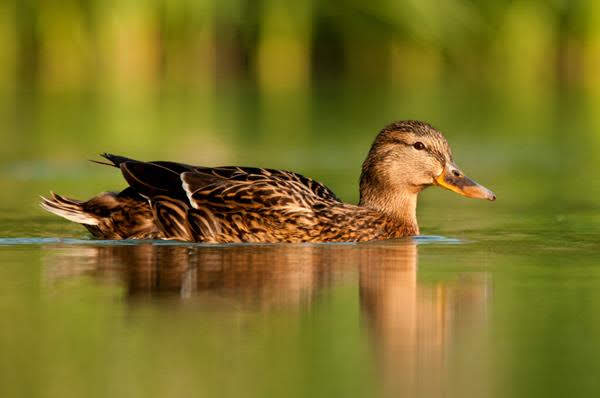
Mallard female

Females are a streaky brown all over. They have a patchy orange and black bill (see gadwall for comparison). Like males, they have a dark blue speculum with broad white borders. This is obvious in flight and can sometimes be seen when the duck is on the water or ground.


Gadwall (male)

Gadwall male

Slightly smaller and slimmer than a mallard. Males are mostly grey, with a wavy pattern (known as vermiculations) that is strongest on the breast. They have slightly browner heads, brown feathers on the back and a black rear. The bill is greyish-black and the speculum is small and white.


Gadwall (female)
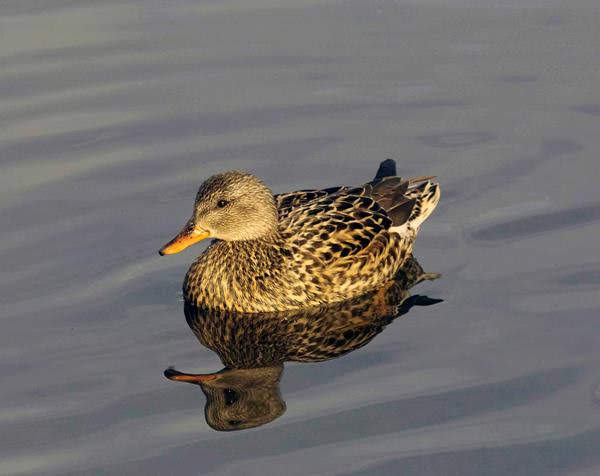
Gadwall female

Females are very similar to female mallards, though slightly smaller and slimmer. The best features to look for are the small white speculum on the wing (much smaller than in male gadwalls) and the bill, which is dark with a neat orange stripe along each side (patchier orange and black in mallard).


Pintail (male)
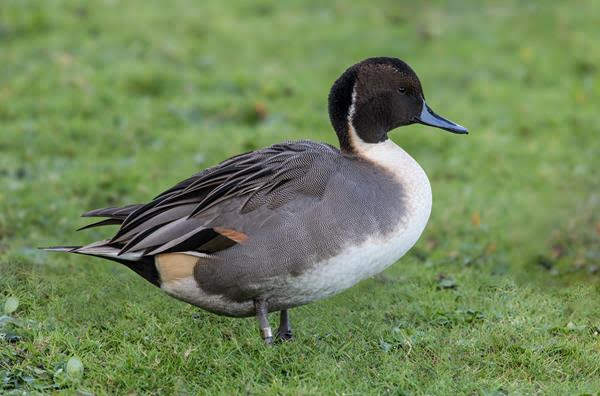
Pintail male

An elegant duck, with a small brown head, a long neck that's brown at the back and white at the front, and grey body. The black middle feathers of the tail are very long. The speculum is dark green, with a white border at the back and a rusty border at the front. The bill is black with blue sides.


Pintail (female)
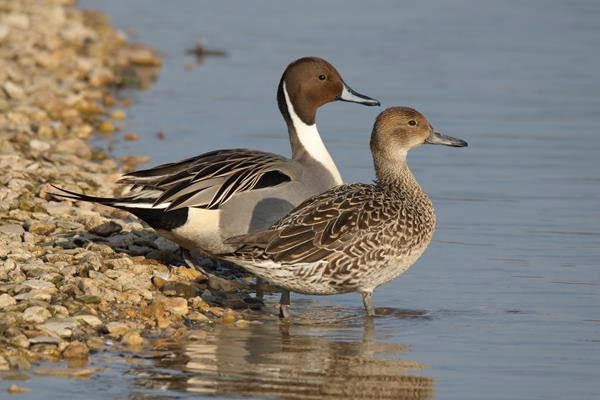
Pintail female

Like a slim, elegant mallard, with a long, slender neck and long, pointed tail feathers (not as long as in male). The head is a richer brown than the greyish body, the bill is dark grey and the speculum is bronze-brown with a thick white border at the trailing edge and a narrow white border at the front.


Shoveler (male)
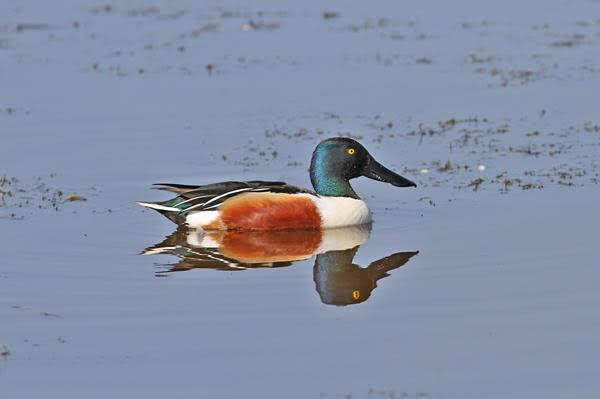
Shoveler male

Similar size to a mallard. Males have a glossy green head, a yellow eye and a huge, broad dark bill. The belly and sides are a rich chestnut brown and the breast is white. The speculum is green, with a white border at the front and a large blue patch on the forewing. Shovelers often feed in pairs or groups, spinning around each other.


Shoveler (female)

Shoveler female

Resembles a female mallard, but with a huge, broad bill (paler than the male's). The speculum is a dull green (blue in mallard), with a white border at the front and no white on the trailing edge (mallard has a white trailing edge).


Teal (male)

Teal male

Our smallest duck (about 2/3 the size of a mallard). The head is chestnut with a yellow-bordered green patch on each side. The body is grey with a horizontal white line running along it, and a yellow patch either side of the rear. The speculum is bright green.


Teal (female)
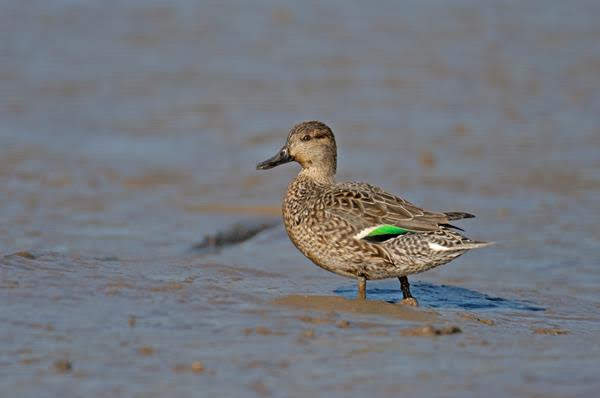
Teal female

A very small, streaky brown duck, with a small, dark bill that often has orange towards the base. The speculum is bright green, with a broad white bar in front of it and a narrower one at the trailing edge of the wing.


Wigeon (male)

Wigeon male

Smaller than a mallard, with a short neck and small, blue, black-tipped bill. They have a round, chestnut head with a creamy-yellow patch on the forehead. The body is mostly grey, with a white belly, pinkish breast and black rear. The speculum is green with a large white patch in front of it. Often gives a whistling call.


Wigeon (female)
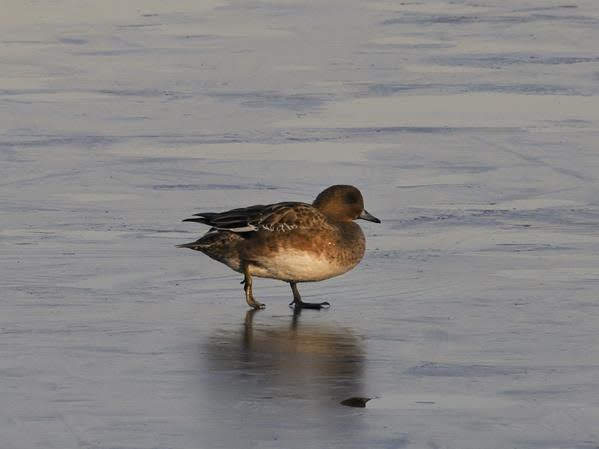
Wigeon female

Females are mostly a mottled brown, though the shades can vary from greyish-brown to a richer red-brown. They have a small, round head and short, blue bill with a black tip. The belly is white and the speculum is dark and they lack the large white patch of the male. Often in large groups, grazing.


See them in action

Dive deeper into the world of dabbling ducks with our video identification guide!


Where to see dabbling ducks

Cheshire Wildlife Trust care for many wetland nature reserves across our region of Cheshire, Halton, Stockport, Tameside, Trafford, Warringon and Wirral. Here are some of best wild places for dabbling ducks.

Compstall Nature Reserve, Etherow Country Park
Gowy Meadows, Thornton-le-Moors
Hatchmere, Frodsham
Marbury Reedbed, Northwich
Trentabank Reservoir, Macclesfield Forest


Let us know how you get on!

Tuesday, 28 January 2020

Bumblebee Identification Session at Chester Zoo


RECORD are holding their first Drop In Session of the year at Chester Zoo next month.

Wednesday 12th February, 6.30- 9 pm
Mottershead Suite, Cedar House, Chester Zoo

Book your place on eventbrite here

We’ll have museum specimens, guides and microscopes on hand to use, so you can familiarise yourself with the bumblebees you are likely to encounter in Cheshire this year. If you’re new to invertebrate identification, we’ll help get you started and work together to understand what features to look out for. For anyone with an existing interest, it’s a great chance to find out some more detail about this group through practicing species identification in a friendly setting.

*Please note* This is not a formal workshop, just an opportunity to 'give it a go' along with other interested people in a shared learning environment.

These Drop-in Sessions are run in collaboration with the Tanyptera project.

Whilst each session will have a theme, you’re welcome to work on your own tasks making use of the RECORD/World Museum facilities. You can request museum reference specimens, equipment and literature in advance to help check identifications / practice with a particular group. Feel free to bring your own material too.

There is no need to be present for the whole session but if you would like to attend please book via eventbrite.

Email info@record-lrc.co.uk for more information or to request specimens or equipment for the session.

If you book on but can no longer attend, please cancel your place on eventbrite or by emailing us as soon as you can so that someone else can take your place.

Kind regards,
The RECORD Team
Tel: 01244 383749
RECORD LRC, Cedar House, Chester Zoo, Caughall Road, Upton, CH2 1LH.
WWW.RECORD-LRC.CO.UK

Thursday, 18 April 2019

The City Nature Challenge


This year, the Liverpool City Region is taking part in the 2019 City Nature Challenge, in which the city will compete against other cities, globally, in what has been described as the ‘premier league’ of wildlife recording.

City Nature Challenge is organised on a global scale by the Natural History Museum of Los Angeles County and the California Academy of Sciences.

Between the 26th and 29th April, over 150 cities worldwide will be competing to find urban and record wildlife. We will be pitting our wildlife spotting skills against the likes of Athens, LA, London and Manchester.

There are two ways to get involved with this fun and friendly competition. You can take part independently using the iNaturalist app to record any wildlife you spot over that weekend. You could record the ladybirds living on your balcony, the birds in the local park or the mushrooms you’ve seen on a walk in the countryside. The app is available to download at www.inaturalist.org

You can also get involved by joining us at one of the many recording events taking place that weekend in parks and greenspaces across the Liverpool city Region held by Liverpool’s amazing local and national conservation organisations.

On Friday the 26th April, Croxteth Park Volunteer Group will be kicking off the Challenge with a Wildlife Walk and Recording Session. On the same day, a Wildlife Recording Day will be taking place at Royden Park organised by RECORD at 10am. On Saturday 27th Heal Earth are hosting a Family Foraging Walk at the North Wirral Coastal Park. And on Sunday 28th to round off the weekend we will be hosting a Wildlife Bring and Share Picnic at Freshfield in Formby, recording wildlife at the Lunt Meadows, Seaforth Nature reserve and Freshfield Dune Heath.

Anyone is welcome to come along and have a go. More information on the recording events taking place that weekend can be found by heading to www.eventbrite.org and searching for 'Greenspace and Wildlife: LCR Year of the Environment’.

Anyone who joins in will be helping to make a difference, mapping where wildlife lives in the city. The information from this weekend will be added to the UK’s biodiversity database, becoming part of the data used to protect nature.

Ben Deed, Lead Environmental Records Officer for Merseyside Biobank said “The City Nature Challenge is a global competition where the Liverpool City Region will join together and go toe-to-toe with the rest of the world to showcase it’s incredible wildlife. We need your help to do this but It’s really easy to take part. Just download the iNaturalist App, get outdoors and upload photos of the wildlife you see. By taking part will help you to discover plants, animals and fungi that make our parks and greenspaces their home and the information you send in will be shared with a range of organisations to help improve our knowledge of wildlife across the region, promoting and protecting important places for wildlife and aiding conservation and scientific research..”

Records also help owners and organisations manage land for all species, and track how climate change, habitat management and other changes affect biodiversity over time – locally and nationally, as our records feed into the national NBN database.”

Monday, 8 April 2019

Wildlife Recording Day


Take part in the Wildlife Recording Day taking place at Royden Park/ Thurstaston Common on 26th April, from 10am to 3pm.

As part of the City Nature Challenge help record as much wildlife as possible in one day. Experts will be on hand to assist with identification.

To book a place please email info@record-lrc.co.uk

Wednesday, 4 April 2018

Wildlife Identification Workshops


Community Nature Hub

RECORD are very excited to announce they are now taking bookings for the first batch of Wildlife Identification Workshops as part of their new Community Nature Hub project.

To book onto the workshops please follow the links and book via Eventbrite.

14th April 2018 - Reptile Identification
23rd June 2018 - Shieldbug Identification
30th June 2018 - Wildflower Identification

If you would like to be kept informed about the project and upcoming Wildlife Workshops and Recording Days, please subscribe to the Community Nature Hub mailing list here.