Showing posts with label butterfly survey. Show all posts

Friday, 23 January 2026

2025 Butterfly Recording Results at New Ferry Butterfly Park

Peacock butterfly
Peacock butterfly

With great pleasure, we would like to share with you the information on butterflies we recorded in our transect walks between April and September 2025 at New Ferry Butterfly Park. 

Small Copper butterfly

2025 was a good year for butterflies thanks to the dry and sunny weather: we recorded 1151 individual butterflies, contrasting 553 in 2024! Almost all the species did well: in particular, Green-veined White, Common Blue, Peacock and Gatekeeper, followed by Speckled Wood, Large White, Holly Blue, Red Admiral, Comma, Meadow Brown, and Ringlet. Even some that are historically rare increased in number too: 8 Small Coppers (3 in 2024), and 5 Dingy Skippers during one walk (2 in 2024 in two sperate walks). 

Orange Tip butterfly

The species whose number remained more or less the same between 2024 and 2025 were Small Skipper, Essex Skipper, Painted Lady, and Small Tortoiseshell, while there was a fall in Orange Tip (from 23 to 11), and Small White (from 123 to 78).

Brimstone butterfly
Brimstone butterfly

Brimstone butterflies have always been a steady and pleasant sighting for visitors in the Park.  Strangely their number in 2025 was less spectacular: we only recorded 47, in contrast with 53 the year before. The good news is that we saw quite a few Brimstone butterfly eggs and caterpillars in 2025 on Alder Buckthorn (their favourite food plant). Fingers crossed there will be more in the next recording season.

A Brimstone caterpillar

2025 saw us gratefully receiving exclusive personal training in the Park from Dave Costello and Eric Davies, whose superb photos made their way to the Butterfly Park's Facebook page. Thank you both for your support!  Our thanks also go to Claire Lyon and Paul Loughnane who stepped in when we were away, which made 26 out of 26 walks during the recording season.

Finally, we wish all the very best to all of you for a fantastic 2026!


Yan and Charles

(Photos by Roy Lowry, taken at New Ferry Butterfly Park)


Tuesday, 17 November 2020

Butterfly Count 2020


Red admiral
Red admiral

Paul Loughnane, Secretary of New Ferry Butterfly Park, has just collated butterfly records for 2020. It has proved to be one of the poorest years ever – apart from Red Admirals. However two new species were recorded at the Butterfly Park, an Essex Skipper and a Purple Hairstreak. So there was a little more diversity in species but a drop in abundance.


Purple hairstreak
Purple hairstreak. Photo: Wikipedia

The numbers may reflect fewer recordings than usual due to Covid19 but the wet weather in July and August will also have had an effect.

This year Pat Thurston has started carrying out regular transect monitoring and his report is below.


Essex skipper
Essex skipper


New Ferry Butterfly Park, Transect Report

Pat Thurston

The first counts were not carried until late May and so a full season of monitoring has still not been carried out on this transect. However, despite its relatively small size and its urban location, this transect has a variety of habitats and is very well managed. As well as a good planting of various larval food plants there are also good sources of nectar throughout the season. Most predominant species are small white and speckled wood. There are very healthy populations of gatekeeper and meadow brown and other meadow butterflies such as common blue, and small and large skipper are also present. Of note, whilst not recorded on my transect counts this year, there has been a confirmed sighting of the Essex skipper during a separate study. Hopefully it will be possible to carry out a full set of counts next year.


Monday, 6 August 2018

Summer 2018 at Cleaver Heath


Volunteers laying down gritstone at Cleaver Heath

The Tesco 'Bags of Help' grant is now making an impact on site. This grant along with Natural Futures funding provides help with new signage, an interpretation board, a proper northern gateway and some approved gritstone to reinforce the vulnerable main path through the heather.

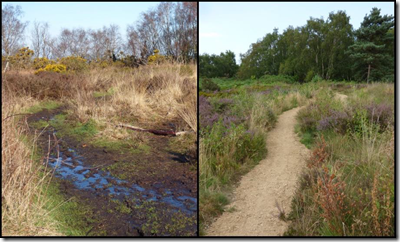
Last week, some kind CWT volunteers helped lay down the first load of gritstone. It turned out to be the hottest day of the year. However, this hard work should make a real difference, turning what can be a mud bath in winter (below left) into an attractive path (below right) which will encourage visitors to respect the fragile heathland all year round.

New path at Cleaver Heath (before and after)

The grant will also provide us with signage to identify the recommended route to maximise visitors’ enjoyment of the reserve and its stunning views. No wildlife or visitors were harmed during those activities although I almost ran over a Common Lizard with my wheelbarrow full of stone.

Summer has now really arrived. We have had a continuous sequence of flowering plants and shrubs - from the Oxeye Daisies, Red Campion and Ragwort in our ‘insect nursery’ (ex-carpark) to the Common Heather (Calluna) and Western Gorse out on the reserve. The Bell Heather (both plants!) bloomed defiantly in June and then lapsed back into obscurity. The Common Heather is now starting to turn from white to purple.

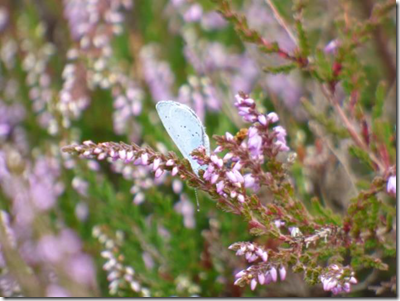
Holly blue butterfly

The small butterfly shown above is a male Holly Blue. This has a blue underwing with black spots. It was photographed during a brief rest period in the stoning! There were plenty of Common Blue butterflies on the wing as well. We were also surrounded by Swallows and House Martins which were feeding low over the heather showing just how productive the heathland is in summer.

Swallows in flight over Cleaver Heath

Swallows in flight are very hard to photograph for us amateurs, as the photograph above  demonstrates. What with humming bees, swarms of insects, fluttering butterflies and swooping swallows, the reserve seems very alive following several weeks of warm weather. The downside of course is that some of the vegetation is visibly starting to wilt.

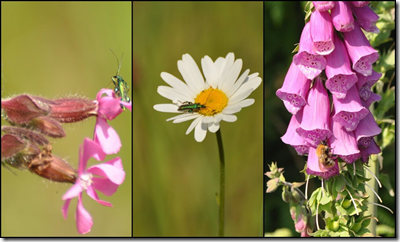
Swollen-thighed Beetle on Red Campion and and Oxeye Daisy and Buff-tailed Bumble bee on Foxglove

A new beetle for me this summer has been the Swollen-thighed Beetle seen on both Red Campion (above left) and Oxeye Daisy above centre). The shiny green colouring is quite striking and the name perfectly describes it. The Buff-tailed Bumble bee on the Foxlove (above right) is of course more familiar. There have been spectacular displays of Foxgloves around the woodland path edges providing a popular source of nectar. Foxgloves like the disturbance associated with paths.

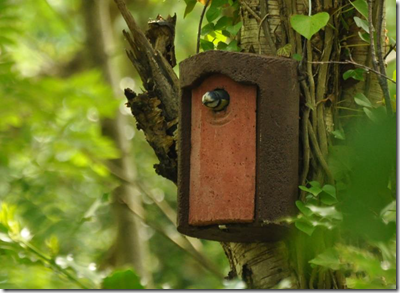
Blue Tit in nest box at Cleaver Heath

The nest boxes installed last winter - see the Winter Newsletter - seem to have been used. I had firm sightings of Blue Tits (above) and Great Tits using at least 6 of the 10 boxes. No sign of occupancy at the Tawny Owl box however.

Linnet and Song Thrush

This year’s Common Bird Census took place between 5th April and 11th June. The overall numbers were down on 2017 probably due to the poor weather in the early breeding season. The Linnets were here again this year (above left) – possibly 2 pairs? Both Mistle and Song Thrush (above right) bred. We had the usual warblers holding territory – Chiffchaff, Blackcap and Willow Warbler. I am not sure if the Willow Warblers actually bred. They seemed to disappear at the end of May but returned in late June. I even heard one singing in the last week of July!

Butterflies at Cleaver Heath

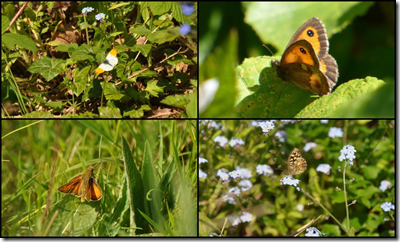
Butterfly sightings have picked up after a slow start – the Cleaver to Thurstaston survey numbers are now running at roughly double those to the same point in 2017: 800 up from 400. Top left is a rare (for me) photo of a male Orange Tip at rest. These were quickly replaced by the other small whites then Meadow Brown and Gatekeeper (top right) and other smaller things such as the Small and Large Skipper (bottom left) and the Blues. The Speckled Woods (bottom right) have been present throughout the surveys. We have had the odd Small Copper, Peacock and Red Admiral and a few Commas, but still no Painted Ladies (as of end July). Our Species Count for the transect this summer remains stubbornly at 15.

Further activities in the pipeline include another round of bracken spraying. This needs to be done annually in a relatively narrow window in time and weather conditions. We also hope to get some of the new signage infrastructure installed in the autumn.

Looking ahead to the monthly workdays, there is plenty to be done. We need to check and clean out the bird boxes, tidy up some path work, remove some non-native shrubs and saplings, start on the annual birch control work using the new pull or cut and treat methods. The first date is Sunday 2nd September from 10 a.m.

Volunteers at a workday at Cleaver Heath

This year’s ‘Beauty of Heswall’s Heathland’ guided walk will take place from 2 to 4 p.m. on Sunday 19th August. More details on the Wirral Wildlife website at www.wirralwildlife.org.uk or on the main Cheshire Wildlife site at www.cheshirewildlifetrust.org.uk.

Alan Irving
Volunteer Reserve Warden for CWT
Cleaver Heath

Wednesday, 7 June 2017

Butterfly Surveys


News from Alan Irving.

''We have now done 9 of the weekly Butterfly Surveys starting in the reserve and continuing to Thustaston Church. This is the first year of the new ‘Cleaver Heath Transect’, now recognised by UKBMS. 


Our previous experience of butterflies on this route had led us to expect swarms of the creatures come early summer. Sadly, not so. Last year, following a wet spring, was a very poor year nationally for butterflies. So maybe we should not be surprised at the small numbers following on this year. Anyway, the stats for these 9 visits are: 81 butterflies from 12 species – we think! My co-observer, the previous Volunteer Reserve Manager  knows much more about these things than I, so I am having to learn fast.

The small whites can be difficult to distinguish when they flutter by without stopping – we see Small White, Green- veined White  (shown below) and the female Orange Tip. Most of us can spot the male Orange Tip with its eponymous wing markings but the female (on top at least) is pretty well just white. They very seldom rest while you get your binoculars focussed.


Other problem species are small Blue jobs. Early season ones are probably the Holly Blue rather than the Common Blue. The following example of the former was photographed at the end of April on a hedge near the Dungeon. The underwing markings are indicative. These small blue butterflies are not to be confused with the Little Blue which is extremely rare!

Holly Blue


Less problematic is the speckled Wood. However, the numbers are currently disappointing. We will keep watching!'

Speckled Wood

Wednesday, 5 April 2017

Spring at Cleaver Heath


On Sunday April 2, I carried out the first Common Bird Census for the 2017 breeding season on Cleaver Heath. I noted a total of 20 species within and around the borders of the reserve, many identified by their songs (the male birds) and their calls. Some – such as the flock of 30 Curlew – were flying over to settle in nearby farmland. Among those setting up breeding territories in the reserve were 4 Chiffchaff and 3 Willow Warblers.  Of particular interest was a pair of Chiffchaffs who seem to be building a nest in the ex-carpark area right next to the new (3 year old) natural hedge which is growing nicely alongside the railings.

The Chiffchaff pair are installing quite a bit of nesting material down there. I went back today to take a picture of the area from where the female was calling and of the male perched on a nearby oak sapling.

I also went down to the lower part of the reserve to check the trail camera which I had set up near a suspected Badger latrine.

The first attempt had caught just a glimpse of the perpetrator .


The camera needed to be reset. While there, I enjoyed the colourful spectacle of the European Gorse now in full bloom and watched a Willow Warbler singing from various song perches on the Gorse and Birch trees.


As the spring days warm up we start to see butterflies. On Sunday April 2, following the bird survey Mike Maher and I deemed it warm enough to conduct the first ‘Pollard Walk’ Butterfly Survey along the newly established Cleaver Heath transect. This starts on the upper part of the reserve and goes through the Oldfield Farm and Church Farm public paths to the church at Thurstaston. (On the map shown below the words ‘Start’ and ‘End’ are interchanged because the route was recorded in the reverse direction – i.e. on the way back! )

During the time of the survey we were unlucky to see nothing until the very last metre of the last designated segment – a pair of Commas came out to sum themselves.

Better butterfly luck next time!

And there was better luck the following evening regarding the badger as the following photograph was captured. 

 Alan Irving