Showing posts with label Bees. Show all posts

Sunday, 28 June 2026

June at New Ferry Butterfly Park


Almost every day, on the New Ferry Butterfly Park Facebook page, we feature amazing photographs taken by Roy Lowry on his regular visits.

We know that not everyone uses Facebook so we have selected some of the images he has taken and shared with us in June.

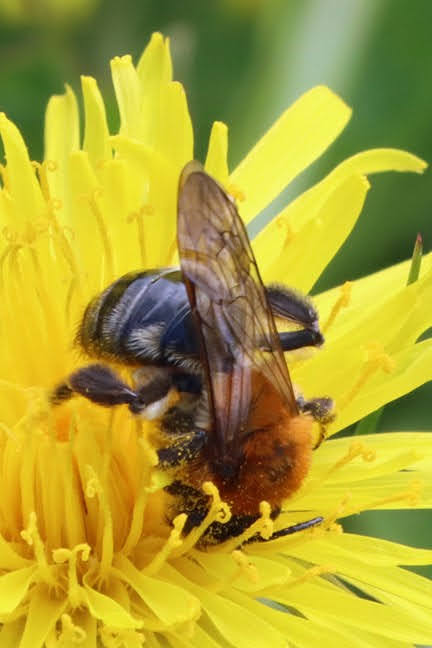
Here are two busy bumblebees photographed at the beginning of the month.

Red tailed bumblebee (Bombus lapidarius)


Common carder bee (Bombus pascorum)

However life will be less easy if they are spotted by a ferruginous bee-grabber. This fly lives up to its name by grabbing hold of bumble and honey bees to lay an egg from which a larva emerges and proceeds to eat the host alive.

Ferruginous bee-grabber on a bramble flower

Close up of Sicus ferrugineus - the ferruginous bee-grabber
Close up of Sicus ferrugineus - the ferruginous bee-grabber


On most sunny day visits to the Butterfly Park Roy will photograph butterflies.

Common blue butterfly (Polyommatus icarus)

Green veined white (Pieris napi)

Both photographs show how the underside of the wings differs from the upper surface.

Recent star of the butterflies for Roy Lowry was a dingy skipper that posed on the lime waste. This was the first he had managed to photograph since 2023.

Say hello to the dingy skipper!


Dingy skipper (Erynnis tages)


Also present at the Butterfly Park this month - small coppers, speckled woods and brimstone caterpillars.

Small copper (Lycaena phlaeas)

Speckled wood (Pararge aegeria)

Caterpillar of the brimstone butterfly (Gonepteryx rhamni)


Day flying moths are good to build a story around. Roy reported “The narrow-bordered five-spot burnet moths were in a frisky mood in Saturday’s warm weather”.

Two's company for the narrow-bordered five-spot burnet moths
Two's company for the narrow-bordered five-spot burnet moths

Three’s a crowd
Three’s a crowd...

But four?????
But four?????

The pond is a good place to find dragonflies and damselflies. 
Here are paired azure damselflies expertly photographed egg-laying in the pond.

Male and female azure damselflies (Coenagrion puella)

The male azure damselfly is blue and the female is green
The male azure damselfly is blue and the female is green


Roy also photographed two male broad bodied chaser dragonflies on the pond.

They had distinctively different markings - one had much more brown colouration on the thorax and base of the abdomen, but this might change as it ages.

Broad bodied chaser dragonfly (Libellula depressa)

A Broad bodied chaser dragonfly with more brown colouration
Broad bodied chaser dragonfly with more brown colouration


Here’s a hairy shieldbug.

Dolycoris baccarum - or the hairy shieldbug


As the name suggests, they're covered in tiny hairs - though you may have to look closely to spot them! They are also known as sloe shieldbugs, because they're often found around blackthorns, where they use their piercing mouthparts to feed on the fruits - called sloes. They also feed on the leaves, seeds and fruits of a wide range of other plants.

Hairy shieldbugs spend the winter as an adult, emerging in spring to mate. Females lay clumps of brownish, barrel-shaped eggs that stick firmly to the chosen plant. The young, known as nymphs, are smaller and rounder than the adults, but still covered in pale hairs. They go through several stages of growth, before maturing into their adult form in late summer or early autumn.

Dock bugs - a northerly migrating species - are now very well established.

Dock bug (Coreus marginatus)

The trivial plant bug is a Mediterranean species that was introduced into the London area on imported plants and has now got this far north. Roy first saw them last year.

Trivial plant bug (Closterotomus trivialis)

This year they are joined by the cabbage bug which Roy had not seen on the Wirral before.

Cabbage bug (Eurydema oleracea)

Roy’s favourite subjects are hoverflies, especially Chrysotoxum festivum (hook-barred spearhorn).

These are specialists with larvae feeding on ant-attended root aphids. He noticed a couple of males - one had territory on the path to the lime waste and the other on the path about halfway along the lime waste, and both territories were being defended.

The territory along the lime waste was also defended last year.

Hook-barred spearhorn (Chrysotoxum festivum)


Here’s Melangyna sexguttata sensu lato which he doesn't see very often.

This name is much longer than the actual hoverfly!

Melangyna sexguttata sensu lato

These mating craneflies make an interesting image.

Cranefly courtship
Cranefly courtship

Not everyone likes spiders but here’s a zebra jumping spider with its prey. 

Zebra jumping spider (Salticus scenicus)

Visitors to New Ferry Butterfly Park can also look out for beetles.

Roy photographed thick-legged flower beetles plus several spotted longhorn beetles. These were flying around the bramble flowers looking a bit like self-propelled aliens.

Thick-legged flower beetle (Oedemera nobilis)
 Thick-legged flower beetle (Oedemera nobilis)

Spotted longhorn beetle (Rupeta maculata)

June is a good time to admire flowers at the Butterfly Park, with the red poppies and marsh orchids being particularly eye-catching.

Poppies in the wild flower strip

A marsh orchid in the limewaste

New Ferry Butterfly Park is extremely lucky to have someone of Roy’s photographic and identification skills creating a monthly visual record of its wildlife.


Thursday, 4 January 2024

New Ferry Butterfly Park Photo Recording 2023

In this blog post, Roy Lowry reviews his photo recording visits to the Butterfly Park in 2023.

I started photo-recording wildlife in New Ferry Butterfly Park back in 2014 making 2-3 visits a year when the reserve was open. Then in 2022 I was entrusted with a key and the number of visits rose to 23. In 2023, it increased to 28 between March and December. On each visit I wander around photographing anything that attracts my attention. Back home the images are converted into wildlife observations on either iRecord or iNaturalist. Inevitably, there is a bias towards pollinating insects because these are the most accessible and also interest me the most. it is also a long way from scientifically rigorous systematic biodiversity surveying, but it provides some evidence on how well the reserve management is working.

During the year I logged a total of 628 observations, which I have now compiled in a spreadsheet to provide an overview. I classified them into 22 categories (ants, bees, other beetles, birds, bugs, butterflies, damselfies, dragonflies, other flies, grasshoppers, hoverflies, isopods, ladybirds, mammals, moths, plants, sawflies, slugs, snails, soldier flies, spiders, spittlebugs, and wasps). Over half of the observations belonged to just three groups, namely bees (81), butterflies (114) and hoverflies (171), so I will concentrate on these for the rest of this summary.

I find bees the most difficult of these groups to record because of the lack of accessible identification support. Bee records submitted to iRecord are very rarely verified and whilst the community approach of iNaturalist can be helpful it can also be disruptive, especially when identifiers fail to take account of differences between bee populations in the UK and elsewhere in the world. Consequently, I am trying to develop my bee identification skills with excellent support from the Cheshire Bee Group and the Tanyptera Project who also help with identifications should I come across anything particularly interesting. Recording hoverflies and butterflies is much easier because all records submitted to iRecord are verified within a couple of weeks or even a couple of days.

Because of the identification uncertainties I can't precisely report the bee species diversity, but it is possible to give an overview based on genus-level identification. During the year I recorded six 'types' of solitary bee in addition to the social honeybees and bumblebees. In early spring there were flower bees (Anthophora) and mining bees (Andrena), followed by mason bees (Osmia), plasterer bees (Colletes), leaf-cutter bees (Megachile) and furrow bees (Lasioglossum). In addition there were cuckoo bees (Melicta, Nomada, Coelioxys and Sphecodes) whose host preferences covered most of the solitary bees seen.

The highlight of the bee recording was the sighting of a male red-girdled mining bee (Andrena labiata) in April. This is quite a rarity with only five records for the Cheshire recording area (which includes Wirral) in iRecord and no other records north of Birmingham in INaturalist. As it was so unusual I had the ID checked and confirmed. I kept a careful lookout after this for any other sightings, preferably of a female, but to no avail. I'll continue the search in 2024 as this species is documented as one of many increasing its range northwards.

Male red-girdled mining bee Andrena labiata
Male red-girdled mining bee Andrena labiata

The hoverfly records were both numerous and diverse with 45 different taxa (species or genus not identifiable to species) logged. These included the four of the five large and spectacular members of the Volucella genus: two variants of the bumblebee hoverfly (Volucella bombylans), two species of hornet mimic (Volucella zonaria and Volucella inanis) and the black and white (almost transparent) pellucid Hoverfly (Volucella pellucens). This last species is a very noticeable resident of the Butterfly Park because the males are very territorial and spend their flight season (June and July) defending their territories against all comers, including people. There was one particularly aggressive specimen on the path between the pond and the lime waste who seemed to have a particular dislike for photographers with telephoto lenses.

Female yellow-girdled fleckwing hoverfly (Dasysyrphus tricinctus)
 Female yellow-girdled fleckwing hoverfly (Dasysyrphus tricinctus)

My favourite hoverfly sightings of the year were a yellow-girdled fleckwing (Dasysyrphus tricinctus) in May and a gorgeous superb ant-hill hoverfly (Xanthogramma pedissequum) in September. I thought the fleckwing (called the yellow-girdled brusheye in iNaturalist) was a rarity. I hadn't seen one before but during the year I found them at Burton Mere and the Liverpool Festival Gardens so maybe they are just under-recorded. The superb ant-hill hoverfly is fairly uncommon (15 Cheshire records in iRecord), but the Butterfly Park is just the place to attract them with its large number of meadow ant nests. The larvae of this hoverfly develop in these nests feeding on the ants' fungus gardens.

Female superb ant-hill hoverfly (Xanthogramma pedissequum)

Butterfly records were also pleasingly diverse with 20 species recorded (14 on a single day - July 19th), which was up from 16 in 2022. The four species added were the brimstone (Gonepteryx rhamni), Essex skipper (Thymelicus lineola), painted lady (Vanessa cardui), and small tortoiseshell (Aglias urticae). The first two of these were artefacts of my modus operandi because although I saw brimstones in flight and what I was convinced were Essex skippers I couldn't get the necessary photographic proof. This year the brimstones co-operated by landing in camera range and I managed to get Essex skipper pictures clearly showing the black antenna nudum. This verified the species and got New Ferry Butterfly Park formally recognised as an Essex skipper site.

Male brimstone butterfly (Gonepteryx rhamni)

Male Essex skipper butterfly (Thymelicus lineola)

The small tortoiseshell and painted lady were different stories. The former have been noticeably absent in the past couple of years so it was delightful to see one. I hope I will see more in 2024. The latter are migrants, arriving in the UK when favourable winds carry them from Africa and Spain. There were about half a dozen present on a single day and I also saw significant numbers in Mayer Park around the same time so I guess this was a migratory fall.

Possibly the most satisfying butterfly sighting was catching a couple of dingy skippers egg laying on patches of birds' foot trefoil, which means that this butterfly not seen in the area for 20 years until last year is now listed as a breeding species for the site.

Female dingy skipper butterfly (Erynnis tages) laying eggs

New Ferry Butterfly Park has provided me with a most interesting year of invertebrate observation in both 2022 and 2023. I can't wait to see what 2024 brings.

Sunday, 30 April 2023

Bees at New Ferry Butterfly Park


Here is Roy Lowry's latest report on his findings at the Butterfly Park, along with a selection of his photos.

I am trying to do an invertebrate photo survey - effectively a survey of flying insects - of New Ferry Butterfly Park at least once every two weeks during 2023. My most recent visit on 15th April gave me the opportunity to photograph the following bees.

Apis mellifera (w) Western honeybee worker

Andrena labiata (m) Red-girdled mining bee (only 3rd record in Cheshire) male

Andrena labiata (m) Red-girdled mining bee
Andrena labiata (m) Red-girdled mining bee 

Anthrophora plumipes (f) Hairy-footed flower bee female

Anthrophora plumipes (m) Hairy-footed flower bee male
Anthrophora plumipes (f) Hairy-footed flower bee female

Anthrophora plumipes (m) Hairy-footed flower bee male

Andrena fulva (f) Tawny mining bee female

Andrena fulva (f) Tawny mining bee female
Andrena fulva (f) Tawny mining bee female


Bombus vestalis (f) Vestal cuckoo bumblebee female

Bombus vestalis (f) Vestal cuckoo bumblebee female
Bombus vestalis (f) Vestal cuckoo bumblebee female

Osmia bicornis (m) Red mason bee male

Bombus pratorum (w) Early bumblebee queen

Melecta albifrons (m) Common mourning bee male

Melecta albifrons (m) Common mourning bee male
Melecta albifrons (m) Common mourning bee male

Bombus pascuorum (q) Common carder bumblebee queen

Andrena nitida (f) Grey-patched mining bee

Andrena nitida (f) Grey-patched bee
Andrena nitida (f) Grey-patched mining bee


In addition, there were several Bombus terrestris queens burrowing around in the undergrowth without giving me a clear shot. I was pleasantly surprised at such apine diversity in an urban environment, and it brought home the value of the reserve to me.

Sunday, 27 March 2022

Wirral's Wild 50: April Worksheets


Here are the Wirral's Wild 50 activity sheets for April. Look for more signs of spring and learn all about bees.

April activities
April activities
 

Things to do in April

Look for swallows returning, young rabbits, wild garlic and bees

Learn about migration

Find out which wild plants can be used for food or as medicine

Learn how to identify 3 different bees

Find out why bees are an important part of the ecosystem


Do a bumblebee survey

Resources


1.  Migratory bird wordsearch

https://www.treetoolsforschools.org.uk/activities/pdfs/pdf_migratory_bird_wordsearch.pdf


2. Bumblebee Conservation Trust lots of resources

https://www.bumblebeeconservation.org/learning-zone/curriculum-resources-for-schools/


3. Bumblebee facts

https://www.bumblebeeconservation.org/wp-content/uploads/2019/11/BBCT_Kids_Activity_7-10_General_v2.pdf


4. Spring bees guide

https://www.record-lrc.co.uk/Downloads/Spring%20bees%20(4)[09042020].pdf


5.How do bees see?

https://www.bumblebeeconservation.org/assets/documents/BBCT_Kids_Activity_7-10_how_bees_see.pdf


6. Pollination

https://www.bumblebeeconservation.org/wp-content/uploads/2019/11/02-InsectPollination.1_v2.pdf


7. How bees use static electricity to collect pollen

https://www.bumblebeeconservation.org/wp-content/uploads/2019/11/03-StaticElectricity.1_v2.pdf


8. Do a bumblebee survey


Monday, 21 September 2020

Kathryn's Garden Makeover For Wildlife

Kathryn J Fegan contacted us with news of her garden transformation. Kathryn's achievements are really impressive and provide habitat for a wide range of wildlife. The results are a pleasure to see...


Bee and butterfly service station flower bed
Bee and butterfly service station flower bed in full bloom


I was both inspired and challenged by your articles over the summer to help wildlife in our gardens, and I just wanted to share the changes I’ve made in my back garden and how I’m enjoying the garden coming to life with bees, other insects, butterflies and a hedgehog.


The beginnings of the new flower bed


Filling the bed with topsoil and compost

My garden used to be a big square lawn with green shrubs around the sides. Very little changed through the seasons. Hardly any living things visited despite me putting out bird feeders and we had an ignored blue tit box.


Starting the new bed in the middle of May’s drought

The finished flower bed

Since March I have created a bee and butterfly service station flower bed to one side of the lawn by placing a layer of cardboard over the grass when it was brown in the hot weather, and covering this with a deep layer of topsoil and mushroom compost which I had delivered. The result has been spectacular and I have had fun identifying honey bees, carder bees, red tailed and buff tailed bumble bees and a cuckoo bumble bee.

I followed Charles Dowding’s no dig method from YouTube which preserves the soil structure and fungal connections beneath, is very much less hard work and in 2 months the cardboard is rotting and feeding the soil, and the plants are rooting into the rich soil below.


Perfect foraging for bees


Then opposite to this I have dug a small shallow pond and already have 4 black diving beetles in it, and today a visit from a mating pair of common darter dragonflies.


Kathryn's small pond
Kathryn's small pond providing a home for aquatic insects


Common darter dragonflies


I have scarified the back half-moon of lawn and sown wildflower seed; it was a little late in the season so I expect to see better results next year but field grasshoppers now visit.


Grasshopper
Grasshopper


An area of lawn with longer grass and wildflowers

I have dug up the back border and planted a mixed native hedge with hawthorn, hazel, blackthorn, field maple and dog rose. I planted whips so they’re about 3 feet tall now. I made 2 hedgehog holes in a fence and a gate, and now have hedgehog poo on the lawn. Gradually I am replacing green shrubs with native and bee-friendly plants.

I’ve been fascinated by the arriving insects and have been uploading them to iNaturalist for identification and recording. I’ve identified Green, Hawthorn and Sloe shield bugs in the garden - that started when one literally fell onto my knee as I sat in the garden with a coffee!


Red admiral on ivy flowers


Sloe shield bug
Sloe shield bug


Green shield bug nymph


All this change has been just one person in 7 months! I would like to encourage others to make the change for wildlife. I’ve found it fascinating to see how nature responds to just a little invitation from us, and my garden is now alive with insects and birds.