Showing posts with label The Wildlife Trusts. Show all posts

Friday, 17 July 2020

Hooray For Our Insect Champions

Cheshire Wildlife Trust's July newsletter invites you to take action to help the decline of insects...

Together we can reverse insects' decline


Today we’re launching Reversing the Decline of Insects, a report commissioned by The Wildlife Trusts as part of our Action for Insects campaign. Reversing the Decline of Insects is a positive look at the great work that is being done across the country to stop the potentially catastrophic loss of insects and help them to recover. With examples from farming, community groups, landowners, Wildlife Trusts, local authorities and individuals we hope to inspire more people to become insect champions and make a real difference for insects!


Reversing insects' decline


Soldier beetle


It's business as usual for Cheshire Wildlife Trust, working with landowners and farmers to encourage wildlife friendly farming practices and create new habitats. This makes space for insects, helping bees, butterflies and beetles to thrive and play their glorious part in the food web.


Earlier this year, we also began discussions with some of your local Councils to see how we can support them in making positive changes to help insects recover. The Trust is asking Councils to:

• reduce their use of pesticides

• create more space for insects on their land and road verges.

Plans were delayed with lockdown but now that restrictions are easing, our work can restart. It's really pleasing to see that Cheshire East, Cheshire West and Chester and Wirral Borough Council are willing to work with us to help tackle insect decline. We're now able to approach other councils across Stockport, Tameside, Trafford and Warrington to ask them to take Action for Insects too.


Become an insect champion


Today's report highlights what organisations, farmers and landowners are doing to stop insect decline. We also need you in your homes and communities to act if we're to stop insect numbers plummeting.


If you haven't already, please take Action for Insects and download your FREE Guide to Taking Action for Insects at home or in the community. These free resources are packed full of top tips on how to garden organically, how to stop using chemicals that harm wildlife and how communities can take action and embrace a little bit of wildness.


FREE Guide to Taking Action for Insects


Many of you have already signed up and we love hearing how you’re getting on. A survey told us your most popular actions are:

• leaving parts of your garden to grow wild (84%)
• planting insect friendly plants (83%)
• building log pile houses and bug hotels (72%)


Share your tips

We can all learn and be inspired by the success stories of others who've stopped spraying chemicals or have changed how they plan their garden to benefit insects and wildlife.

However we know that it's not always easy. So if you have a top tip of how helping insects has benefitted the wildlife in your garden or local neighbourhood do share it with us (pictures are always encouraged).

As always, thank you for your support and stay WILD!

Monday, 20 May 2019

Are you ready to go WILD?


30 Days Wild

The latest news from Cheshire Wildlife Trust…

30 Days Wild is the UK’s biggest, month-long nature challenge organised by The Wildlife Trusts, and it’s back for its fifth year. A celebration of everyday nature, an excuse to wallow in the wonderful wildness we encounter at home, at work, at leisure and everywhere in between.

The challenge is simple – can you do one easy and exciting wild thing a day, every day in June?
30 days + 30 wild things = 30 Days Wild!

Snail

We call these wild moments Random Acts of Wildness: you could eat your lunch outside and watch the butterflies flutter by.

Or stop, close your eyes, and listen to the birds singing, see how many you can identify.

Or if it’s a rainy day, you could challenge yourself to learn something new about nature.

Whether you can spare a few seconds or devote a whole day - all that matters is you make time for nature.

Random Act of Wildness

We’ve worked with the University of Derby over the past four years and have proved that taking part in 30 Days Wild and spending time in nature can make you healthier and happier, and this effect can last for months after, too. Building a stronger bond with nature also makes us even more determined to protect it; to paraphrase Sir David Attenborough: ‘we only look after the things we care about’.

Every Random Act of Wildness brings people closer to nature, and over the last four years of 30 Days Wild more than 10 million have been done! That’s 10 million times people have made space in their day to enjoy nature, to watch a bee bumble from flower to flower or a buzzard trace lazy circles in the sky.

The 30 Days Wild pack

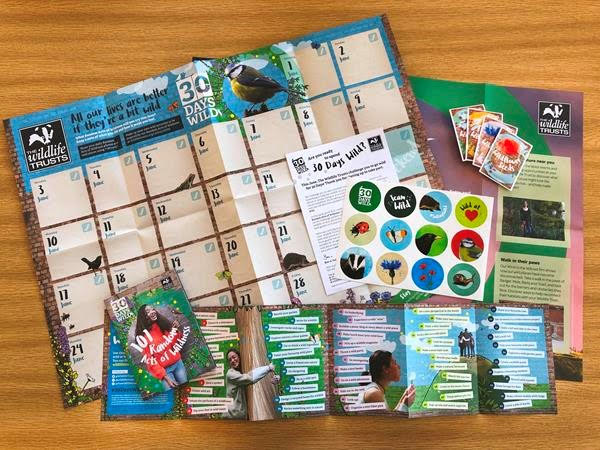
You can sign up for 30 Days Wild on our website and get a pack to help plan your wild June. You’ll receive a wallchart to write down your wild ideas and a poster to inspire you; a booklet full of Random Acts of Wildness; a sticker sheet; and a packet of wildflower seeds to brighten up your garden or window box!

You can sign up as an individual, a school, an organisation or a care home, so there's no reason why you can't join in.

Are you up for the challenge?

Thursday, 13 June 2013

100th Anniversary of The Wildlife Trusts


The Wildlife Trusts: 100 years of nature conservation is a documentary film telling the story of The Wildlife Trusts. From its inception as the Society for the Promotion of Nature Reserves in 1912 under the leadership of Charles Rothschild, to the birth of the local conservation movement after WWII, through its dramatic growth in the 1960s to the present day. 

The film visits locations such as Skomer, Loch of the Lowes, Brockholes, Flamborough Head, Woodwalton Fen and Ballynahone Bog. It also uses archive footage from Trusts, the BBC and other sources. Interviewees include Sir David Attenborough, Prof Aubrey Manning, Simon King, Ted Smith, Stephanie Hilborne, Hilary Benn MP and trustees, staff and volunteers from around the Trusts.