Showing posts with label fungi. Show all posts

Wednesday, 4 March 2026

Cleaver Heath - Mushrooms from the Ashes


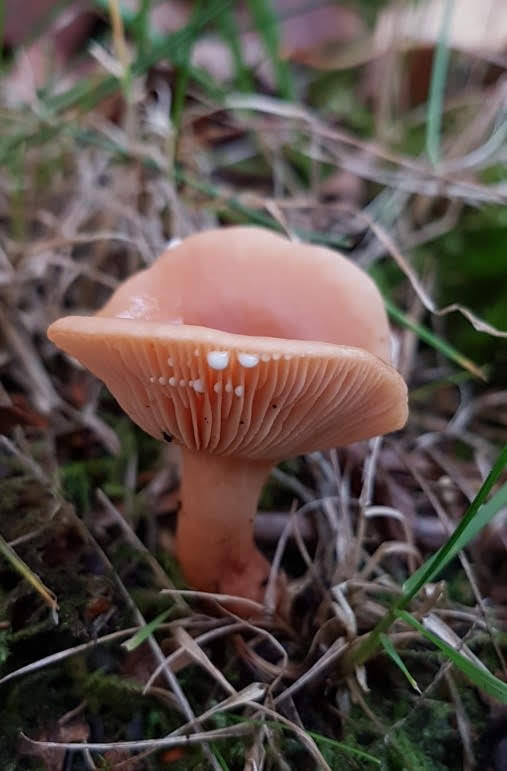
Toodstools growing in the burnt area at Cleaver Heath

Less than two months after the summer fire at Cleaver Heath in August last year, mushrooms appeared growing directly within the burnt ground. During the period between October and early December they gradually spread across most of the burnt surfaces and by mid-December they had all disappeared.

Taking into account this particular habitat and their distinguishing features, they are likely to be Rooting Bonnet (Mycena megaspora) mushrooms. The preferred habitat for this uncommon species is burnt heathland (also Sphagnum bogs) and they are described as having dark, ridged, conical caps, each with a prominent central 'swelling'. They also have stems which penetrate deep into the growing surface, hence the term 'rooting'.

This species appears to fit within the definition of so-called pyrophilic or 'fire-loving' fungi, i.e. fungi that are either associated with fire or found within post-fire environments. Are the spores dormant within the ground and then triggered to germinate by the fire heat? These fungi were certainly not recorded within these areas at Cleaver before the fire.

Definitely a need for further research I think!

John McGaw
Voluntary Warden Cleaver Heath

Friday, 30 January 2026

Fungal Safari at Hoylake Willows

Earlier this month a Wirral Wildlife member got in touch with us to ask for help identifying the fungus she had photographed on a willow log at Hoylake Willows, near Manor Road station.

What fungus is this?

We sent the query to fungus expert John Ratcliffe who said it was probably Turkeytail (Trametes versicolor) but he would need to have a closer look to be sure. He set off for Hoylake Willows the following day and found the log where the fungus was growing. John was able to confirm his identification of Turkeytail.

Turkeytail (Trametes versicolor)

Not one to miss a chance for some mycological exploration, he had a look around the site and spotted all these other fungi too!

Willow Barkspot (Diatrype bullata)
Willow Barkspot (Diatrype bullata)


Common Jellyspot (Dacrymyces stillatus)

Crystal Brain (Exidia nucleata)
Crystal Brain (Exidia nucleata)


Netted Crust Byssomerulius corium
Netted Crust Byssomerulius corium

Scarlet Elfcup Sarcoscypha austriaca

Amber Jelly Exidia recisa
Amber Jelly Exidia recisa


Smoky Bracket Bjerkandera adusta
Smoky Bracket Bjerkandera adusta

Yellow Brain Tremella mesenterica
Yellow Brain Tremella mesenterica


Poplar Bells Schizophyllum amplum
Poplar Bells Schizophyllum amplum


The underside of Poplar Bells Schizophyllum amplum
The underside of Poplar Bells Schizophyllum amplum


White Brain Exidia thuretiana
White Brain Exidia thuretiana

Blueing Bracket Postia subcaesia
Blueing Bracket Postia subcaesia

Scurfy Twiglet Tubaria furfuracea
Scurfy Twiglet Tubaria furfuracea

Oysterlings Crepidotus sp.
These need microscopy to get to species level
but John's microscope was away being serviced!

Many thanks to John for sharing his knowledge and going above and beyond in not only providing the answer to the initial question but going on a fungal safari and sending us these wonderful photos!


Friday, 27 October 2023

Fungal Foray at Dibbinsdale


Fungal Briefing by John Ratcliffe

A third fungal foray was held by Wirral Wildlife at Dibbinsdale Local Nature Reserve. Prior to the foray a recognisance survey was undertaken by John Ratcliffe of North-West Fungal Group, and it was found to be a fungal desert as a result of the dry weather. John added “Our only hope is rain.” The Eventbrite attendees were emailed to warn them the host of fungi may not be as impressive or abundant as other years. Luckily for these fungal detectives it did rain, it rained so much that the path by Otter’s Tunnel under the railway was flooded and the planned route was altered. The autumn flowers of the fungi came out, though not very as abundant in numbers a respectable diversity of 52 species were recorded with 30 species not having been recorded on the previous fungal foray here.

Amethyst Deceiver
Amethyst Deceiver

The gills/pores of a mushroom head give 20 times the area of the mushroom for spores' dispersal. It can be quite daunting with all those new names in English and Latin, but as the attendees went along, they started recognising the fungi that were seen early in the foray. Crib sheets of the previous year’s fungal records were provided to help recall the names.

One fungus found was the Beef Steak mushroom which when you pressed it oozed out red dye as you see in a steak. Also found was the attractive Amethyst Deceiver and a Blushing Bracket. Clive, another fungal expert, was full of anecdotes about each fungus. Cramp balls, so called as you put them down your breeches when on a long horse ride to prevent cramp. Birch Polypore can be dried and used as a razor strop, or the fresh elastic skin peeled into a strip could be used like a sticking plaster, with the inside being clean. John was pleased to see attendees were all interested. One of the attendees, Ben Hart, typed up a list of the species seen on the day in the evening, including the common and Latin names. John, our fungal leader, searched for the Horn of Plenty on the damp rock cutting on the banks of the river Dibbin but unfortunately, we did not find that this time. We will look for it during next autumn’s Fungal Foray.

Horn of Plenty
Horn of Plenty


Thursday, 17 December 2020

Fantastic Fungi


Blue Roundhead toadstool

While out working with the North Wirral Coastal Park volunteers at the Gunsite in early October, John McGaw came across a lovely blue 'toadstool'. 

Looking on the internet he thought it may well belong in the genus Stropharia, possibly S. caerulenta, the blue roundhead. 

He referred it to RECORD, who passed it to a fungus expert, who said `It is most likely to be a Blue Roundhead. It’s hard to be 100% sure without seeing the gills closely though. You are correct in thinking this is an unusual record for the area, I’ve had a look on our main database and there are only 8 records from our area'. So a most unusual and interesting sighting.


Collared Earthstar
Collared Earthstar 

A week later John found another unusual one nearby, Collared Earthstar (Geastrum triplex

It has been a good year for fungi. Has anyone found other unusual ones?


Wednesday, 4 November 2020

Autumn 2020 at Cleaver Heath


Autumn at Cleaver Heath


It’s been a strange autumn here. The leaves are being prematurely ripped from the branches by a series of gales and a sequence of showery periods has contributed to some flooded paths.

Of course, the weather has not been the only complication in getting conservation work started this year - COVID has played its part. We need guaranteed dry spells for carrying out stump treatment within the heather panels but we also need a number of willing volunteers to help with that and other routine task such as birch and gorse coppicing. We have nevertheless been able to carry out some COVID-safe jobs working independently in the fresh air. Even if the socialising aspect is a bit restricted, I found many volunteers grateful for the excuse to get out, spend time in a nice place and help the environment.

Common lizards found during the survey at Cleaver Heath

So, what else has been happening at Cleaver since the summer newsletter? The Common Lizard survey has drawn to a close. There were a total of 16 sightings between July and September. The good news was that most of the sightings were juveniles including some quite tiny ones. So we have breeding lizards at Cleaver. Less good news was that the sightings were confined to one particular panel east of the main path. Strangely, there were no sightings in the many refugia deployed in the less frequented areas of the reserve. We will be pondering this when planning future surveys.

Butterflies and spider web at Cleaver Heath

As summer moved into autumn there were still quite few second brood butterflies on the wing. As well as large numbers of whites we had regular sightings of Holly Blues (top right), plenty of Red Admirals feeding on holly flowers (bottom left) and a nice Small Copper seen right at the end of September (top left). On the colder bright mornings, much of heather was adorned with ‘hammock’ spider webs (bottom right) as well as the more conventional concentric circle webs.

Fungi in the woodland at Cleaver Heath


Lots of fungi are to be seen in any walk round the reserve these days. The path through the south woodland area had lot of Earthballs (genus Scleroderma) like the ones shown on the top left here. The others are all from the Amanita genus: continuing clockwise Tawny Grisette (A fulva), Blusher (A rubescens), Fly Agaric (A muscaria)…. I think!


Long-tailed tits
Long-tailed tits


On the bird front, there was a spell in September when the now less frequent Easyjet and Ryanair flights tracking over our house and the reserve were replaced by skeins of Pink Feet all heading for the Dee. Their musical calls as they agree final landing arrangements are always a welcome sign of autumn. The tits are starting to go around in flocks, especially the Long-tailed Tits whose gang sizes are growing. Redwing and Fieldfares have been appearing around Wirral but I have not yet spotted any in the reserve or in my garden. We had a very good, early crop of Rowan berries which the Mistle Thrushes and Blackbirds finished off in short order, leaving nothing much for the other winter thrushes. On a couple of mornings we observed 8 Mistle Thrushes at a time on the garden Rowan.

Mistle thrush
Mistle thrush


Following the increased footfall through Cleaver, particularly on sunny Sundays, a member recruitment officer from the Trust visited recently and had some success showing that the face-to-socially-distanced-face recruitment still works. This is Will Robinson pictured in a brief spell between his sign-up activities and bird spotting. As a keen birder he particularly enjoyed his day out even with his mask on.

Will Robinson, Cheshire Wildlife Trust Member Recruitment Officer
Will Robinson, Cheshire Wildlife Trust Member Recruitment Officer 


Here is my usual seasonally-updated photo of the reserve entrance. Do you notice that the gate has finally been painted to match the railings?


Cleaver Heath entrance


Alan Irving
Volunteer Reserve Warden for CWT

Cleaver Heath
November 2020

Wednesday, 13 November 2019

Autumn 2019 at Cleaver Heath


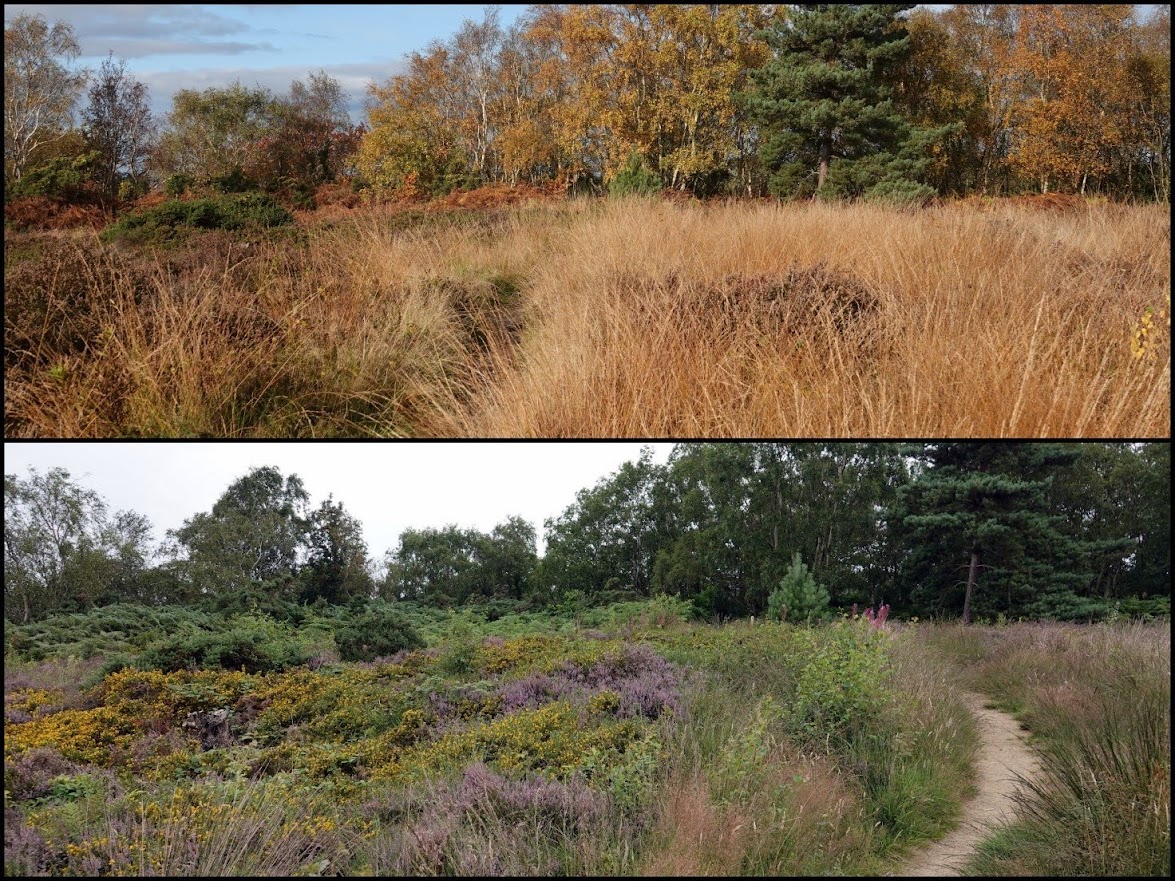
Cleaver Heath in November (above) and August (below)

I recently got back from a trip to South America where spring was in progress. Further north in the tropics, the ‘seasons’ were described as simply rainy or dry. Returning to Cleaver I was reassured that normal service had resumed and autumn colours were starting to show. Above is a comparison of our reserve in August and November.

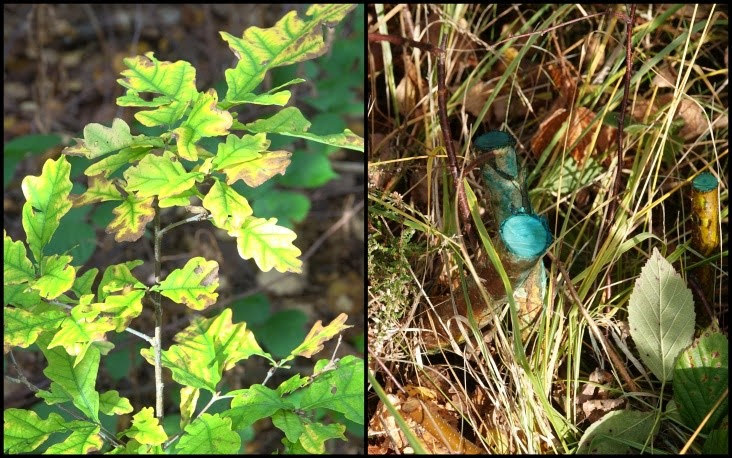
You will know that our native broadleaf trees turn off photosynthesis in autumn losing their green colour and preserve energy by absorbing nutrients back down from the leaves. Below (left) is an oak sapling in Cleaver in the transition phase where the leaf is yellowing while the leaf veins are still green as the chlorophyll drains back. Now that the predominant fluid flow is down rather than up, we can carry out our glyphosate stump treatment more effectively. The glyphosate is colourless but we add a blue dye to make sure we can see what has been done and also reduce the trip hazard (below right).

Oak leaves (left) and stump treatment (right)

The last Oldfield swallows left on 22 September just a few days earlier usual. I saw 2 Chiffchaff in Cleaver on 14 September. One of them was actually singing and continued to do so for a few more days. In autumn, Wirral sees quite few birds on passage back to warmer climes while the first of the winter visitors start to arrive. We had a couple of Redwings in our rowan tree as early as 9 October this year.

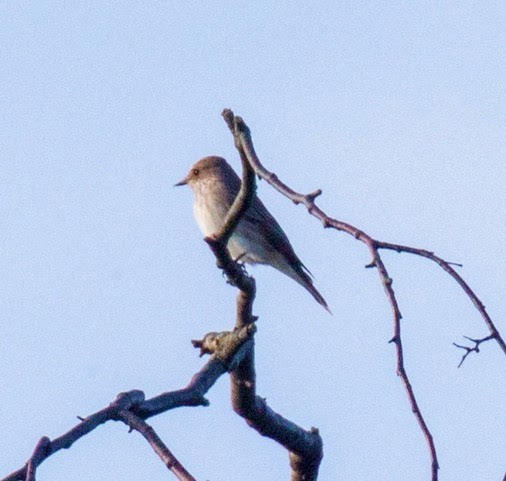
Spotted flycatcher

Local resident Frank Burns, whose garden backs on to Cleaver, was lucky enough to spot, and photograph, this Spotted Flycatcher in late September (above). It stayed a couple of days and then, presumably, continued its journey south suitably refuelled with Cleaver insects. Frank was able to observe, from his kitchen window, the typical flycatcher behaviour where the bird darts off following an unseen prey then loops round back onto its chosen perch.

As well as plentiful insects, we have been seeing lots of spiders tending their webs in the heather. These are most visible in the morning when the low sun and moisture make them stand out. As well as the traditional spiral webs (below left) we saw lots of ‘sheet’ or ‘hammock’ webs (below right).

Spider webs

Sometime this winter, we hope to get access to a list of the invertebrates found on Cleaver during a series of visits this summer by colleagues from the World Museum (Liverpool). The sightings are being logged in the rECOrd biological database at www.record-lrc.co.uk. It should be interesting.

We are being visited soon by a reptile expert who is going to advise us on reptile conservation and survey techniques. As far as we know our only resident reptile is the Common Lizard. Larger lowland heath sites also have Adders. We don’t know of any recent sightings on Wirral.

On the subject of surveys, we duly completed our 26-week transect survey from Cleaver to Church Farm. The summary which went to Butterfly Conservation along with our data said:
‘This 2km transect, which is mainly along farmland footpaths, yielded similar numbers overall to last year with a few anomalies: Painted Ladies (70 this year, none last year); fewer whites particularly the early ones, and especially the Large Whites; many fewer Common Blues; Commas and Small Skippers were down: Red Admirals and Speckled Woods were up. The overall species count (17) was typical. We didn’t see anything we hadn’t seen before.’

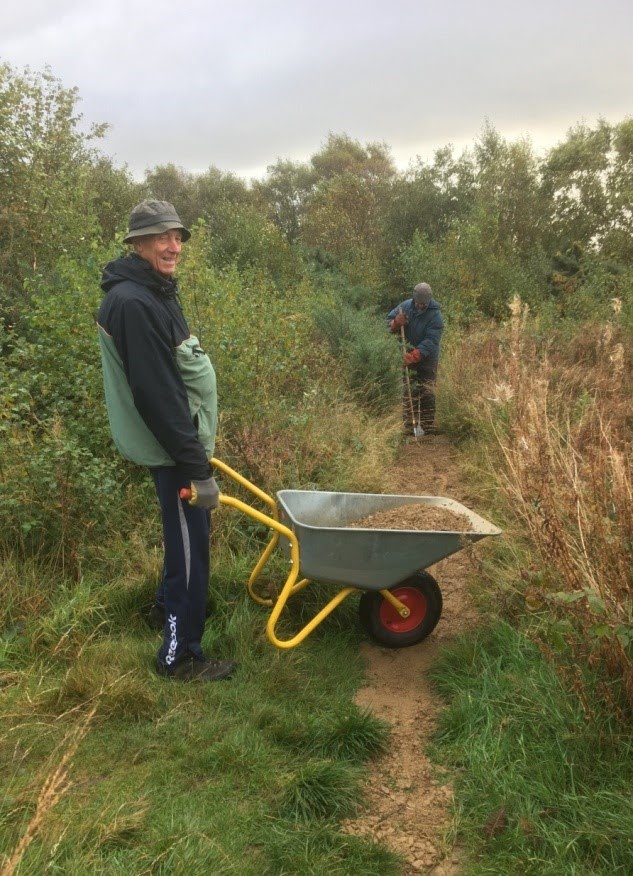
Workday at Cleaver Heath

We have now had 3 formal Autumn/Winter workdays in the 2019-20 session. Birch control on the upper heathland panels is now complete and we took the opportunity to extend the stoning on the main path using the spanking new wheelbarrow provided by the trust (above). There is always something to do no matter the weather. In this case we were waiting to be sure the rain would clear to allow stump cutting to go ahead. There is little point in cutting if you don’t treat the stumps more or less straight away, or if the rain is about to return and wash it out.

As well as continuing birch control in the lower panel, our next sessions will include coppicing of the tallest birch saplings in our designated scrub area and European gorse in the main stand between heathland panels. Oh, and we still haven’t cleaned our nesting boxes. We certainly need to get on with the Tawny Owl box as these early nesters will soon be scouting for accommodation.

Birch Milkcap (Lactarius tabidus)

Fungi are present all year round in woodland and an essential part of the ecosystem but it is in autumn that we tend to be more aware of them via their fruiting bodies. One of our local volunteers is particularly interested in fungi and we have been drawing on his expertise to log what is present in Cleaver. At the latest count, some 15 species have been identified. In last year’s Autumn Newsletter, I was able to highlight quite an array of colourful fungi all showing well. There were Fly Agaric (the spotty red poisonous ones) everywhere. This year, I don’t recall seeing a single Fly Agaric here or in Heswall Dales. Presumably the state of the ground plays a role. We had quite dry conditions in the summer and now quite a bit of water-logging in the reserve. Nevertheless there are many interesting fungi to look for including this Birch Milkcap (Lactarius tabidus) photographed by Gianfranco Uli (above). Note the latex dripping from the damaged gills. The milky substance gives rise to its name.

Cleaver Heath entrance

Alan Irving
Volunteer Reserve Warden for CWT
Cleaver Heath
November 2019

Friday, 1 November 2019

A Light In The Dark


Cheshire Wildlife Trust’s latest newsletter shares some fascinating facts about fungi.

Mycena chlorophus

Imagine taking an evening autumn stroll through your local woodland, crunching over the crispy fallen leaves and watching the light slowly fade. Something catches your eye in the now dark surroundings, a dim light, almost like a comforting bedside night light. The closer you get the more obvious it becomes that the small glowing hummocks are in fact fungi.

Bioluminescent fungi are fungi that, incredibly, glow in the dark. There are around 80 species worldwide that produce the fairy-like luminosity which has caught many a dreamer’s imagination. Mark Twain even noted the phenomenon in his book,The Adventures of Huckleberry Finn, writing, "Rotten chunks that’s called ‘Foxfire’ that just makes a soft kind of glow when you lay them in a dark place."

Foxfire, is just one of the many words through the ages that has been used to describe the glowing fungi. The bioluminescence emitted has also been mistaken for strange fixations such as a ghostly presence or fairy light.

So what is it about certain species of fungi that makes them glow? Well, it’s caused by a chemical reaction between oxygen and the compound luciferin in the presence of an enzyme. This results in the formation of oxidized luciferin (oxyluciferin), which when it decomposes, gives off light. The bioluminescence of fungi is produced without heat and still glows in the daylight - it’s just not easy to see. The luciferin found in fungi of this kind is actually the same compound that is found within glow worms and those deep sea curiosities we watch on David Attenborough’s Blue Planet.

Sulphur tuft

Why would fungi glow?

There have been many debates as to the reason. Some argue it is to attract more insects to carry off their spores; some say it’s just an unusual by-product of fungal metabolism. Whatever the reason it’s been supplying us with endless entertainment for years and even sometimes been put to use. It’s been said that the soldiers in the WWI trenches fixed bits of rotten wood to their helmets to guide their way in the dark.

The luminescent species we have in the UK include the likes of Sulphur tuft (above) and Mycena chlorophus (top). They don’t however give off as much light as some species overseas. In the United states, Omphalotus illudens' ability to glow in the dark has given it its common name of Jack O’Lantern.

So, you now know it’s not all doom and gloom in the decaying world of fungi - there is always a light in the dark to be found.

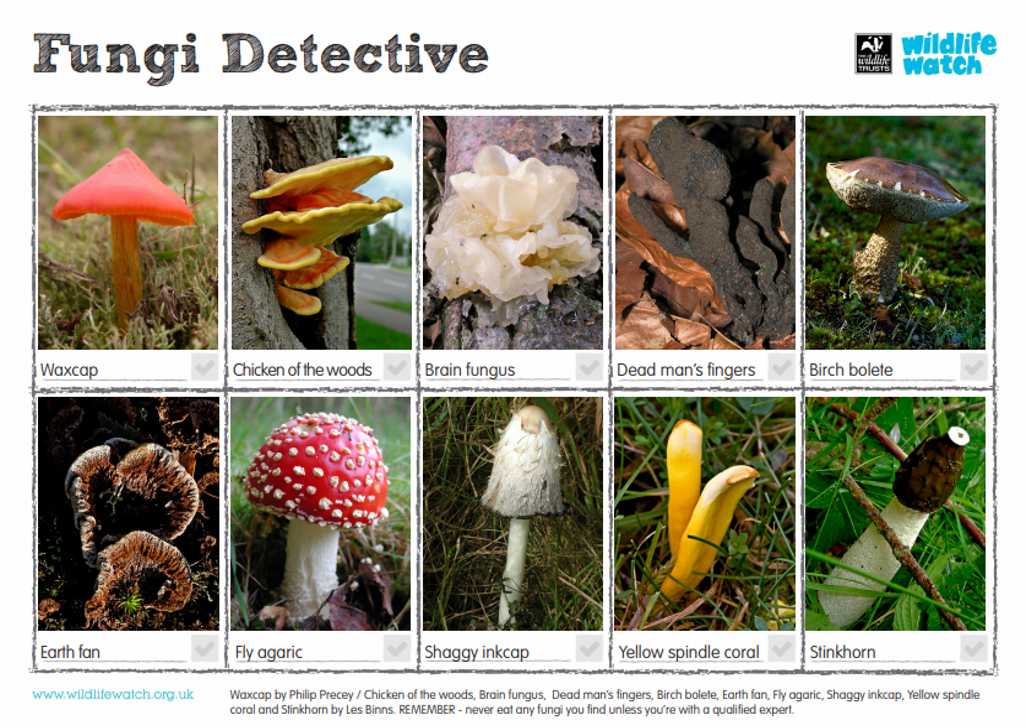
Fungi detective

Be a fungi detective

Autumn is the perfect time of year to get out there and look for fungi. Use our above guide to help you ID some of the most common species.

Don't know where to begin? Our nature reserves are a great place to start the search:


Let us know what you find and where by sharing your pictures with us on Facebook, Twitter or Instagram.

Saturday, 10 November 2018

Autumn 2018 at Cleaver Heath


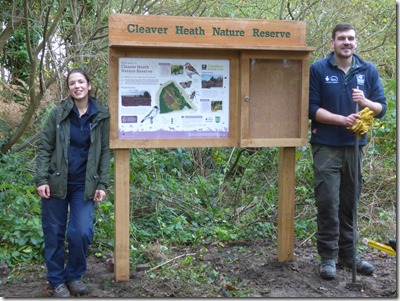
Cleaver Heath Notice Board

Recent visitors to the reserve will have noticed our smart new signage made possible largely by the Tesco Bags of Help grant described in our summer newsletter. At the end of October, some of our expert staff from CWT: Sarah Bennet (Area Manager West), Kevin Feeney (Living Landscape Officer West and author of the original Tesco bid), Fiona Megarrell (Community Conservation Co-ordinator) and their volunteer helpers completed the installation of the major parts of the new signage and access improvements.

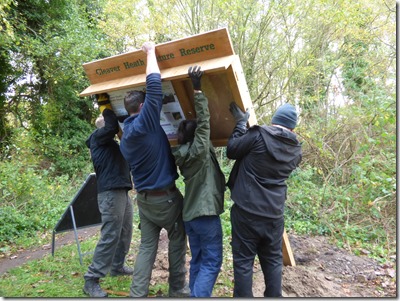
Putting up the Notice Board

This involved quite a bit of hard work – digging 1m down through layers of tarmac, builders’ rubble (the old hospital visitors’ car park), sandy soil and boulder clay. Then we manhandled the high quality, and very heavy, wooden sign and notice board into the carefully measured holes. The experts then positioned and stabilised it with millimetre precision using spirit levels - a work of art.
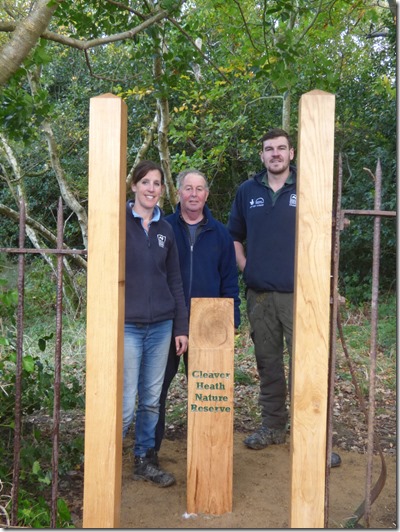
Northern Entrance at Cleaver Heath

The unofficial reserve entry from Oldfield Drive has now become official and rather smart. My memory of the old one goes back to the late 70s. Some enterprising resident (not me!) took it upon themselves to crowbar the railings apart to enable entry to the Cleaver Hospital site by those with a reasonably slim and flexible physique. Repeated attempts by authorities to straighten the railings were quickly undone. The new entry will give dog-walkers convenient access to the nearby litter bin and also help those who wish to incorporate the reserve paths into a linear walk. The main entrance gate has a fine quality routed wooden sign leaving no doubt that this is a Cheshire Wildlife Nature Reserve. To help orient visitors and encourage them in keeping to the main paths, there are some tasteful new way markers. When the finishing touches have been made, the Trust will be organising some appropriate publicity.

The winter work parties have now started – these are on the first Sunday of the month from 10.00. We are making good progress on the ‘bread and butter’ tasks of removing unwanted vegetation from the heathland panel. We have also removed a few more of the non-native saplings such as Sweet Chestnut and Sycamore.

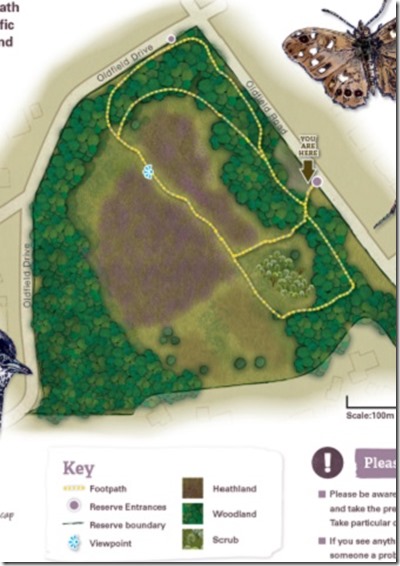
Interpretation Board Map

As last year, we have been making good use of the tree poppers where possible and stump treatment of things we cut. There are, however, places where the best thing is to coppice i.e. cut but not treat. For example, we have an area of ‘managed scrub’ which you can see on the snapshot of our new interpretation board (above). We will also be carrying out more coppicing of European Gorse stands where we are happy to keep them provided they thicken out at the base rather get old and lanky. Gorse provides important shelter for some of our nesting birds. We think we had two pairs of breeding Linnets this year.

My overall conclusion from this year’s Common Bird Census survey at Cleaver is of a lower presence of summer warblers. I made 10 early morning visits to the reserve noting where the birds were visible or singing.

Bird Census Map

The number of Willow Warbler territories was certainly down this year. I had only sporadic sightings of Whitethroat this year – not enough to do any sort of territory analysis. The map above summarises sightings of Linnets and Willow Warblers. I also do some Breeding Bird Survey work for the BTO (British Trust for Ornithology) and noticed a similarly poor turnout this year on my 1km square near Thornton Hough. I don’t know if this was due in part to our poor UK weather conditions in spring or to some other effects on the migration routes.

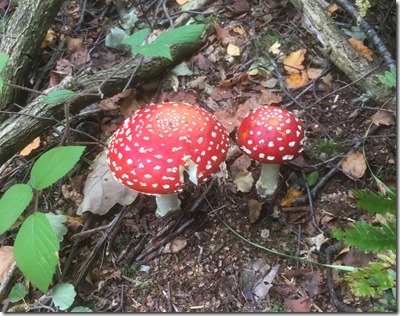
Fly Agaric

Many of us associate autumn not just with colourful tree leaves but also with fungi. The autumn colours we see in the UK are often due to non-native trees e.g. Maples. Since Cleaver is primarily a Lowland Heath habitat, with only a limited amount of native woodland, we don’t expect to have spectacular autumn colour displays. However, like others who have walked around the Cleaver paths from September onwards, I have instead been enjoying the displays of colourful fungi.

Fly Agaric

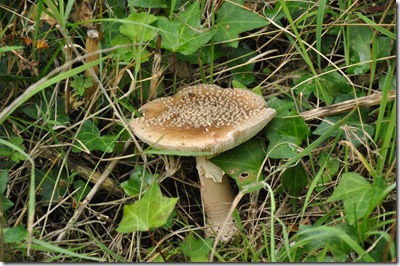
Most of us are familiar with Fly Agaric (Amanita muscaria). When the fruits first emerge they have orange or red hemispherical caps which then flatten out as they grow. These are still showing along many of the woodland paths segments. I have also spotted examples of another member of the Amanita genus, commonly known as a species of Blusher (Amanita rubescens). This also has white spots, but on a less threatening grey background. The development of its cap follows a similar pattern.

Blusher (Amanita rubescens)

Blusher (Amanita rubescens)

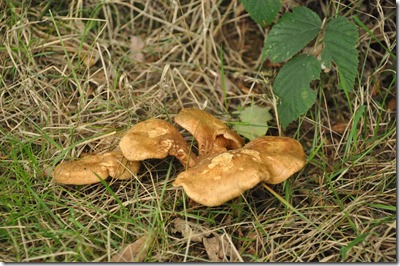
There have been plenty of fine examples of False Chanterelle (Hygrophoropsis aurantiaca). The example below seems to have developed in four segments.

False Chanterelle (Hygrophoropsis aurantiaca)

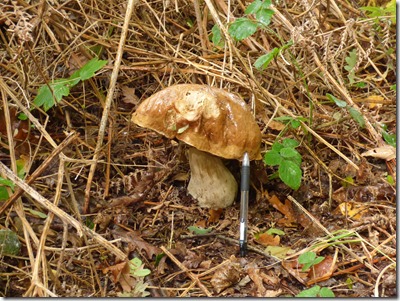
I am told they are very sensitive to nearby plants. Even a blade of grass flapping against the cap edge can lead to permanent deformation. I am not sufficiently confident of identifying edible to test my judgements. However, this large toadstool shown below (next to a ballpoint pen for scale) has as one of its common names Penny Bun and is commonly eaten. In Tesco, it would be called a porcini and you would get charged more than a penny. It is Boletus edulis.

Penny Bun (Boletus edulis)

I had occasion to seek help from Trust staff when a mature birch, attacked by fungus at the base of the trunk, fell across one of our paths in an October gale. The trunk structure had been damaged by a Southern Bracket fungus (Ganoderma australe).

Southern Bracket fungus (Ganoderma australe)

The Aminita fungi shown above get their nourishment from the soil, particularly in rich woodland soil. Bracket fungi like this one get their food from trees and in so doing, turn the fibres into a mush. The layers on this bracket count the number of years it has lived. When the food runs out the underside turns white as shown below.

Southern Bracket fungus (Ganoderma australe)

The birch seen here then tipped over. We didn’t even need a chain saw to complete the job. My helpful Trust staff member Kevin, used his superior strength to push it all the way down into a safe place.

Not all fungi are harmful to plants. In fact, it is quite the reverse for many of them. I am looking forward to the November Wirral Wildlife talk which will be all about Symbiotic Mycorrhizal Fungi. Large classes of plants benefit from such fungi which facilitate the absorption of soil nutrients via their root systems. The plant gets minerals from the soil and the fungi get sugars and carbohydrates from the plant. Such fungi are also important in helping with plant to plant communication. Trees find out if there is some threat on the way. Fungi are not nearly as well understood as most other life forms. They are quite fascinating. Next time you walk in the reserve think about all the activity going on in the soil under your feet – all year round, not just in autumn.

Alan Irving
Volunteer Reserve Warden for CWT
Cleaver Heath

November 2018