Thursday, 28 July 2022

Wirral's Wild 50: August Worksheets


Here are the Wirral's Wild 50 activity sheets for August. Enjoy a seashore search, learn about the wildlife that can be found at the coast and discover the importance of sandy and muddy habitats.


August activities and resources


Things To Do In August


Go to the beach and look for shells and objects on the sand.

Download the Shoreline Detective sheet here:

Visit a heathland and smell the heather.

Listen for grasshoppers. How do they make their sound?

Make a nature collage and take a photograph to take into school in September


Take a look at sand and mud habitats and the wildlife found there


Resources


1. Top 10 strandline spots

https://www.record-lrc.co.uk/Downloads/Top%2010%20strandline%20(1)[12062020].pdf


2.  Identify shells

https://record-lrc.co.uk/Downloads/Shell%20identification%20February%202012%20version2%5B18042012%5D.pdf


3.Do a coastal wordsearch 

https://www.wildlifewatch.org.uk/sites/default/files/2021-01/coastal%20wordsearch_0.jpg


4. Make a seal mask

https://www.wildlifewatch.org.uk/sites/default/files/2020-07/seal-mask.pdf


5. Make an egg carton crab

https://www.wildlifewatch.org.uk/sites/default/files/2020-08/Egg%20carton%20creatures.png


6. Spot estuary wildlife

https://www.wildlifewatch.org.uk/sites/default/files/2020-07/Estuary.jpg


7. Craft: nature mandala

https://www.wildlifewatch.org.uk/sites/default/files/2020-08/Nature%20mandala.jpg


Friday, 22 July 2022

Royal Society of Biology Medal for Botanist Eric Greenwood


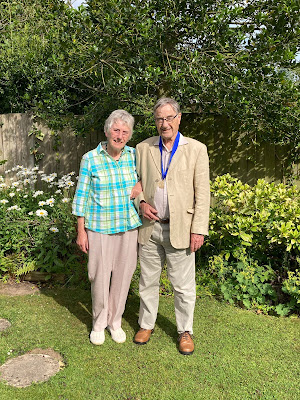
Eric Greenwood, with his wife Barbara, in their garden at the presentation of the medal from the Royal Society of Biology
Eric Greenwood, with his wife Barbara, in their garden
at the presentation of the President's Medal from the Royal Society of Biology


Eric Greenwood CBiol, FRSB has been presented with the President’s Medal of the Royal Society of Biology. He was awarded the Medal in 2020 in recognition of his work with the local RSB branch, but was unable to receive it due to Covid restrictions. However at a recent happy event in his Heswall garden, Eric was presented with the Medal by members of the North Western branch of the RSB surrounded by friends and family.
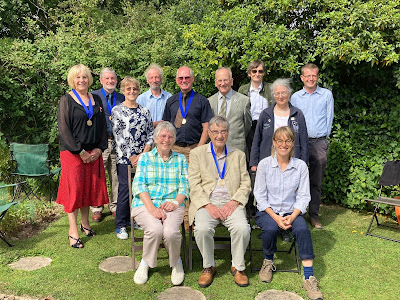

Back row, L - R: Jean Wilson (RSB), Dr Alan Bedford (RSB), Chippy Wielopolska, Dr Hugh McAlister, Mike Clapham (RSB), Stephen Ross, Robert Freath, Dr Hilary Ash, Dr Thomas Evans (son-in-law). Front row, L - R: Barbara Greenwood, Eric Greenwood, Dr Emma Greenwood (daughter). Photo: Lesley Sutherland.

Back row, L - R: Jean Wilson (RSB), Dr Alan Bedford (RSB), Chippy Wielopolska, Dr Hugh McAlister, Mike Clapham (RSB), Stephen Ross, Robert Freath, Dr Hilary Ash, Dr Thomas Evans (son-in-law).
Front row, L - R: Barbara Greenwood, Eric Greenwood, Dr Emma Greenwood (daughter).
Photo: Lesley Sutherland.


Eric was Keeper of Botany at the Liverpool Museum, becoming Keeper of the World Museum Liverpool. He was largely responsible for securing the large Lottery grant to enable the Museum’s major redevelopment, before retiring in 1998. He was responsible for setting up the North West Biological Field Data Bank ensuring that local naturalists’ records did not get lost. This eventually led to Record and Mersey Biobank, who today do the same work electronically, and pass records to the National Biodiversity Network. Eric is the author of Hunting Plants and Flora of North Lancashire, the latter being an accumulation of systemic survey work of the region’s plants over the course of 46 years.
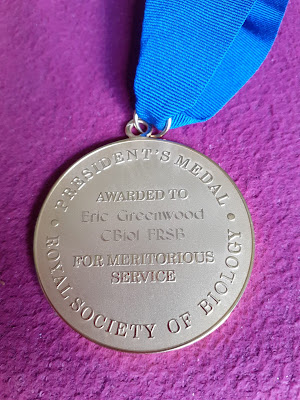

Eric's President’s Medal from the Royal Society of Biology

Following retirement, Eric remains an active member of the botanical community, even though he has retired as the Botanical Society of Britain and Ireland’s vice-county recorder for VC60 (West Lancaster). He has acted as botanical advisor to Wirral Wildlife’s recording team for years, identifying difficult plants especially grasses, sedges and orchids. He is still doing much botanising in Wirral, finding new plants and re-finding old records.
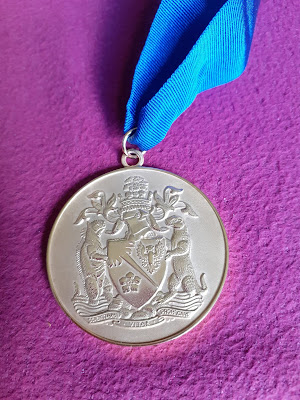

The other side of Eric's Medal

Eric was nominated by Jean Wilson MBE CBiol FRSB, current vice chair of the North Western branch of the RSB. She commented: “I would describe Eric as a gentleman biologist, always polite and completely professional. He is still passionate and committed to the natural world, and is a man for whom I have the greatest respect.”


Professor Sir Ian Boyd FRSB, President of the RSB writes: “I want to offer you my sincere congratulations on your award and to thank you for your hard work over many years’ association with the North Western branch, and for your extremely long-term Fellowship support over many years. Your significant contribution to the Society is very much appreciated and I hope that this is reflected in the award of your President’s Medal”.


Wednesday, 13 July 2022

White Letter Day


White letter hairstreak butterfly. Photo: Colin Millington

Here are some photo of a white letter hairstreak, taken on Sunday at New Ferry Butterfly Park by Colin Millington.


White letter hairstreak butterfly. Photo: Colin Millington


Not seen for nearly two decades, this species was last recorded at the Butterfly Park on 5th July 2003. We rarely see them as they are feeding on the honeydew in the tree canopy (especially on elms). Perhaps levels of honeydew are low, bringing them down to the ground to find nectar in privet and bramble flowers.


Monday, 27 June 2022

Wirral's Wild 50: July Worksheets


Here are July's Wirral's Wild 50 activity sheets. There is a butterfly and moth theme this month.


July activities and resources

Things to do in July

Look for butterflies, moths and caterpillars

Learn about the butterfly life cycle

Find out about animal camouflage

Look for moths

Do the Big Butterfly Count (mid July - mid August)

Plant a bee and butterfly garden


Moth spotting and gardening for bees and butterflies


Resources

Sunday, 26 June 2022

Poulton Hall Garden Opening on Saturday 2nd July


After such a successful event last year, Poulton Hall are kindly holding another Open Day in their Walled Gardens to raise awareness and funds for Wirral Wildlife and New Ferry Butterfly Park. This will take place on Saturday 2nd July, from 2 - 5 pm.

  • Enjoy a guided tour of the wild flower meadow
  • Have a go at hedge laying and scything
  • Make a newspaper pot and sow a seed to take home to nurture
  • Explore the eclectic mix of themed formal gardens
  • Be entertained by the storyteller
  • Find out more about spiders
  • Watch a bee keeping demonstration

Admission: £6 for entrance, £9.50 for entrance and cream tea.
Free entrance for under 16s, with £3.50 for a child's cream tea.

Please book your ticket here:
https://www.ticketsource.co.uk/whats-on/wirral/poulton-hall/poulton-hall-walled-gardens-opening/2022-07-02/14:00

You can also book in advance for your guided tour of the wild flower area:
https://www.eventbrite.co.uk/e/walk-around-wildflower-area-at-poulton-hall-tickets-368259172097

For pictures and a description of the gardens, please see our blog post written prior to last year's open day:
https://wirralwildlife.blogspot.com/2021/06/poulton-hall-garden-opening.html


Thursday, 16 June 2022

A Most Unusual Visitor to New Ferry Butterfly Park


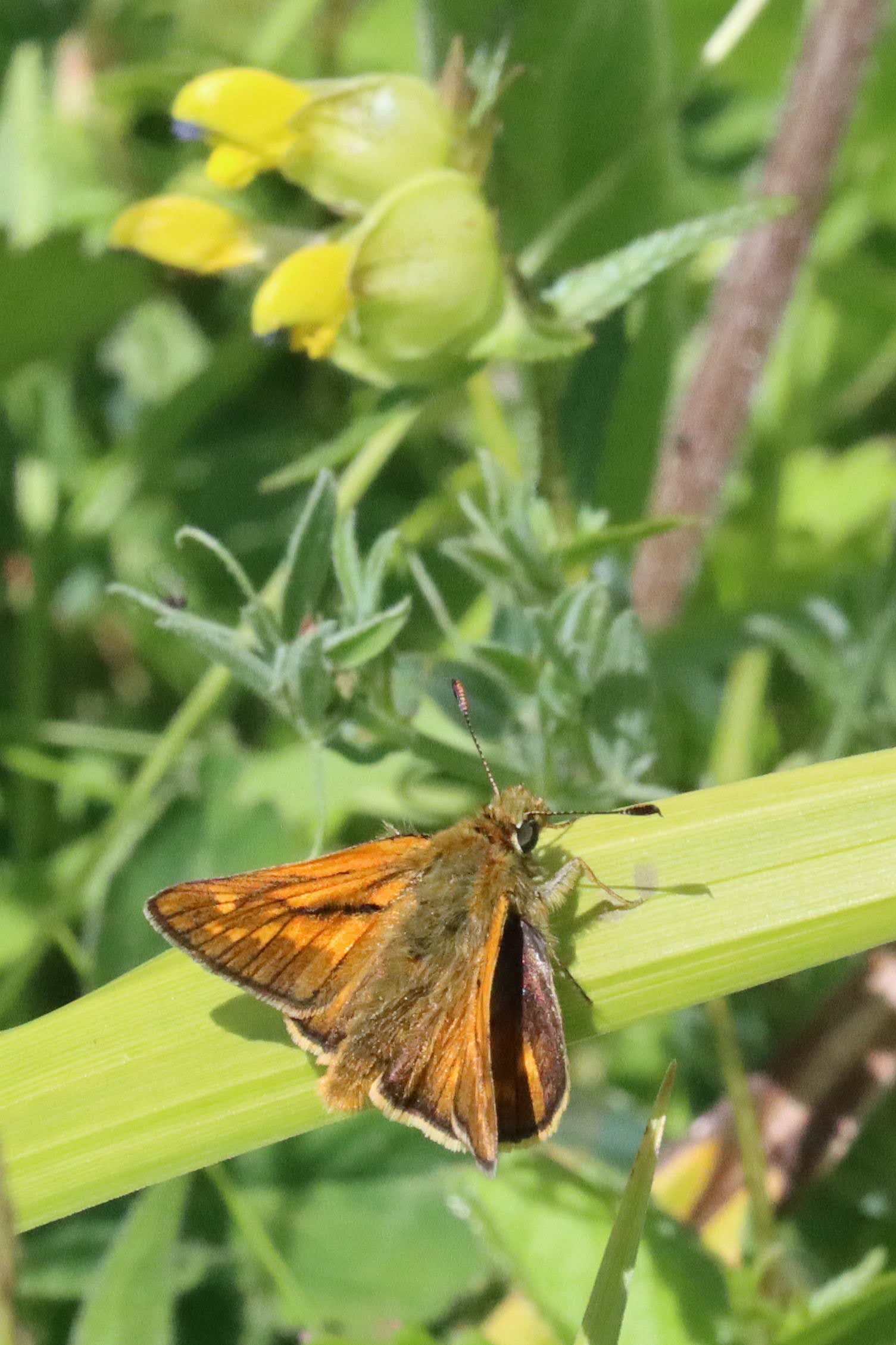
Large skipper at New Ferry Butterfly Park. Photo: Roy Lowry
Large skipper at New Ferry Butterfly Park.
Photo: Roy Lowry

On the morning of Sunday 12th June Roy Lowry came down to New Ferry Butterfly Park with his camera.

He managed to spot and photograph the first Large Skipper butterfly of the season.


Locust blowfly, a new visitor to the Butterfly Park.
Photo: Roy Lowry

His most unusual photograph was of a fly which struck him as very different. Roy thought he recognized it as a locust blowfly - an African species that has been reported more frequently in recent years as a vagrant in the south of England.  One was seen in Southport in 2020. It did indeed turn out to be a correct identification so this is definitely a first at the Butterfly Park.

Thanks Roy for your keen observation and excellent photos.


Wednesday, 1 June 2022

A Hot ‘Cool’ Day and a Windy Biodiversity Day

Wirral Wildlife volunteers were at two local events in May.

The Wirral Wildlife stall at Cool Heswall

‘Cool Heswall’ was held on May 14th in Hill House Gardens. It was organised by the Joint Rotary Environment Group to showcase local organisations with an environmental message to impart.

Visitors and stalls in the sunshine at Cool Heswall

We took information about our reserves, including New Ferry Butterfly Park and have since welcomed visitors who first heard about us there. We also had paper craft activities and bug houses for children to make. More than 30 other organisations were there including Wirral Countryside Volunteers, Wirral Borough Council's Tree Planting Officer, Planet Heswall, Waste Not Want Not, Friends of Hill House Gardens, Merseyside Cycling Campaign, Wirral Wombles and Our Dee Estuary. Visitors could find out about local flora and fauna, play a recycling game, take home a free native tree, make a paper seed pot and plant a seed, taste vegetarian soup and curry and lots more.


Wirral Countryside Volunteers stall, where visitors could make a paper seed pot and plant a seed.
Wirral Countryside Volunteers stall,
where visitors could make a paper seed pot and plant a seed.

On May 26th a Biodiversity Day was held on the school field at Castleway Primary School, Leasowe. The day was inspired by the Wirral’s Wild 50 monthly activity sheets that Wirral Wildlife created to mark their 50th anniversary last year. These were made available to local schools. The event was organised jointly by Lynn Struve, Eco Schools Programme Manager for Wirral Council, Diana Powell, CEO of Wirral Unplugged and Naomi Graham, Project Manager at Wirral Environmental Network.


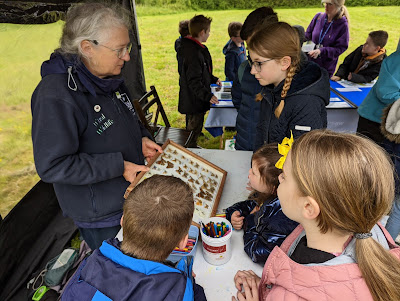
Learning about butterflies and their lifecycles at the Biodiversity Day.
Photo: Diana Powell


Several primary schools brought pupils to experience a wide range of activities. We had information about our reserves and the plants and animals found there. We looked at the life cycles of natterjack toads and butterflies and considered camouflage and symmetry. The pupils also had opportunity to look at the wildflower meadow and recent tree planting at Castleway, to learn about hedgehogs, make models of different animals and sow seeds.


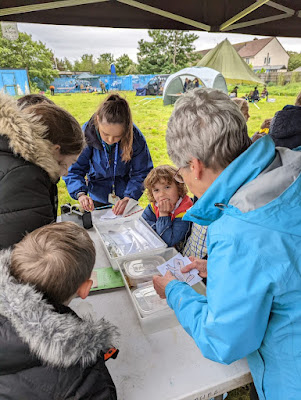
Making a fold out lifecycle of the natterjack toad
Making a fold out lifecycle of the natterjack toad.
Photo: Diana Powell.


Unlike ‘Cool Heswall’ where the sun shone all day this day was damp and extremely windy and not everyone’s gazebo survived the day upright. Nevertheless the pupils were full of enthusiasm and chasing paper across the field added to the fun.


Visitors and stalls in the sunshine at Cool Heswall
Learning how to identify trees from their leaves with Wirral Eco Schools


We must give a big thank you to our volunteers without whose involvement we wouldn’t be able to participate in these events.